
Daily Podcast full article
Elon Musk's Next-Gen Motor Destroys the Entire EV Industry
Tesla’s rare earth-free Cybercab motor is less a single “killer part” than a strategic attempt to remove one of the EV industry’s most sensitive chokepoints: magnet supply. The current story is about whether Tesla can turn a clever motor into a scalable advantage before regulators, rivals and raw-material markets catch up.
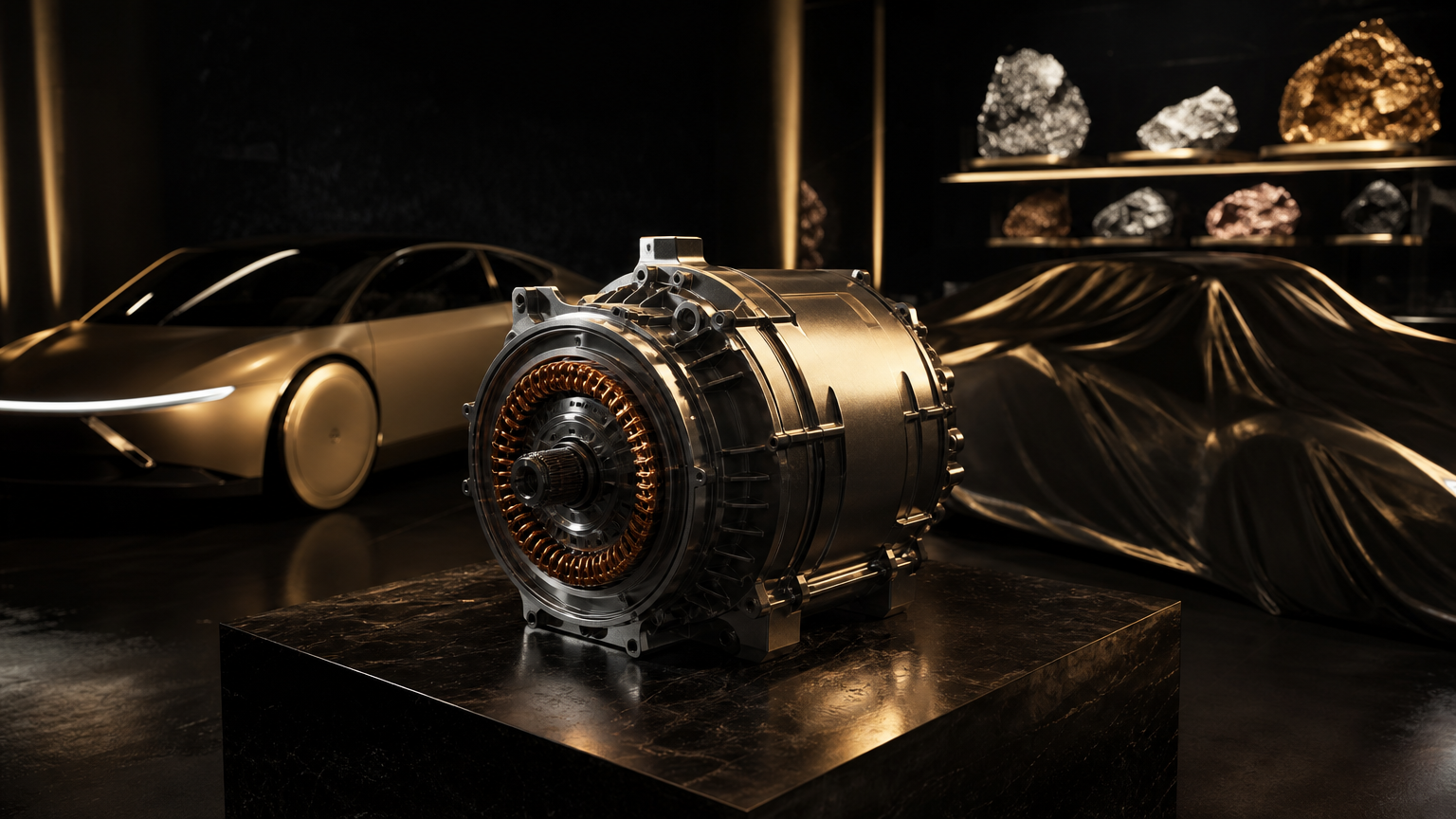
The headline is loud, but the real disruption is quiet
“Elon Musk's Next-Gen Motor Destroys the Entire EV Industry” sounds like classic Tesla hyperbole. Yet the underlying story is more serious than the headline. Tesla is trying to prove that a high-efficiency EV can be built around a drive motor that avoids rare earth metals, a materials category that has become central to modern electric propulsion and vulnerable to geopolitical pressure .
The Cybercab is the right place for that experiment. Unlike a performance sedan or pickup, a robotaxi is a cost, durability and utilization machine. Every gram, every dollar and every maintenance event matters. If Tesla can remove rare earth dependency from the propulsion system while maintaining range and packaging targets, the impact is not just technical. It could reshape purchasing strategy, factory design and long-term bargaining power across the EV sector .
The current state of the story, based on the fresh 72-hour research window, is that Tesla’s rare earth-free motor claim remains the core engineering narrative, while the broader Cybercab program is now being judged through production cadence, fleet deployment and regulatory scrutiny rather than through a standalone motor announcement . That distinction matters. A motor can win a slide deck. A robotaxi fleet has to win the street.
Why rare earth-free matters
Most consumers never think about dysprosium, terbium or neodymium. Automakers do. Since the Model 3 era, Tesla and much of the EV industry have leaned on permanent-magnet motor designs because they are compact, efficient and well suited to high-volume vehicles . The problem is that the magnets depend on materials whose extraction, refining and processing are concentrated in a small number of supply chains.
Rare earths are not necessarily “rare” in the geological sense. The bottleneck is industrial: mining, separating, refining and magnet-making capacity. Heavy rare earth elements such as dysprosium and terbium are especially valuable because they help permanent magnets retain performance under heat. In an EV motor, that thermal stability is not optional. It is central to repeatable efficiency and durability.
That is why Tesla’s Cybercab motor claim is strategically bigger than a laboratory achievement. A rare earth-free motor could reduce exposure to export controls, price spikes and supplier leverage. It could also give Tesla more freedom to localize production, redesign cost structures and avoid competing directly with every other automaker for the same magnet inputs. In the rare-earth market, industry monitoring during the current window still places EV motors, magnet supply and heavy rare earth exposure at the center of the debate .
The phrase “destroys the industry” should therefore be read as a challenge, not a conclusion. Tesla has not eliminated competition. It has potentially changed the question competitors must answer: if a high-volume EV platform can avoid rare earth magnets, how long can rival cost models assume the old dependency remains unavoidable?
Cybercab turns the motor into a business case
The Cybercab is not just another Tesla model. It is a purpose-built autonomous vehicle, and its economics are different from consumer EV economics. A private owner might tolerate a higher purchase price in exchange for acceleration, brand appeal or features. A robotaxi operator cares about utilization, uptime, charging efficiency, repair simplicity and depreciation.
That makes the motor central to the business case. If the drive unit can be smaller, lighter and easier to manufacture, Tesla gains advantages that compound across thousands or millions of vehicles. Less weight can improve energy consumption. Lower parts complexity can reduce factory time and service exposure. Reduced exposure to rare earth supply chains can stabilize long-run costs. In a robotaxi model, those differences feed directly into cost per mile.
Fresh tracking of the Cybercab ecosystem shows that attention has moved beyond the original motor reveal into production and fleet signals, including drive-unit output claims and observed expansion of autonomous-vehicle activity . That shift is important because the market will not reward a rare earth-free motor indefinitely as a concept. It will ask whether Tesla can manufacture it repeatably, install it in vehicles at scale and maintain efficiency in real-world service.
The next question is not whether Tesla can build one impressive motor. It is whether the motor can survive the brutal arithmetic of robotaxi deployment: high daily mileage, frequent acceleration cycles, charging heat, software-managed driving behavior and minimal downtime.
The industry threat is supply-chain optionality
The EV industry has spent years optimizing around batteries. Motors received less public attention because they are less visible and, for most drivers, less emotionally important. But as EV platforms mature, motor materials are becoming a strategic fault line.
If Tesla’s rare earth-free architecture works at scale, it gives the company optionality. It can negotiate differently with suppliers. It can insulate itself from heavy rare earth volatility. It can push cost reductions without waiting for the magnet market to cooperate. It can also tell investors a cleaner story: the Cybercab is not merely a self-driving vehicle, but a vertically engineered product designed to remove cost and supply risks from the ground up .
Competitors would face a choice. They could continue using high-performance rare earth permanent-magnet motors and accept the supply-chain exposure. They could move toward induction, ferrite or other rare earth-light designs and risk packaging or efficiency trade-offs. Or they could diversify motor strategies across vehicle classes. None of those paths is impossible. But all of them create engineering and purchasing work that Tesla may already be folding into a production vehicle.
That is the real “destroyer” effect: not instant extinction, but forced repricing. If one major player proves rare earth-free propulsion at robotaxi scale, every rival procurement team has to revisit assumptions about motor cost, supply risk and geopolitical exposure.
Regulation could slow the victory lap
The motor is only one part of the Cybercab story. The vehicle’s driverless design brings regulatory pressure that could shape how quickly Tesla’s engineering advantage becomes a commercial one. Current EV and autonomy coverage still highlights the Cybercab safety-certification issue as an active part of the autonomous-vehicle news cycle .
That matters because a breakthrough motor does not generate revenue by itself. It needs a road-legal vehicle, an approved operating model and customer trust. A Cybercab without steering wheel and pedals challenges conventional safety frameworks. Regulators are not evaluating only whether the vehicle can move efficiently; they are evaluating how it fits rules built around human controls, mirrors, pedals and driver responsibility.
This creates a paradox. Tesla may be simplifying the machine mechanically while complicating the approval pathway legally. The rare earth-free motor reduces one kind of dependency, but the autonomous vehicle introduces another: permission. If Cybercab deployment is delayed or constrained by regulators, the motor’s strategic impact will remain partially trapped inside a vehicle that cannot scale freely.
What about the Roadster hints?
The subject also carries a second Tesla thread: hints of a delayed Roadster with active aerodynamics and extreme performance targets . The Roadster matters here less as a volume product and more as a signal. Tesla often uses halo vehicles to compress engineering ambition into a public symbol. If Cybercab is the cost-and-scale laboratory, Roadster is the drama machine.
Active aerodynamics and extreme performance would not solve rare earth dependency across the EV industry. But they would reinforce Tesla’s larger message: propulsion, software, thermal management, aerodynamics and manufacturing are converging into one system. A next-gen motor is not just a motor. It is part of an architecture.
Still, the Cybercab is the more consequential platform. A Roadster can impress enthusiasts. A rare earth-free robotaxi motor, if scaled, can pressure the entire market.
The bottom line
Tesla has not literally destroyed the EV industry. But it may be attacking one of the industry’s most uncomfortable dependencies. The rare earth-free Cybercab motor is important because it links three things automakers usually discuss separately: engineering efficiency, raw-material security and manufacturing economics.
The current evidence points to a story entering its proof phase. The claim is known. The supply-chain logic is clear. The Cybercab platform is now being watched for production, deployment and regulatory signals . If Tesla can deliver range, durability and cost advantages without rare earth magnets, rivals will have to respond. If it cannot, the announcement becomes another ambitious Tesla waypoint rather than a structural break.
For now, the torque is not destroying the industry. It is forcing the industry to recalculate.
Sources from the last 72 hours
- [1]Trends · AutoSignalSep 28, 2026, 6:15 AM
- [2]Rare Earth Metals Newswire - Rare Earth Metals News Today - EIN PresswireSep 28, 2026, 2:00 AM
- [3]EVMagz - Electric Vehicle News & Sustainable Mobility UpdatesSep 28, 2026, 2:00 AM
- [4]Elon Musk's Next-Gen Motor Destroys the Entire EV IndustrySep 28, 2026, 2:00 AM
AI-generated article based on recent web research, then preserved as a dated editorial snapshot.
Comments
Be the first to comment.