
Daily Podcast full article
Quantum computer finishes in 19 seconds
A commercially accessible IBM quantum processor has produced one million random-circuit samples in 19 seconds, while researchers estimate that a comparable classical run on a leading supercomputer could take about 110 years. The result is a sharp quantum-advantage claim, but it is also a carefully bounded one: it concerns a specialized benchmark, not a sudden replacement for classical machines.
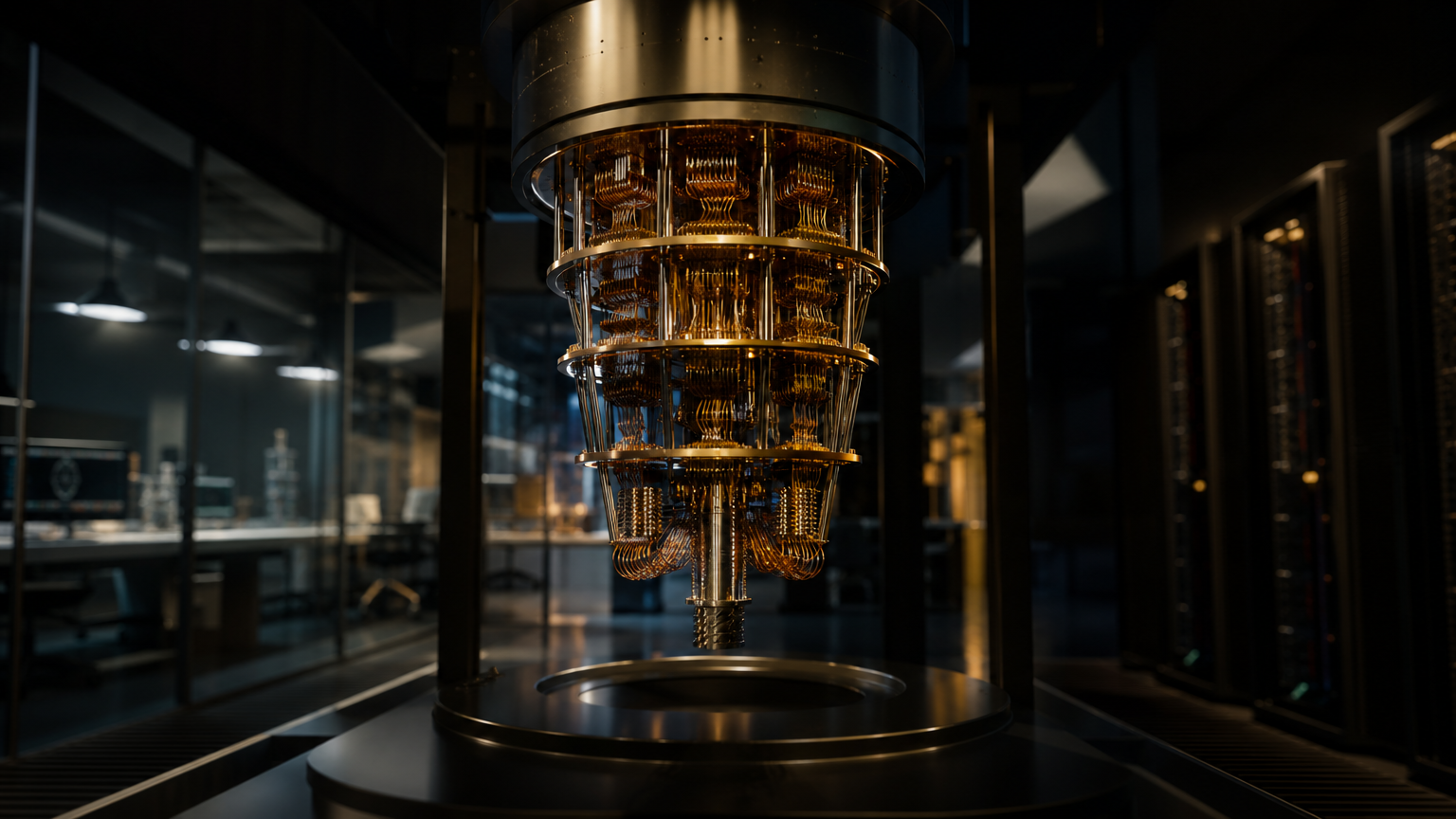
The 19-second result, and what was actually measured
The headline number is arresting: IBM’s Nighthawk r2 quantum processor generated one million samples in 19 seconds for a random-circuit sampling task that researchers estimated would take a conventional supercomputer roughly 110 years to reproduce at comparable scale and quality . The work was led by researchers including BlueQubit physicist Tigran Sedrakyan, and the reported results are based on a preprint that had not yet completed peer review when it was covered this week .
The experiment did not ask the quantum computer to solve a broad business, climate, medical or engineering problem. It asked the processor to perform random-circuit sampling, a benchmark designed precisely because the output distribution becomes very difficult for classical machines to simulate as circuit size and depth increase . In the reported run, the team used 61 qubits on IBM’s Nighthawk r2 processor and collected one million outputs with 19 seconds of quantum processing unit time .
That distinction matters. Random-circuit sampling is a useful stress test for quantum hardware, but it is not the same thing as showing that quantum computers are now better at everyday computation. The “110 years” figure is an estimate tied to specific assumptions about classical simulation, hardware and algorithms, not a universal exchange rate between quantum seconds and classical decades .
Why random-circuit sampling is used
Random-circuit sampling works by applying a sequence of quantum gates to many qubits, producing a complicated probability distribution over possible bitstrings. A quantum processor naturally samples from that distribution by running the circuit repeatedly and measuring the qubits. A classical computer, by contrast, must simulate the evolving quantum state or otherwise approximate the output distribution, and that cost can rise extremely fast.
That is why this kind of benchmark has become a recurring battleground in quantum computing. It is deliberately narrow, but it is narrow in a way that tests whether quantum hardware can enter a computational region that is costly for classical machines to follow. The current claim is especially notable because the reported run used a processor accessible through IBM’s commercial cloud environment, not a one-off laboratory device available only to its builders .
Still, the comparison is fragile by design. Classical algorithms improve, and previous quantum-advantage claims have often triggered better classical simulations after the fact. The stronger version of this week’s claim is therefore not simply “19 seconds beats 110 years.” It is that the circuit, data and workload are specific enough for other researchers to examine, challenge and rerun .
What the result says about hardware progress
The Nighthawk r2 result points to improvements in control, throughput and circuit execution on superconducting quantum processors. The useful signal in such an experiment depends not just on the number of qubits, but on how accurately gates are applied, how errors accumulate, how fast measurements can be repeated and how well the hardware maintains coherence long enough to finish the circuit.
That is why the 19-second time is only one part of the story. A fast noisy machine would not be impressive if its samples carried no meaningful relation to the intended quantum distribution. The more interesting claim is that the researchers report a difficult circuit at a quality high enough to make known classical reproduction costly under their model .
The finding also lands at a moment when the industry is trying to move beyond “more qubits” as the only scoreboard. Qubit counts remain important, but fidelity, connectivity, error correction and system-level engineering increasingly decide whether a machine is merely large or actually useful.
Europe’s scaling push: 1,000 qubits, but not just 1,000 qubits
That broader shift is visible in a separate development from the same news cycle: Alpine Quantum Technologies has joined a €122 million QUDORA-led project to develop a 1,000-qubit fault-tolerant quantum computer for Germany and Europe . The NFQC-1k project brings together seven research and industry partners and targets a trapped-ion system with at least 1,000 individually addressable physical qubits and 50 logical qubits .
The logical-qubit target is the key phrase. A physical qubit is the raw device-level unit. A logical qubit is built from multiple physical qubits using error-correction techniques, with the aim of making quantum information more reliable than any individual component. That is why a 1,000-qubit target is meaningful only if it arrives with improved control, lower error rates and a path to error correction.
The project also aims to establish a pilot line for high-performance quantum processing units based on ion-trap technology . That industrial detail matters because scaled quantum computing is not only a physics problem; it is a manufacturing, packaging, control-electronics and systems-integration problem.
The networking side: teleportation without science fiction
A third development adds the communications layer to the same picture. Researchers at Kyoto University and Hiroshima University have demonstrated a long-sought method for identifying W states, an important class of multi-photon entanglement, addressing a measurement challenge linked to quantum teleportation, communication and computing . The work demonstrated an entangled measurement for three-photon W states and points toward more efficient ways of characterizing complex entangled systems .
Despite the word “teleportation,” this does not mean moving people or objects across space. Quantum teleportation transfers an unknown quantum state using entanglement and classical communication. The Kyoto and Hiroshima result is relevant because future quantum networks will need reliable methods to create, identify, manipulate and distribute entangled states .
The researchers built their approach around cyclic shift symmetry and a photonic quantum circuit performing a quantum Fourier transformation, then tested it with three photons . The team’s longer-term aim is to extend the method to larger and more general multi-photon states, including on-chip photonic circuits that could be integrated into future quantum systems .
A milestone, not a finish line
Taken together, the week’s developments sketch a coherent picture. The 19-second Nighthawk run shows that accessible quantum hardware can now produce highly specialized outputs that are difficult for classical machines to match under stated assumptions . The European NFQC-1k program shows governments and companies trying to turn quantum processors from prototypes into engineered infrastructure . The W-state work shows that quantum communications and measurement science are advancing alongside processors .
The caution is just as important as the excitement. Random-circuit sampling does not make quantum computers generally superior to classical computers. A 1,000-qubit target does not guarantee useful fault tolerance. A teleportation-related entanglement breakthrough does not create a Star Trek transporter.
But quantum progress is rarely one giant leap. It is usually a series of controlled, measurable improvements: cleaner gates, faster execution, better benchmarking, more credible scaling plans and more precise entanglement tools. This time, the stopwatch said 19 seconds. The classical estimate said 110 years. The real test now is how well the claim survives replication, classical counterattack and the long engineering climb from advantage demonstrations to useful quantum machines.
Sources from the last 72 hours
- [1]IBM's Quantum Computer Completes in 19 Seconds What Could Take a Supercomputer a CenturySep 29, 2026, 2:00 AM
- [2]IBM Quantum Processor Claims 19-Second Result That Would Take a Supercomputer 110 YearsSep 29, 2026, 2:00 AM
- [3]Alpine Quantum Technologies joins €122M effort for 1,000-qubit quantum computerSep 29, 2026, 2:00 AM
- [4]Quantum teleportation breakthrough: Scientists crack a 25-year entanglement challengeSep 29, 2026, 2:00 AM
AI-generated article based on recent web research, then preserved as a dated editorial snapshot.
Comments
Be the first to comment.