
Daily Podcast full article
Starship reaches orbit on Flight 14
SpaceX’s Starship finally crossed from near-orbital demonstration to orbital flight on Flight 14, deploying 26 Starlink V3 satellites before controllers ended the test early after an engine issue. The result is both a landmark and a checklist: orbit is now proven, but endurance, recovery, heat-shield confidence and rapid reuse still stand between Starship and routine service [1].
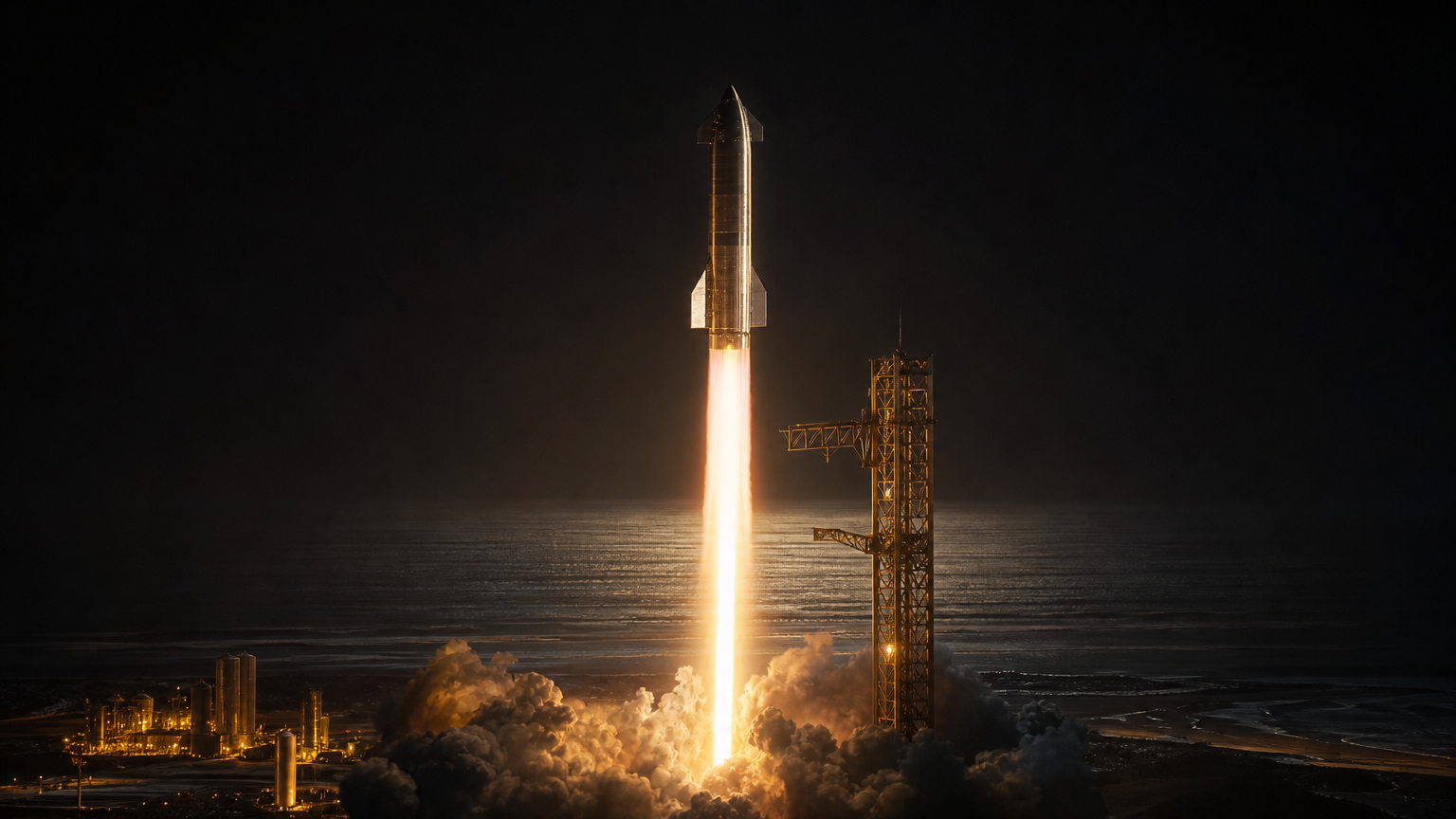
The milestone: Starship is orbital
SpaceX’s Starship reached Earth orbit for the first time on Flight 14, turning the company’s 407-foot fully reusable launch system from a dramatic test article into an orbital launch vehicle in development . The vehicle lifted off from Starbase in South Texas on September 28, 2026, at 8:48 a.m. EDT, with the Super Heavy booster and Ship upper stage flying the program’s 14th full-scale test .
The core achievement was clear: after 13 earlier full-scale flights that remained suborbital, Ship performed the burn needed to enter low Earth orbit and mission control confirmed, “Starship is orbital” . That single phrase matters because orbit is the threshold that separates a high-altitude demonstration from a vehicle that can begin proving real operational use: delivering payloads, staying healthy through multiple revolutions of Earth, deorbiting accurately and eventually coming home for reuse.
Flight 14 also did not fly empty. Starship deployed 26 Starlink V3 satellites, the first operational Starlink payloads carried by Starship into orbit . The payload deployment began roughly half an hour after launch and unfolded over about 30 minutes, according to reporting from the mission . For a program often judged by explosions, reentries and tower-catch attempts, this was a different kind of signal: Starship did productive work in space.
A success with an asterisk
The mission was not clean. During ascent, one of Ship’s engines shut down earlier than planned, briefly throwing the orbital attempt into doubt . SpaceX commentators initially suggested the vehicle might not proceed to orbit, but controllers reassessed the situation and pressed ahead with the orbital insertion burn . Reuters reported that Starship reached orbit despite having one engine down, making the satellite deployment attempt riskier than planned .
That decision appears to have paid off. Starship reached orbit and deployed the satellites, while Super Heavy came down for a controlled splashdown in the Gulf of Mexico minutes after liftoff . But SpaceX did not continue with the original nearly 10-hour mission plan. The company had intended for Ship to make about six laps around Earth at roughly 275 kilometers altitude before splashing down in the Pacific west of Chile . Instead, flight controllers brought the spacecraft home after about three hours, after only a couple of orbits, with the splashdown occurring in the northern Pacific north of Hawaii .
That early end tempers the headline but does not erase it. AP reported that SpaceX attributed the decision to an “abundance of caution” following the engine trouble . Axios similarly reported that Starship returned earlier than planned after its first orbital flight, with an explosion visible on the livestream just after touchdown in the Pacific . In test-flight terms, that is not necessarily a contradiction: a mission can meet its highest-value objectives and still expose the next set of engineering problems.
Why the 26 satellites matter
The most business-relevant part of Flight 14 may be the payload bay, not the splashdown. Starship’s long-term economic case depends on flying heavy payloads at high cadence, and Starlink is SpaceX’s most obvious internal customer. The 26 Starlink V3 satellites aboard Flight 14 were intended to expand the constellation’s capacity and demonstrate that Starship can place SpaceX’s next-generation broadband hardware into useful orbit .
SpaceX’s mission materials described each Starlink V3 satellite as adding 1 terabit per second of capacity, for 26 terabits per second from this mission alone . The same preview framed that as roughly 10 times the capacity of a single Falcon 9 launch carrying V2 mini Starlink satellites . Those numbers explain why this flight matters far beyond a test-score narrative: if Starship can repeatedly carry larger Starlink batches, it could change the unit economics of the satellite network.
That pressure would not stop at Starlink. A reusable heavy-lift launcher capable of frequent, large payload deployments would challenge incumbents across commercial launch, government missions and deep-space logistics. But Flight 14 also shows why that future is not automatic. A productive orbital deployment is one step; routinely performing it while recovering hardware quickly and safely is the business model.
What still has to work
The early deorbit points to the next bottlenecks. First is engine reliability across the whole flight profile. Flight 14 proved that Starship can survive an engine issue and still reach orbit, but operational launch customers will expect less drama and tighter margins. The vehicle must demonstrate that engine-out capability is not a recurring mission-management problem.
Second is thermal protection. Starship’s upper stage must survive orbital-speed reentry if SpaceX is to make the architecture fully reusable. AP reported that engineers had modified the heat shield on the newly launched Starship using lessons from a previous vehicle recovered from the Indian Ocean . That is exactly how test programs mature, but it also shows that the heat shield remains an active development area rather than a solved production system.
Third is recovery. Super Heavy has already demonstrated tower-catch capability on earlier Starship tests, but Ship itself has not yet been caught by the launch tower . Flight 14 did not attempt that; it ended with an ocean splashdown and visible fire after contact with the water . SpaceX ultimately wants both stages to return to the pad and be reused rapidly, because without that, Starship is merely a very large rocket rather than the reusable transportation system promised.
Fourth is endurance. The planned mission was nearly 10 hours; the flown mission was roughly three . That leaves questions about long-duration health, thermal management, propellant behavior, power and guidance during extended orbital operations. Those are not abstract concerns: lunar missions, Mars campaigns and depot-based refueling all require confidence over longer timelines than a short orbital checkout.
The Artemis and Mars context
Starship’s first orbital flight also lands inside a larger strategic clock. NASA has selected a version of Starship for its Artemis lunar landing architecture, and AP reported that upcoming Artemis missions are tied to competing lander readiness from SpaceX and Blue Origin . Starship does not merely need to reach orbit; it must eventually support docking, refueling, crew-rated operations and lunar descent.
SpaceX’s own ambitions are even broader. Starship is designed as a fully reusable system for missions to Earth orbit, the moon, Mars and beyond . Musk’s Mars narrative has always depended on scale: many vehicles, many launches and eventually a level of cadence that looks more like transportation infrastructure than bespoke exploration. Flight 14 is the first orbital proof point on that road, but it is not the finish line.
The bottom line
Flight 14 should be read as a major validation, not a graduation ceremony. Starship reached orbit for the first time, deployed 26 satellites and returned to Earth under control after an abbreviated mission . That is a historic step for SpaceX and for heavy-lift launch development.
But the shortened flight is just as important as the headline. It says Starship has crossed the orbital threshold while still carrying the normal burden of an experimental vehicle: engine reliability, heat-shield resilience, reuse, endurance and operational cadence. After 14 flights, SpaceX has earned the orbit badge. Now it has to prove that orbit can become a factory floor.
Sources from the last 72 hours
- [1]SpaceX launches Starship into orbit for 1st time — largest rocket ever built notches key milestone on dramatic Flight 14 testSep 28, 2026, 3:52 PM
- [2]SpaceX’s Starship reaches orbit despite engine issueSep 28, 2026, 3:33 PM
- [3]SpaceX brings Starship home early after first orbital flightSep 28, 2026, 6:13 PM
- [4]What time will SpaceX launch its 1st orbital Starship test on Flight 14 today? (Full mission timeline)Sep 28, 2026, 2:05 PM
- [5]SpaceX’s supersized Starship launches into orbit for the first time but flight ends earlySep 28, 2026, 2:50 PM
AI-generated article based on recent web research, then preserved as a dated editorial snapshot.
Comments
Be the first to comment.