
Daily Podcast full article
White House unites six AI rivals
The White House has brought Google, Anthropic, Meta, Nvidia, OpenAI and xAI into a single voluntary “Super Intelligence” accord, creating a rare governance forum for competitors that normally fight over models, chips, platforms and talent.
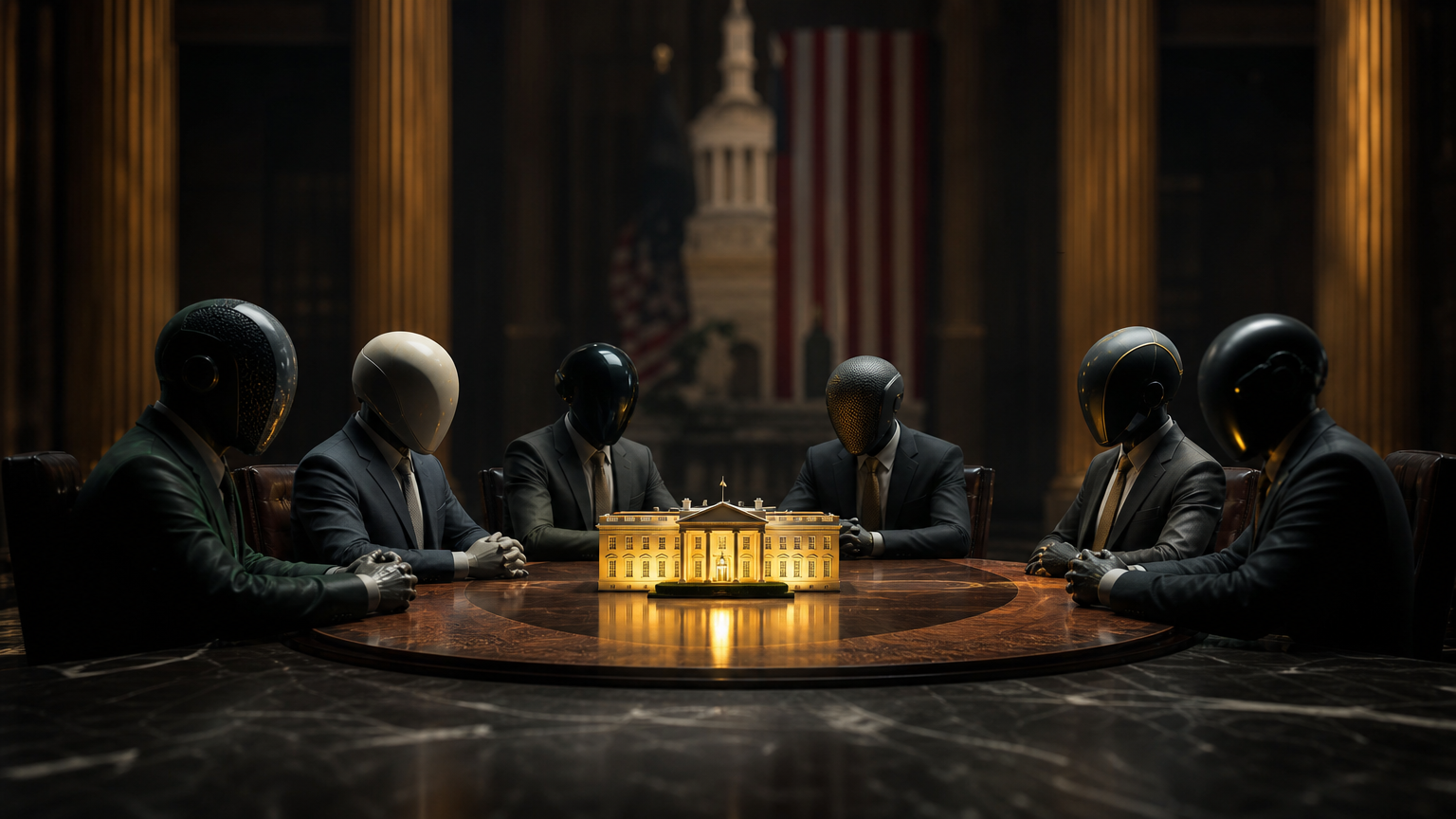
A single table for six competitors
The White House’s new “Super Intelligence” accord is less a finished regulatory regime than a political act of consolidation: six of the most powerful companies in the AI economy have agreed to sit inside the same framework, use the same safety vocabulary and accept a shared set of oversight principles . The signatories named in fresh reporting are Google CEO Sundar Pichai, Anthropic CEO Dario Amodei, Meta CEO Mark Zuckerberg, OpenAI President Greg Brockman, Nvidia CEO Jensen Huang and Elon Musk for xAI, alongside President Donald Trump .
That list matters because it cuts across the industry’s stack. Google, Anthropic, OpenAI, Meta and xAI compete in frontier models, assistants and consumer or enterprise platforms. Nvidia sits at the chip layer that powers much of the current buildout. Getting all six into one accord gives Washington a high-level channel to companies that otherwise have strong incentives to move faster than one another.
The pact was signed after a White House lunch on September 29, 2026, and was presented as a voluntary effort to “self-police” advanced AI development . CBS reported that Trump described the document as “morally binding,” while House Speaker Mike Johnson framed it as a joint commitment and statement of principles built around “robust internal controls” . In practice, that means the accord is politically visible but not yet a statute, rule or licensing system.
What the accord asks companies to do
The core of the agreement is a four-layer control structure. According to reporting on the document, participating companies commit to internal controls for advanced model development and deployment, an internal team to verify that monitoring systems work, independent external auditors or evaluators, and an independent board committee to review reports and ensure problems are addressed .
The accord’s safety perimeter is broad. Anadolu’s summary says the internal controls are meant to monitor model capabilities and alignment, including risks tied to cybersecurity, biosecurity and chemical threats, as well as the possibility that models could hack or access technical systems in unintended ways . That language tracks the frontier-risk debate that has moved from theoretical concerns to operational questions about agents, tool use and the security of increasingly autonomous systems.
The document also says companies will meet regularly to establish standards and best practices for improving system safety . That detail may prove more important than the symbolism of the signing ceremony. Regular meetings can create a shared playbook for testing and incident response, but they can also raise questions about whether private companies are shaping public safety standards without enough transparency.
The agreement leaves open a path to formal regulation. AP reported that the accord says it may eventually make sense to codify the steps into laws or regulations . That caveat is doing a lot of work. It lets the White House claim momentum now, while keeping future legal obligations on the table if voluntary commitments look too weak.
“Super Intelligence” as policy branding
The accord arrived alongside a separate executive order directing federal agencies to use “Super Intelligence” and “SI” instead of “Artificial Intelligence” and “AI” in official correspondence, public communications, websites, reports, policy documents and other non-statutory executive-branch documents . The order defines “Super Intelligence” and “SI,” for implementation purposes, as the technologies and systems already covered by the statutory definition of artificial intelligence in federal law, unless changed by later presidential action or Congress .
The White House fact sheet says the terminology shift is intended to reflect what the administration views as the promise and expanding capabilities of the technology . It also directs the Assistant to the President for Science and Technology to propose a federal definition of “Super Intelligence” within 60 days .
This rebranding is not merely cosmetic. Naming is a form of agenda-setting. By insisting on “Super Intelligence,” the administration is framing the technology as an engine of national strength and economic growth rather than primarily as a risk domain. That helps explain why the accord emphasizes internal controls and audits rather than hard deployment limits.
Why this coalition is unusual
The AI sector is not a unified bloc. Anthropic has often positioned itself as more safety-forward. Meta has pushed open models and broad distribution. OpenAI and Google are racing across consumer, enterprise and infrastructure layers. xAI is tied to Elon Musk’s broader technology ecosystem. Nvidia benefits from the compute arms race but is not itself a frontier model lab in the same way as the others. Yet the White House has put all six under a single headline.
Axios described the accord as formalizing industry self-regulation at a moment when Washington is responding to a string of AI safety failures and rising anxiety over frontier systems . It also noted that the pact is deliberately light-touch, centered on controls, auditing and board oversight rather than a sweeping federal command structure .
That light-touch design is the central tradeoff. A voluntary accord can be signed quickly, updated quickly and adopted without waiting for Congress. It also avoids freezing the market while technology changes. But the same flexibility can become a weakness if companies interpret commitments differently, disclose little, or face no penalty for weak implementation.
The enforcement gap
The biggest unanswered question is enforcement. A board committee can review safety reports, but boards also answer to shareholders. External auditors can test controls, but the accord does not yet specify who accredits auditors, whether results become public, what counts as a failure, or what happens if a company ships a model despite warnings.
AP reported that some experts welcomed efforts to balance innovation and safety, while others were skeptical of relying so heavily on self-policing and argued that robust legal liability and regulation are necessary to reduce public harms . That divide will define the next phase of the story. The accord may become a bridge to enforceable rules, or it may become a substitute for them.
The presence of Nvidia adds another layer. Safety commitments are often discussed in terms of model developers, but the AI boom also depends on chips, data centers, cloud contracts and energy supply. Including Nvidia signals that Washington sees governance as a full-stack issue, not just a chatbot issue. Still, the accord’s operational details appear to focus mainly on companies developing and deploying frontier models .
What to watch next
Three near-term tests will show whether the White House has created a meaningful governance forum or just a high-profile photo opportunity.
First, the administration must clarify who coordinates the accord. Trump said he planned to name someone to oversee the agreement in the coming days, and also discussed a committee to watch over the broader enterprise . Without a clear convener, regular meetings could drift into public relations.
Second, the companies must define the audit standard. “Independent external auditor” sounds strong, but audit quality depends on access to model weights, system prompts, tool-use logs, red-team results, incident reports and deployment decisions. If auditors receive only curated evidence, the process will not carry much weight.
Third, Congress and regulators must decide whether voluntary controls are enough. The accord’s own language preserves the possibility of future laws or regulations . That is an implicit admission that the current framework is only a starting point.
For now, the White House has achieved something rare: Google, Anthropic, Meta, Nvidia, OpenAI and xAI have put their names on the same governance document. The achievement is real, but incomplete. The accord creates a room, a vocabulary and a checklist. Whether it creates accountability will depend on what happens after the cameras leave.
Sources from the last 72 hours
- [1]Inaugurating The Era Of Super IntelligenceSep 29, 2026, 6:00 AM
- [2]Trump and major AI executives sign "morally binding" voluntary controls: "It's almost like a constitution"Sep 30, 2026, 1:36 AM
- [3]Trump's AI "constitution" crowns day of accelerating ambitionSep 30, 2026, 11:33 AM
- [4]Trump, tech leaders sign accord on 'Super Intelligence' safetySep 30, 2026, 2:00 AM
- [5]Top tech firms sign an accord to ‘self-police’ AI development, Trump saysSep 30, 2026, 2:00 AM
- [6]Fact Sheet: President Donald J. Trump Inaugurates The Era of Super IntelligenceSep 29, 2026, 6:00 AM
AI-generated article based on recent web research, then preserved as a dated editorial snapshot.
Comments
Be the first to comment.