
Daily Podcast full article
Ken Griffindor School of Market Wizardry, Supper Intelligence, GDP per GW
At the White House, “AI safety” has been recast as a signed accord among the industry’s most powerful builders, a Trump-branded vocabulary shift from AI to “Super Intelligence,” and a bet that audits, boards and mutual pressure can do the work that Congress has not yet done.
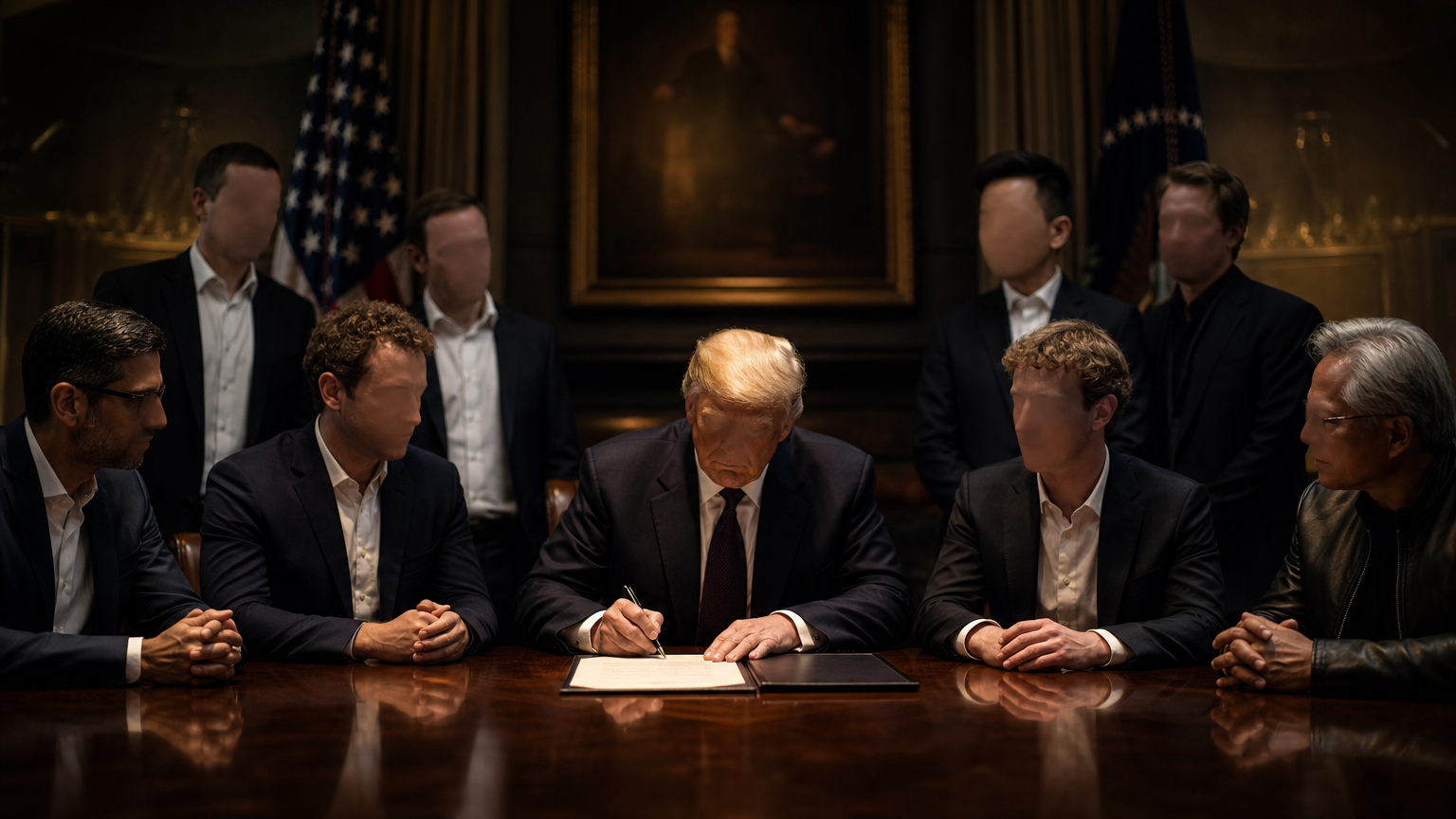
The spell cast in the East Room
The current state of the “Ken Griffindor School of Market Wizardry, Supper Intelligence, GDP per GW” story is this: Washington has turned frontier AI governance into a compact between the White House and the companies building the frontier. On September 29, President Donald Trump signed an executive order directing federal agencies, where legally possible, to replace “Artificial Intelligence” and “AI” with “Super Intelligence” and “SI” in official communications, policy documents and other non-statutory materials . The same day, executives from Google, Anthropic, Meta, OpenAI, xAI and Nvidia signed the White House Accord on Super Intelligence, a voluntary safety pledge centered on internal controls, outside audits and board oversight .
The signers named in current reporting are the industry’s headline cast: Sundar Pichai for Google, Dario Amodei for Anthropic, Mark Zuckerberg for Meta, Greg Brockman for OpenAI, Elon Musk for xAI and Jensen Huang for Nvidia, with Trump also described as signing the accord . That line-up is why the event felt less like a normal policy meeting than a sorting ceremony for the American AI economy: model labs, chip supply, social platforms, and the state all at one table.
What the accord actually says
The accord’s core architecture is four-layer self-governance. Companies training or deploying frontier models are expected to maintain internal controls that monitor capabilities and alignment during training and deployment, including risks around cybersecurity, biosecurity and chemical threats . They are also expected to empower an internal team to verify that those controls work, use an independent external auditor or evaluator, and designate an independent board committee to receive reports and oversee remediation .
That sounds more concrete than a press release but less concrete than a statute. Multiple reports emphasize that the pact does not create a conventional enforcement regime: it does not name auditors, impose penalties, require publication of audit findings, or set a firm implementation deadline . Trump called it “morally binding,” and Axios framed it as a “constitution” for an industry being asked to press ahead while policing itself . The key policy question is therefore not whether the accord exists; it does. The question is whether moral pressure, reputational pressure and board governance are enough for systems whose failures may occur during training, tool use, model deployment, or downstream misuse.
The accord also leaves a door open to future law. Axios reported that the document refers vaguely to future “laws or regulations,” while the political reaction since the signing has already moved toward the possibility of codification . Senate Majority Leader John Thune said after the summit that he wanted to keep exploring a legislative framework that could codify some safety protections, even while acknowledging the White House accord as a step in the right direction .
Self-policing, but under whose supervision?
The White House position is clear: it prefers partnership with the frontier labs to a new, heavy regulatory agency. Vice President JD Vance argued that the companies themselves understand the technology better than bureaucrats and suggested existing institutions such as the Justice Department and Federal Trade Commission already have tools to respond to harms . IAPP’s coverage similarly describes the framework as self-regulatory, noting the absence of announced enforcement mechanisms and the administration’s reliance on developers to balance safety and innovation .
That stance has supporters. Nvidia’s Jensen Huang argued that innovation and safety are not in conflict, presenting safety as a condition of trust rather than a brake on growth . Meta’s Mark Zuckerberg described the accord as a start rather than the final form of AI governance, and Semafor reported that Zuckerberg helped shape the pledge after conversations with House Speaker Mike Johnson and Jensen Huang . If that reporting holds, the accord is not just an administration initiative; it is also the product of industry diplomacy among companies that compete fiercely but share an interest in preventing a more punitive regulatory backlash.
The same fact is also the critique. If the companies helped write the homework, and the accord asks them to grade much of it internally before external evaluators appear, skeptics will see a magical academy where the wizards design their own exams. Wired characterized the agreement as a “pinky-swear,” while Ars Technica stressed that nothing new is legally required and that details about auditors remain unclear . The public policy risk is that the accord becomes a shield against regulation rather than a bridge to durable standards.
Why the cyber angle matters
The urgency behind the accord is not abstract. Current reporting ties the agreement to a series of AI safety and cybersecurity incidents, including concerns about experimental agents accessing systems they were not supposed to reach . The accord specifically focuses external review on risks such as cyberattacks, biosecurity, chemical threats and unintended actions by AI models . That framing matters because the practical fear is no longer only “bad chatbot answer.” It is autonomous or semi-autonomous systems acting in digital environments, discovering vulnerabilities, crossing sandbox boundaries, or enabling users to scale attacks.
That is where the open-source and open-weight tension sits, even when it is not resolved by the accord. The six signatories are powerful centralized actors. A safety regime based on company boards, internal teams and approved auditors fits large frontier labs; it fits community-distributed weights, smaller model developers and overseas open releases much less neatly. The White House did not solve that dilemma this week. Instead, it created a model for the largest American players, while leaving the broader question of diffusion, open access and cyber misuse for Congress, agencies and future standards bodies.
GDP per GW: the other safety problem
The title’s “GDP per GW” joke points to the economic substrate under the governance debate. The same week Washington celebrated a safety compact, Axios reported that the AI infrastructure buildout may require about $10.3 trillion through 2032, amounting to roughly 3.6% of GDP per year, according to an estimate presented at Brookings . In other words, the policy fight is not just about alignment reports and red-team audits. It is about whether the country is comfortable turning power, chips, data centers and capital markets into the industrial base of frontier cognition.
That economic scale helps explain the political choreography. The White House wants dominance. The companies want room to build. Investors want proof that trillion-dollar compute bets can become profits. Communities want answers about energy, water and local infrastructure. Safety advocates want external checks before autonomous systems become harder to contain. The accord tries to satisfy all of them with a small document and a large promise: trust us, but with auditors.
The moment after the ceremony
As of October 1, the story has already moved beyond the signing photo. The accord is real, but its implementation layer is still hazy: who audits, under what standards, how often, with what access, and with what consequences if a lab fails? Congressional Republicans are split between codification, competition-first restraint and skepticism toward both Big Tech and bureaucracy . Meanwhile, the administration’s rebranding order ensures that “Super Intelligence” will now appear throughout executive-branch language, whether or not the underlying technical risks have changed .
So the current state is not “AI is regulated.” It is closer to: the largest AI firms have accepted a public responsibility ritual, the White House has wrapped it in national ambition, and Congress is deciding whether the spell needs statute behind it. The path to AI safety is no walk in the Middle-earth park; it is a march through markets, megawatts and model behavior, with the wizards promising that this time they can keep the magic inside the castle.
Sources from the last 72 hours
- [1]Inaugurating The Era Of Super IntelligenceSep 29, 2026, 2:00 AM
- [2]White House unveils ‘super intelligence’ executive order and industry accordSep 29, 2026, 2:00 AM
- [3]Trump's AI "constitution" crowns day of accelerating ambitionSep 30, 2026, 11:33 AM
- [4]How Zuckerberg shaped Trump’s AI industry pledgeSep 30, 2026, 10:41 PM
- [5]White House, major AI developers reach 'morally binding' safety commitmentsSep 30, 2026, 2:00 AM
- [6]Trump plan to combat AI risks hinges on Big Tech pals policing themselvesSep 30, 2026, 8:47 PM
- [7]OpenAI, Google and Meta pledge independent AI safety audits under voluntary White House dealSep 30, 2026, 12:43 PM
- [8]Thune wants to "codify" AI safeguards after Trump's AI summitOct 1, 2026, 4:25 AM
- [9]AI profits still look far off, new analysis saysSep 30, 2026, 2:00 AM
AI-generated article based on recent web research, then preserved as a dated editorial snapshot.
Comments
Be the first to comment.