
Daily Podcast full article
Quantum computer operates in orbit: what the first space run really proves
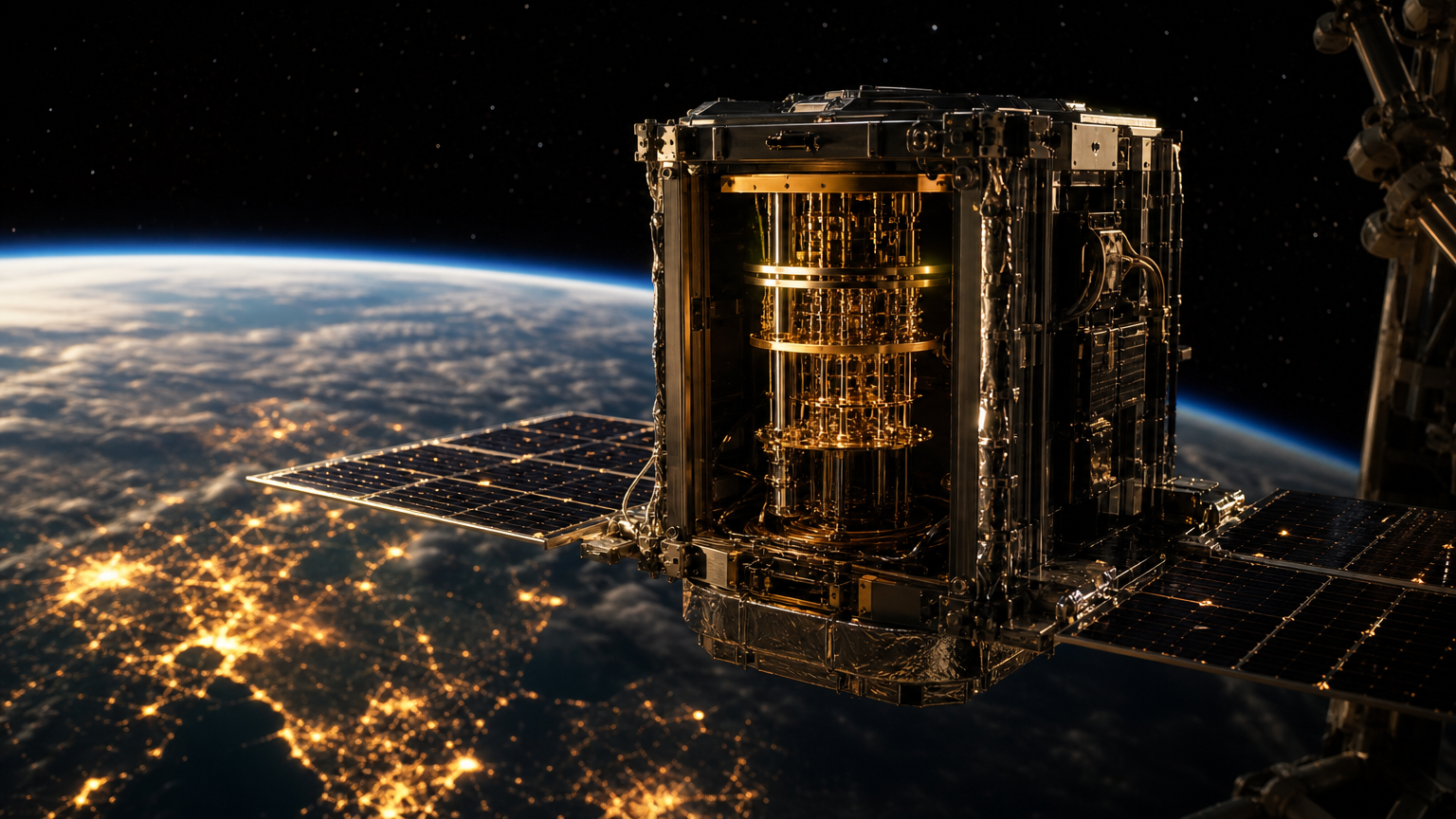
A programmable photonic quantum processor has now operated in low Earth orbit, showing two-photon quantum interference aboard a spacecraft rather than only in a protected laboratory [1]. The result is not a spaceborne quantum supercomputer, but it is a serious engineering milestone for future secure links, onboard satellite data processing and orbital quantum networks [1].
A small processor, a large threshold
The working headline is simple: Quantum computer operates in orbit. The more precise version is that researchers have operated a programmable photonic quantum processor in low Earth orbit, using light particles as the information carriers and measuring the quantum interference needed by linear-optical approaches to quantum computing . That distinction matters because this was not a demonstration of practical quantum advantage, nor did it solve an industrial problem faster than a classical machine .
The experiment is still important because it moved a fragile quantum-computing building block into one of the least forgiving engineering environments available: a spacecraft exposed to launch vibration, vacuum, radiation, sunlight-driven noise and thermal drift . The project reported operation over the first eight months in orbit, after a June 23, 2025 launch on SpaceX’s Transporter-14 mission aboard D-Orbit’s ION SCV platform . In other words, the milestone is less about raw processing power today than about proving that delicate quantum hardware can remain usable beyond terrestrial labs.
The platform was compact by space standards: reports describe a payload of about 9.8 kilograms, a 3U-class volume around 15 by 15 by 45.3 centimeters, and average power consumption near 10 watts . Those numbers are central to the story because satellites live under severe size, weight and power limits, and a quantum payload that demands laboratory-scale support equipment would be irrelevant for orbital infrastructure .
What actually happened on the chip
The processor used photons generated in pairs and routed them into a programmable glass photonic circuit with six optical modes . The circuit’s paths were adjusted by tiny heaters, allowing researchers to program how the photons moved through the device and then count the photons at the outputs . This is not the same architecture as superconducting or trapped-ion quantum computers found in many ground facilities; it is a light-based platform intended to exploit interference between indistinguishable photons .
The headline measurement was a Hong-Ou-Mandel interference dip, a standard quantum-optics signature that appears when two photons become so alike that their separate paths through an optical junction interfere . The team tuned the temperature of the photon-generating crystal and observed the expected dip near 32.5 degrees Celsius, closely matching ground-test behavior . Reported visibility was 0.908 with an uncertainty of 0.191, exceeding the relevant classical limit by 2.14 standard deviations, according to the current technical reporting .
That result should be read carefully. It is evidence of non-classical two-photon interference in orbit, not a finished proof that useful quantum computing has arrived in space . The experiment also tested programmable linear-optical operations, with one summary reporting average fidelity of 0.888 across nine settings and 0.949 after excluding two settings affected by apparent calibration problems . That is a meaningful orbital result, but it also shows how much harder the task becomes outside a controlled optics lab.
Why orbit is so difficult for quantum hardware
Quantum photonic processors rely on extreme control of timing, wavelength, polarization and path stability . On Earth, that control is usually protected by optical benches, stable temperatures, careful alignment and easy access for repairs. In orbit, the payload had to survive a rocket launch first, then keep operating through radiation exposure, orbital day-night cycling and limited access to maintenance .
The engineering setbacks are part of the significance, not a footnote. Only three of six detector channels were reported as usable after launch; one detector was already defective before launch, and two additional channels may have been lost because of fiber damage during launch . The team worked around the missing channels by routing usable outputs through the functioning detectors . That kind of workaround is common in early space demonstrations, but it is also a reminder that a production-grade orbital quantum processor would need more redundancy and autonomous recalibration.
Radiation created another problem by increasing detector dark counts, meaning false detections registered even when no photon arrived . Sunlight also raised noise during illuminated portions of the roughly 92-minute orbit, so useful measurements were restricted mainly to about 30-minute windows in Earth’s shadow . Reports also describe a laser-power decline linked to contamination from material released by an adhesive in vacuum, a mundane-sounding failure mode with serious consequences for a precision optical payload .
These complications make the achievement more credible rather than less. A clean laboratory demonstration can show ideal physics, but an orbital experiment reveals what breaks, what degrades and what can still be recovered through calibration and operational discipline . If quantum processors are ever to become routine satellite components, the boring details of adhesives, shielding, detector noise and thermal control will matter as much as the elegance of the quantum theory.
What it could be used for
The most immediate motivation is not to put a general-purpose quantum computer in space. It is to explore whether satellites can process some of their own data before sending it down to Earth . Earth-observation spacecraft can collect more raw data than they can quickly transmit, so onboard classification, filtering or compression could reduce downlink bottlenecks .
Photonic quantum hardware is attractive for that scenario because optical transformations can occur inside compact circuits, potentially supporting specialized machine-learning or pattern-recognition tasks under tight power budgets . The current demonstration did not process live satellite imagery, and it did not show an advantage over classical onboard computers . It did, however, establish that a relevant quantum optical resource can be generated, manipulated and measured in orbit .
A second long-term use case is distributed quantum infrastructure. Space-based quantum communication has already been discussed for secure links and global-scale quantum networks, but communication channels alone are not the same as orbital processing nodes . A processor that can manipulate quantum states onboard could eventually complement satellite quantum links, although today’s experiment remains an early building block rather than an operational network node .
Why the milestone matters now
The key lesson is that the first orbital quantum-computing step looks less like a giant leap in processing power and more like a ruggedization test for a new class of satellite payload . The processor survived launch, operated under constrained power, endured partial hardware failures and still produced the expected quantum-interference behavior . That combination is exactly why the story matters for the satellite industry: it shifts quantum computing in space from concept art toward engineering iteration.
The limitations are equally important. The work is based on a preprint, not yet a peer-reviewed final paper, and several current reports caution that the result should not be oversold as practical quantum computing in space . The device used two-photon interference and a small six-mode circuit, not a large fault-tolerant processor . The statistical strength of the HOM result is suggestive rather than overwhelming, and the operational windows were constrained by environmental noise .
Still, the direction is clear. The next versions will need radiation-hardened detectors, better optical packaging, cleaner space-qualified materials, stronger thermal management and automated calibration that can respond without a graduate student beside the apparatus . They will also need algorithms designed for very small photonic processors, because copying ground-based quantum-computing ambitions into orbit would ignore the harsh constraints that make satellites different .
For now, the story is best understood as a proof that quantum hardware can move from a protected laboratory into orbit and still perform a defining quantum operation. That is a modest claim compared with “space quantum supercomputer,” but it is a much more useful one. The window seat belongs to the qubits only if engineers can keep them aligned, powered, shielded and quiet enough to do real work.
Sources from the last 72 hours
- [1]One Giant Leap: Researchers Demonstrate Programmable Quantum Photonic Processor in OrbitSep 29, 2026, 2:00 AM
- [2]University of Vienna Demonstrates First In-Orbit Operation of a Programmable Quantum Photonic ProcessorSep 29, 2026, 2:00 AM
- [3]Scientists operate quantum computer in space for first time after launch challengesSep 28, 2026, 1:53 PM
- [4]Photonic Quantum Circuit Operates in Orbit for the First Time, Vienna Team ReportsSep 29, 2026, 2:00 AM
AI-generated article based on recent web research, then preserved as a dated editorial snapshot.
Comments
Be the first to comment.