
Daily Podcast full article
SpaceX compresses orbital launch cadence
SpaceX’s Crew-13 launch put four astronauts on a fast-track ride to the International Space Station, while the company lined up two more orbital missions inside the same 13-hour window. The story is not only another successful crew rotation; it is a snapshot of orbital flight turning into a tightly scheduled transport operation.
A crew launch measured in hours, not days
SpaceX launched NASA’s Crew-13 mission from Space Launch Complex 40 at Cape Canaveral Space Force Station on Thursday, October 1, sending NASA astronauts Jessica Watkins and Luke Delaney, Canadian Space Agency astronaut Joshua Kutryk and Roscosmos cosmonaut Sergey Teteryatnikov toward the International Space Station aboard a Crew Dragon spacecraft . The mission is SpaceX’s 13th operational long-duration human spaceflight mission to the station under NASA’s Commercial Crew framework, with the crew assigned to a long-duration science stay in orbit .
The standout figure is the planned transit time. NASA’s latest mission advisory set docking for about 7 p.m. Eastern time on October 1, roughly 7 hours and 50 minutes after the 11:10 a.m. liftoff, which the agency described as the fastest trip to the station by a U.S. spacecraft in ISS history . AP’s launch report framed the same point more simply: after a mission that will last about six months, the flight to get there was expected to take only about eight hours .
That compression changes the feel of crewed orbital flight. A launch to the ISS is still high-consequence engineering, but the operational target is increasingly closer to airline-style scheduling than one-off expedition theater. The goal is not drama; it is getting a certified crew vehicle, a Falcon 9, a launch range, mission control teams and station traffic all synchronized tightly enough that astronauts can leave Florida in the morning and arrive at the orbiting laboratory before the end of the day .
Crew Dragon’s central role deepens
Crew-13 also reinforces Crew Dragon’s central role in U.S. access to low Earth orbit. NASA’s advisory listed the mission as a long-duration science flight, and AP noted it was the 13th crew SpaceX has launched for NASA, excluding the 2020 test flight . That distinction matters because the Commercial Crew Program was designed to make transport to the ISS repeatable. Crew-13 is evidence that the repeatability is no longer theoretical.
The crew lineup also illustrates the ISS partnership model. Watkins commands the mission, Delaney serves as the NASA pilot, Kutryk represents Canada, and Teteryatnikov represents Roscosmos . AP reported that Watkins became the first Black woman to lead a crew to orbit, while the other three Crew-13 members are first-time spaceflyers . The spacecraft is therefore carrying both institutional continuity and new human spaceflight entrants.
NASA had also built the schedule around a handover. Crew-13 was expected to overlap briefly with Crew-12 before Crew-12 begins its return no earlier than Monday, October 5 . In station operations, that overlap is not a ceremonial detail. It gives outgoing astronauts time to brief incoming colleagues on experiments, maintenance routines, spacecraft configurations and the small operational knowledge that keeps a permanently crewed outpost running.
The other half of the cadence story: a same-day tripleheader
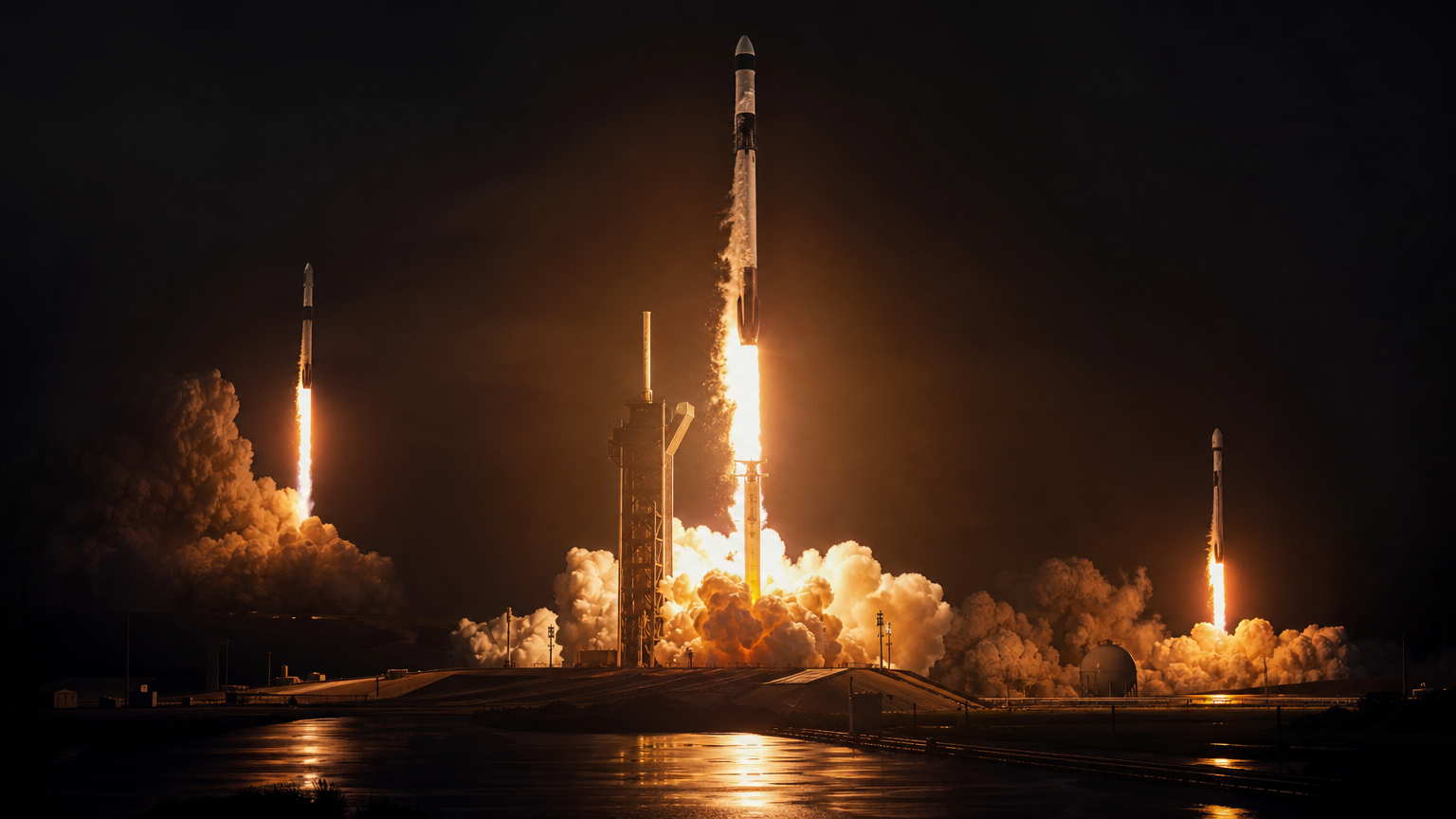
The Crew-13 launch was only the first act in a far denser SpaceX day. Space.com reported that SpaceX had three orbital missions scheduled inside a 13-hour span on October 1, a feat the company had accomplished only once before . The planned sequence began with Crew-13 at 11:10 a.m. EDT from Cape Canaveral, continued with the Transporter-18 rideshare mission from Vandenberg Space Force Base during a 58-minute window opening at 2:18 p.m. EDT, and was set to end with a Falcon Heavy launch of the classified NROL-97 mission for the National Reconnaissance Office from Kennedy Space Center at 11:53 p.m. EDT, or 03:53 UTC on October 2 .
That lineup is more revealing than a raw launch count. It crosses mission categories, geography and vehicle types: human spaceflight from Florida, a payload-rich rideshare from California, and a national-security Falcon Heavy mission back on the Space Coast . In practical terms, SpaceX was attempting to run parallel launch campaigns across ranges, pads, recovery assets and control teams with almost no empty space in the schedule.
The tripleheader also shows why cadence has become a strategic capability. A company that can turn launch operations into an assembly line can deploy constellations faster, clear rideshare backlogs sooner, offer national-security customers more schedule options and still preserve capacity for crewed missions. The advantage is not merely that Falcon 9 and Falcon Heavy can fly; it is that SpaceX can stage unrelated missions close together without treating each as a singular event.
The hidden work behind a 13-hour manifest
From the outside, a dense launch day looks like a public spectacle: countdown clocks, plume shots and booster landings. Inside the system, it is a test of sequencing. Weather calls must be made at multiple ranges. Launch licenses, range safety, tracking assets, propellant loading timelines, spacecraft checkouts, abort zones and recovery teams all have to fit around one another. Crew-13 adds the extra constraints of human-rating, suit-up timelines, medical readiness and station rendezvous geometry .
NASA’s Crew-13 plan shows how exact the choreography had to be. The agency scheduled launch coverage, an audio-only transit phase, a postlaunch briefing, arrival coverage, docking and hatch-opening events in a single day, with times explicitly subject to real-time operations . That caveat is important: compressed does not mean casual. It means the system has enough practiced margin to plan aggressively while still leaving room for weather, hardware or orbital mechanics to intervene.
AP also noted that Crew-13 followed a three-week delay tied to repairs for a leaking fuel system on the capsule . In a less mature cadence model, that kind of slip could ripple through the manifest for weeks. SpaceX’s October 1 schedule suggests a different pattern: delays still happen, but the broader machine is designed to absorb them and re-stack missions quickly.
Why this matters beyond SpaceX
The operational benchmark is rising for every launch provider. A decade ago, three orbital launches inside roughly half a day would have looked like a remarkable monthly tempo compressed into a single news cycle. Now it is becoming a measure of launch-system maturity. The most important number is not just how many rockets fly per year, but how many missions can be safely integrated, launched and recovered without turning each one into an all-consuming campaign.
For NASA, Crew-13 is a transportation milestone with immediate station benefits: a faster arrival, a structured handover and continued use of commercial crew capacity . For SpaceX, the same day is a broader demonstration of launch elasticity: astronauts, rideshare payloads and a classified national-security customer all moving through the manifest in rapid succession . For rivals, it is a warning that reusability is only the first layer. The deeper advantage is operational rhythm.
Routine human spaceflight is not routine because it is easy. It becomes routine when the hard parts are standardized, rehearsed and repeated often enough that the schedule itself tightens. Crew-13 and the October 1 tripleheader show SpaceX pushing that logic further: orbital commuting now has a speedrun category, but the real prize is dependable cadence.
Sources from the last 72 hours
- [1]NASA Sets Crew-13 Launch, Docking CoverageSep 29, 2026, 8:57 PM
- [2]SpaceX - Crew-13 MissionOct 1, 2026, 5:10 PM
- [3]Launch tripleheader! SpaceX to fly 3 rockets in 13 hours todayOct 1, 2026, 6:00 AM
- [4]SpaceX launches 4 astronauts on a fast track to the International Space StationOct 1, 2026, 5:12 PM
AI-generated article based on recent web research, then preserved as a dated editorial snapshot.
Comments
Be the first to comment.