
Daily Podcast full article
Falcon Heavy launches first U.S. spy satellite mission
SpaceX sent Falcon Heavy into the center of U.S. intelligence launch work with NROL-97, a classified National Reconnaissance Office mission from Kennedy Space Center that marked the heavy-lift rocket’s first dedicated flight for America’s spy satellite agency.
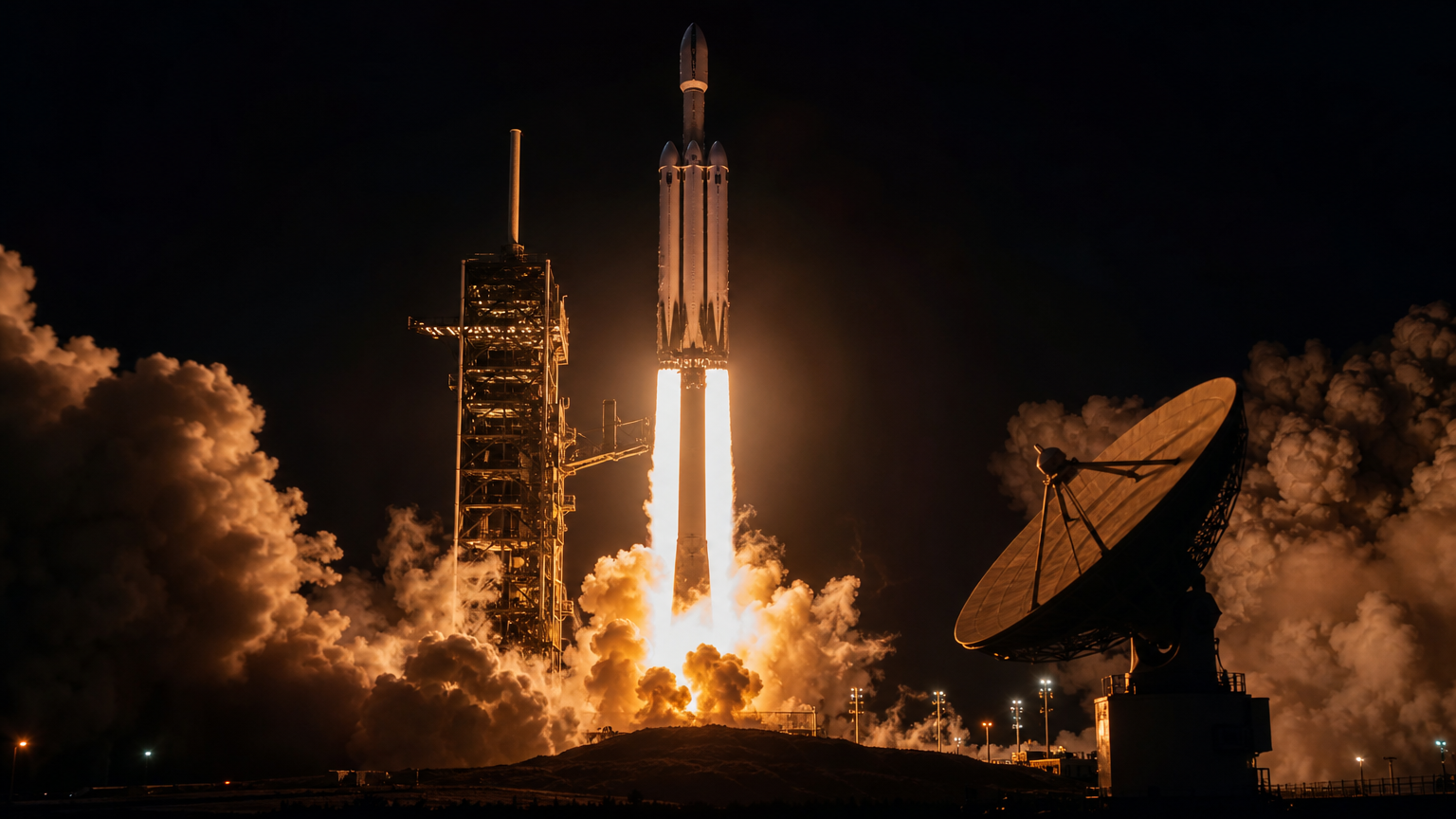
The working headline matches the subject: Falcon Heavy launches first U.S. spy satellite mission.
A classified payload, a very public signal
SpaceX’s Falcon Heavy launched the classified NROL-97 mission from Launch Complex 39A at NASA’s Kennedy Space Center, turning a secret payload into a public milestone for U.S. national-security spaceflight . The customer was the National Reconnaissance Office, the agency that builds and operates U.S. intelligence satellites, and the mission stood out because the NRO had previously flown SpaceX missions on Falcon 9 but had not yet used Falcon Heavy for a dedicated launch .
That distinction matters. Falcon Heavy is not just a bigger Falcon 9; it is the version SpaceX uses when mass, orbit, performance margin or national-security requirements exceed what a single-core rocket can comfortably provide. For NROL-97, SpaceX listed liftoff for 11:53 p.m. Eastern time on October 1, equal to 03:53 UTC on October 2, from LC-39A in Florida . Local reporting also identified the mission as a classified spy-satellite launch from the Space Coast and noted a backup launch opportunity on October 2 at 11:48 p.m. Eastern .
The payload stayed classified, as is typical for NRO missions. That secrecy does not make the launch less important; it is the point. The NRO buys access to orbit not to advertise satellite design, but to place strategic collection systems where the United States wants them. The public facts, therefore, are mostly about the rocket, the site, the timing and the customer. Those facts are enough to show that SpaceX’s heavy-lift vehicle has moved deeper into the most sensitive layer of U.S. launch demand.
Why Falcon Heavy was the right tool
Falcon Heavy consists of three Falcon 9-derived first-stage cores and an upper stage, producing liftoff thrust from 27 Merlin engines . Spaceflight Now reported that NROL-97 was Falcon Heavy’s 14th flight and that the mission used a new center core, B1106, which was to be expended rather than recovered . SpaceX’s mission page said the two side boosters were planned to return to Landing Zones 1 and 2 at Cape Canaveral Space Force Station after separation .
That split architecture explains Falcon Heavy’s appeal. The side boosters can return for reuse when mission energy allows, while the center core can be sacrificed when the payload or target orbit demands more performance. In this case, SpaceX identified the side boosters as previously flown hardware: one on its second flight and the other on its fourth . Spaceflight Now added that both side boosters had flown just a month earlier on the Nancy Grace Roman Space Telescope launch, while the payload fairing had previously supported NROL-95 in July .
The reuse details are not trivia. They show how SpaceX is attempting to normalize a once-radical model inside conservative national-security procurement: previously flown boosters and fairings can support high-priority government missions, while new expendable hardware can still be used where performance demands it. For an intelligence payload, that balance is significant. The government gets heavy-lift capability and schedule flexibility; SpaceX gets another proof point that reusability and national-security mission assurance can coexist.
The first NRO Falcon Heavy flight
The key milestone is narrow but meaningful: this was the first NRO mission flown on Falcon Heavy after 22 NRO payloads had previously flown on Falcon 9, according to Spaceflight Now . It was also identified as the first NRO mission procured through the National Security Space Launch Phase 3 Lane 2 contract structure .
That places NROL-97 in a broader procurement shift. Lane 2 missions are the demanding national-security launches where the government wants certified providers, robust performance and assured access to a range of orbits. Falcon Heavy had already been used for high-profile civil and military launches, but the NRO’s first dedicated use of the vehicle gives SpaceX a new credential in the intelligence community’s launch portfolio.
The public could see the rocket; it could not see the spacecraft. That contrast is normal for NRO work. Launch visibility ends where payload secrecy begins. The exact satellite type, orbit and mission are not publicly disclosed, though tracking notices suggested a northeast trajectory from the Florida coast . For readers, the most careful interpretation is this: the launch confirms the NRO’s willingness to put a classified mission on Falcon Heavy, but it does not reveal what capability was placed in orbit.
A busy SpaceX news cycle
The NROL-97 launch did not happen in isolation. Space.com described October 1 as an unusually dense SpaceX launch day, with Crew-13, Transporter-18 and the Falcon Heavy NROL-97 mission all scheduled within about 13 hours . The same report noted that the week came shortly after Starship’s 14th test flight, in which SpaceX’s next-generation vehicle reached Earth orbit for the first time .
That pairing is strategically important. Falcon Heavy is the operational heavy-lift system SpaceX can sell today to NASA, the Pentagon and intelligence customers. Starship is the developmental architecture SpaceX wants to turn into a fully reusable super-heavy transport system. In the same week, SpaceX demonstrated the mature side of its business and the experimental side of its future.
Aviation Week reported that Starship Flight 14 reached orbit during its first orbital test run and deployed 26 Starlink V3 satellites . Astronomy likewise reported that Flight 14 followed 13 previous suborbital test flights and marked the first time Starship reached orbit . That success does not replace Falcon Heavy. It reinforces SpaceX’s broader argument: the company can keep flying operational national-security rockets while pushing toward a much larger, more reusable system.
What success means, and what remains unproven
For Falcon Heavy, NROL-97 strengthens the rocket’s national-security résumé. The launch showed that the NRO is willing to use Falcon Heavy not merely as a theoretical option but as an active vehicle for classified missions. It also showed that SpaceX can support a heavy-lift intelligence launch while managing a rapid broader cadence across crew, rideshare and test-flight operations.
For Starship, the lesson is more nuanced. Reaching orbit on Flight 14 was a major technical milestone, but repeatability is the real industrial standard. A single orbital achievement proves possibility; repeated orbital flights, payload delivery, safe recovery and eventually rapid reuse will prove the system. Falcon Heavy already lives in the world of operational commitments. Starship is still earning its way there.
That is why the NROL-97 launch may be the quieter but more immediately consequential story. A classified satellite on Falcon Heavy says SpaceX is trusted with sensitive work today. Starship reaching orbit says SpaceX may reshape heavy space transportation tomorrow. Together, they show a company operating on two tracks: one delivering high-value missions for national-security customers, the other trying to rewrite the economics of orbit.
The public achievement behind the classified mission
Because the payload remains secret, the public story of NROL-97 is not about what the satellite does. It is about who launched it, which rocket was chosen and what that choice says about U.S. access to space. Falcon Heavy’s first dedicated mission for the NRO broadens SpaceX’s role from frequent Falcon 9 intelligence launches into the heavier, higher-performance tier of spy-satellite deployment .
The achievement is therefore both technical and institutional. Technically, Falcon Heavy demonstrated the capacity to support a demanding classified launch profile from Kennedy Space Center. Institutionally, the mission showed that SpaceX has become embedded not only in commercial and civil spaceflight, but also in the most sensitive parts of the U.S. space architecture.
The payload stayed hidden. The rocket’s message did not.
Sources from the last 72 hours
- [1]Falcon Heavy to fly its first mission for U.S. spy satellite agencyOct 2, 2026, 12:37 AM
- [2]NROL-97 MissionOct 2, 2026, 5:53 AM
- [3]SpaceX's Falcon Heavy rocket launching classified spy mission from Florida's Space CoastOct 1, 2026, 8:56 PM
- [4]Launch tripleheader! SpaceX to fly 3 rockets in 13 hours todayOct 1, 2026, 2:00 AM
- [5]Aviation Week & Space Technology, October 5, 2026Oct 2, 2026, 2:00 AM
- [6]Starship reaches orbit on 14th test flightSep 30, 2026, 2:00 AM
AI-generated article based on recent web research, then preserved as a dated editorial snapshot.
Comments
Be the first to comment.