
Daily Podcast full article
Google takes AI compute orbital
Google’s Project Suncatcher has moved the AI infrastructure debate from zoning boards and power grids to low Earth orbit. The prototype now in space is small, experimental and constrained, but it marks a serious test of whether future machine-learning compute can be powered by near-continuous sunlight rather than terrestrial utilities.
A data-center race leaves the ground
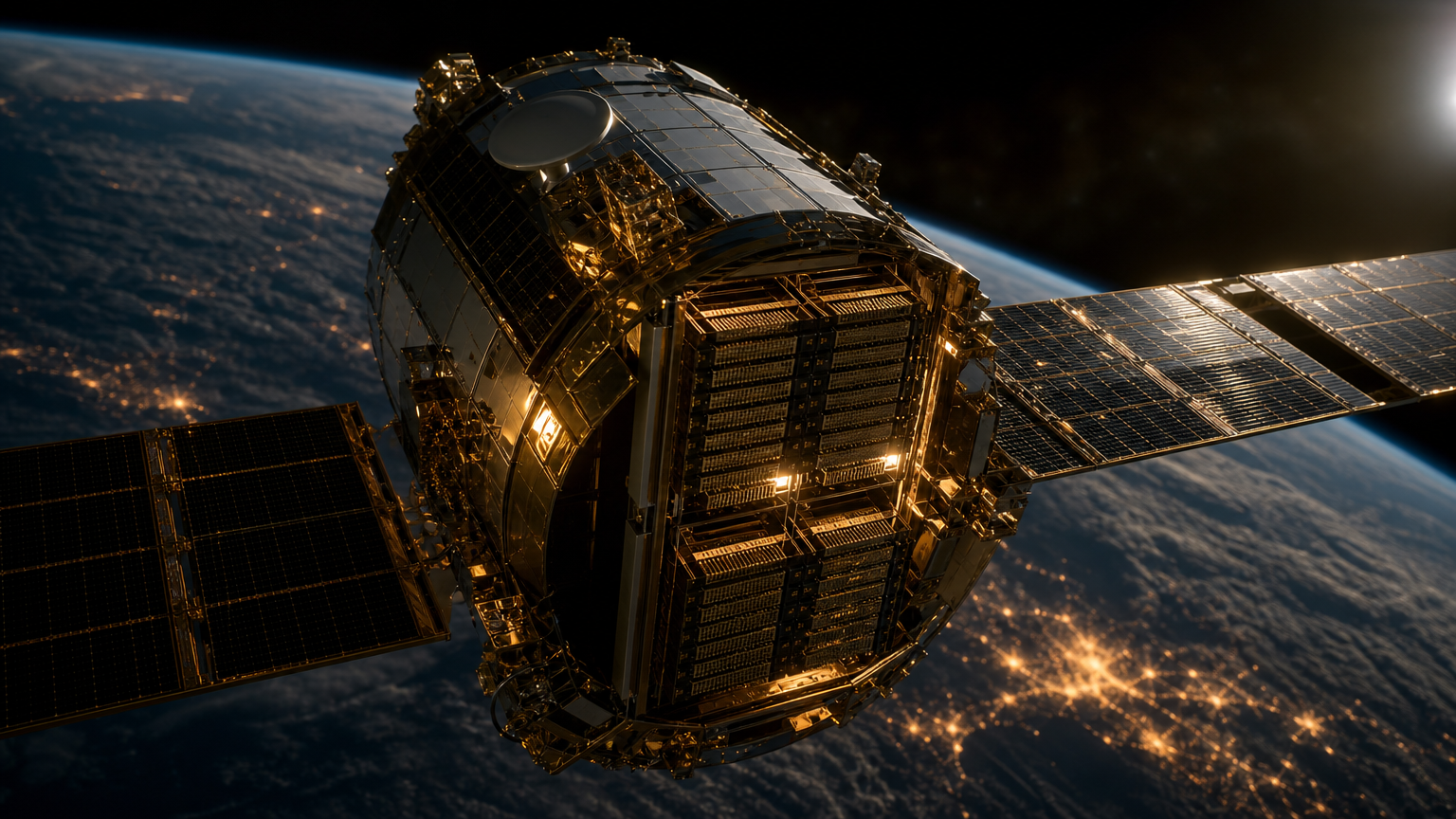
Google’s Project Suncatcher crossed a symbolic line on October 1: its prototype satellite reached orbit aboard SpaceX’s Transporter-18 rideshare mission, and Google said it had confirmed contact with the spacecraft and that it was operating as expected . That is not the same as launching a real data center into space. It is, however, the first in-orbit step in Google’s long-term attempt to learn whether scalable machine-learning infrastructure can eventually live above Earth rather than inside more conventional cloud regions .
The flight matters because AI infrastructure has become a power, cooling, land and politics problem, not merely a chip problem. On Earth, hyperscalers can buy processors, design accelerators and sign power contracts, but the physical reality of AI growth is increasingly visible in grid queues, water debates and local resistance to large data-center campuses. Project Suncatcher asks a radical question: if AI compute is constrained by terrestrial energy and siting, can part of the stack move to the one place where solar power is abundant and the neighbors are orbital mechanics?
The answer is nowhere near proven. Google itself describes Suncatcher as a research moonshot, and the current satellite is closer to a laboratory instrument than to a commercial cloud region . Yet the test gives the industry a concrete object to measure: real Tensor Processing Units, real thermal loads, real radiation exposure and real communication limits in low Earth orbit.
What actually launched
The Project Suncatcher prototype was built with Planet Labs and rode to orbit on SpaceX’s Transporter-18 mission from Vandenberg Space Force Base in California . Space.com reported that the Falcon 9 mission lifted off at 2:32 p.m. ET on October 1 and carried 130 payloads to orbit, including Google’s pathfinder spacecraft . SpaceX’s upper stage deployed the payloads in low Earth orbit after launch, and the Google satellite was one of the highest-profile items on the rideshare manifest .
The prototype is deliberately modest. NPR reported that the refrigerator-sized satellite carries four Google Tensor Processing Units, the company’s specialized AI chips already used in terrestrial data centers . Those chips are expected to run a version of Google’s Gemma model in 15-minute stretches because heat management remains a limiting factor . In other words, this is not a miniature hyperscale campus; it is an engineering trial designed to expose the most uncomfortable parts of the space-compute problem.
Google says the mission will collect data over the coming weeks on how the TPUs handle the physical stress of spaceflight, radiation and thermal extremes . That framing is important. The project is not only testing whether a model can answer queries from orbit. It is testing whether the hardware foundation of Google’s AI business can survive the environment that future orbital compute clusters would have to inhabit for years.
Why the sun is the attraction
The attraction is simple to state and difficult to turn into a system. A satellite in the right orbit can see sunlight far more consistently than a solar farm on Earth, avoiding night cycles, weather and many land-use constraints. NPR reported that Google expects the Suncatcher satellite to operate in a sun-synchronous orbit where its solar panels are almost never in shade, reducing the need for heavy backup batteries .
For AI infrastructure planners, that is an obvious temptation. Electricity is the strategic input for advanced AI; if compute demand keeps rising, power availability becomes a competitive boundary. Project Suncatcher is therefore not just a space experiment. It is also a bet that future AI economics may be shaped by access to energy as much as by access to chips.
But the phrase “free solar power” can mislead. Energy may be abundant in orbit, yet every kilogram of satellite, radiator, shielding and communications hardware has to be manufactured, launched, operated and eventually replaced. The project is trying to discover whether the energy advantage can outweigh those added costs.
The hard parts: heat, radiation, links and launch costs
The first barrier is heat. On Earth, data centers can use air, water, chillers and large mechanical systems to move waste heat away from chips. In orbit, there is no surrounding air to carry heat off the spacecraft. NPR quoted Carnegie Mellon professor Brandon Lucia explaining that higher compute power inside a satellite means more heat trapped in a confined environment . Google is working with pipes and radiators to wick heat away from the chips, but radiators add mass, and mass is expensive to launch .
The second barrier is radiation. Google’s October 1 update says the mission will study how its TPUs handle radiation and thermal extremes in orbit . That question is not academic. A terrestrial data center can replace failed boards quickly; an orbital cluster needs hardware that can tolerate particle strikes, solar events and long-duration exposure without routine human maintenance.
The third barrier is networking. A data center is not simply a pile of chips. Large AI workloads depend on fast, predictable communication among accelerators. NPR reported that Google’s longer-term concept involves clusters of satellites communicating with one another and with Earth via lasers, with two additional satellites planned next year to test connections . TechCrunch reported that Google’s vision includes an orbital data center made of 81 satellites flying in close formation and processing workloads in parallel . That architecture would demand precision formation flying and extremely high-bandwidth optical links, not just solar panels and processors.
The fourth barrier is launch economics. TechCrunch reported that Google’s research points toward launch prices near $200 per kilogram by 2035 as a possible threshold for orbital data-center economics, but reaching that trajectory would require enormous Starship cadence: roughly 1,800 launches over 10 years under the assumptions cited in the article . That is the sober part of the Suncatcher story. Google is testing something real, but the path from four TPUs to industrial-scale orbital compute runs through an aerospace supply chain that does not yet exist at the required scale.
Why this small test still matters
The immediate payload is tiny compared with a terrestrial AI data center. But infrastructure shifts often begin as measurement campaigns. The important output from Suncatcher may not be model answers from orbit; it may be data about error rates, thermal behavior, power budgets, and how much design margin future compute satellites need.
The test also places Google in a broader orbital infrastructure moment. Via Satellite reported that Transporter-18 carried several milestone missions, including Google and Planet’s Suncatcher prototype, as well as other demonstrations tied to power beaming, servicing and communications . Axios likewise framed the mission as part of a boom in commercial efforts that are testing concepts long discussed in science fiction and aerospace planning . Suncatcher is therefore both an AI story and a space-industrial story.
For cloud strategy, the signal is clear: AI capacity planning is no longer limited to choosing regions, substations, campuses and cooling systems. The frontier now includes launch cadence, satellite mass, radiation tolerance, optical crosslinks and orbital debris risk. That does not mean the next Gemini training run will happen in space. It means the largest AI companies are already modeling infrastructure futures beyond the grid.
The bottom line
Project Suncatcher is not proof that orbital data centers will work. It is proof that Google considers the terrestrial constraints on AI compute serious enough to test an alternative in orbit. The current spacecraft is small, the workloads are brief, and the economics remain uncertain. Still, after October 1, the debate is less abstract: Google has hardware in space, contact confirmed, and TPUs waiting to be stressed by the environment they would have to master .
Apparently, cloud computing decided the cloud was not high enough. The serious version is that AI infrastructure has entered an era where the cloud, the grid and the launchpad are becoming parts of the same conversation.
Sources from the last 72 hours
- [1]Our Project Suncatcher prototype satellite is in orbit.Oct 1, 2026, 2:00 AM
- [2]SpaceX launches Google AI satellite, 129 other payloads on 2nd leg of spaceflight tripleheader (video)Oct 1, 2026, 10:35 PM
- [3]Google launches Project Suncatcher, a step towards AI data centers in spaceOct 1, 2026, 8:41 PM
- [4]Google thinks SpaceX’s Starship has to launch 1,800 times before space data centers get off the groundOct 1, 2026, 9:18 PM
- [5]The First Mission Milestones Onboard SpaceX’s Transporter-18 Rideshare LaunchOct 1, 2026, 2:00 AM
- [6]SpaceX Transporter-18 rideshare mission carries orbital data center testOct 1, 2026, 10:00 PM
AI-generated article based on recent web research, then preserved as a dated editorial snapshot.
Comments
Be the first to comment.