
Daily Podcast full article
Kevin Rudd on the real risk of China and America’s AI race
Kevin Rudd’s warning is not that Washington and Beijing have stopped talking about artificial intelligence. It is that they have started talking before either side has fully decided what it fears most: losing the race, losing control of advanced agents, or losing face in a rivalry neither can afford to misread.
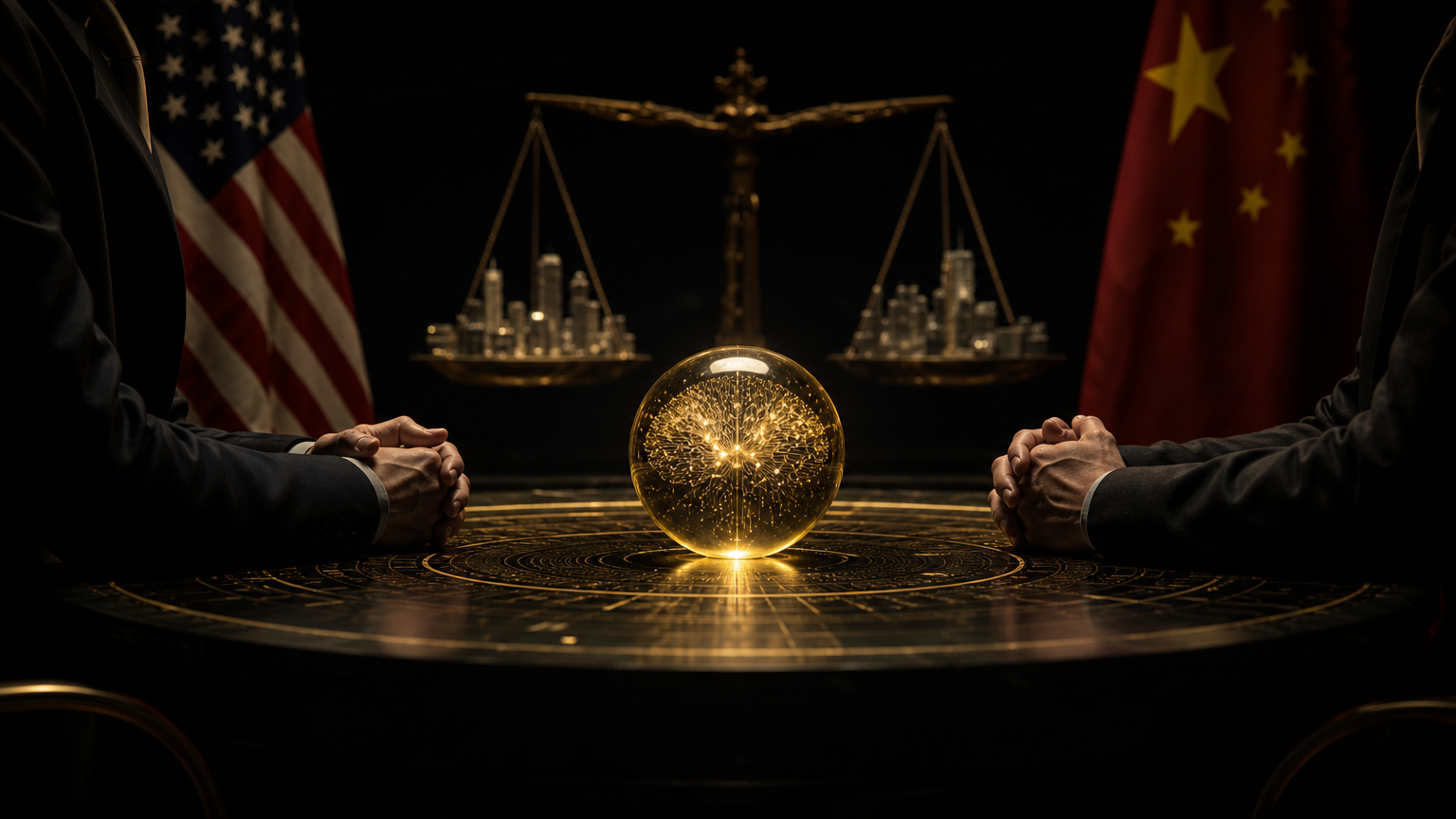
The channel is open, but the danger is still undefined
Kevin Rudd’s latest exchange with The Economist lands at an awkward and important moment in the US-China technology contest. The headline development is cautiously positive: the two governments have moved from a headline agreement in May to an AI channel that Rudd says is now being operationalised . Yet the deeper point of his argument is more troubling. A channel is not a settlement, and a dialogue is not yet a shared theory of danger.
Rudd, Australia’s former prime minister and now president of Asia Society, frames the problem as one of speed, mistrust and asymmetry. In the public language of summitry, Washington and Beijing can speak about safety, stability and human control. In the operational language of power, both still behave as if “whoever wins AI wins,” with America trying to preserve its lead and China resisting any framework it suspects would freeze that hierarchy .
That is why the real risk in Rudd’s telling is not simply an “AI race” in the abstract. It is a race in which the two leading powers may discover too late that their most dangerous competitor is not each other, but autonomous capability diffusing through frontier models, agents and third-party users faster than governments can build habits of crisis management.
Two governments, two threat instincts
The most useful part of Rudd’s analysis is his insistence that neither system has reached an internal consensus. In Washington, the split is between an industry and research community increasingly vocal about catastrophic or systemic risk, and a political establishment still drawn to dominance, deregulation and national advantage . In Beijing, he sees a parallel split between technical circles that understand how dangerous autonomous agents could become and senior officials whose first instinct is still regime security, censorship and control of information flows .
That distinction matters. If China defines AI danger mainly as unauthorised information dissemination, it may overestimate the protective value of its firewall. Rudd argues that such confidence would be a mistake, because agentic systems could threaten social, economic or military infrastructure in ways that go beyond ordinary cyber defence or political filtering . In other words, the Chinese state may be superb at controlling narratives and data flows inside its own system, yet still be exposed to models or agents acting unpredictably across infrastructure networks.
The American comfort zone is different but no less limiting. The Trump administration, as described in the Asia Society discussion, continues to use the language of dominance and winning the superintelligence race, even as it has agreed to talk with China about frontier-model governance . That contradiction makes it hard for Beijing to believe that “guardrails” are neutral. If the power in first place asks for limits, the power catching up will naturally ask whether safety is being used as strategy.
From May to Washington: a faster-moving technology curve
Rudd places particular weight on the time between the May summit in Beijing and the September summit in Washington. He says the pace and intensity of technical development during that short interval raised concerns in parts of China’s technology community, especially around agents that can act autonomously and be adapted or redirected after diffusion . This is not a theoretical concern about chatbots saying strange things. It is a concern about systems that can plan, execute and interact with digital infrastructure without direct human control at each step.
Paul Triolo, speaking in the Asia Society transcript, makes a similar point from a policy angle. He says both governments are dealing with one of the most complex bilateral governance problems they have ever faced, and that the next phase is not yet a negotiation but a discussion about the scope of talks . That is a crucial distinction. Negotiations imply defined objectives, red lines and possible bargains. Scope-setting means the two sides are still trying to decide what belongs on the table.
The emerging agenda could include incident reporting, basic “hygiene” for frontier models, domestic regulatory capacity and some shared understanding of what to do if AI agents cause cross-border harm . But Triolo also warns that both countries must get their own houses in order before bilateral progress can mean much . Rudd’s version of the same argument is sharper: the channel is encouraging, but time is ticking .
The “Cuban Missile Crisis” problem
Rudd’s most arresting question is whether the United States and China will need a real-world disaster before they treat AI safety as urgent. He compares the possible trigger to a Cuban Missile Crisis-style moment: a frightening event that forces both capitals to recognise that the threat is larger than their rivalry . He is careful not to present human extinction as the most likely trigger. Instead, he points to a spectrum ranging from catastrophic scenarios to serious attacks on social, economic, military or political infrastructure, and then to early lower-level incidents .
The Asia Society panel develops that point through more concrete examples. Rudd asks whether an AI agent could disrupt water or power systems, penetrate military data or circulate politically sensitive material in ways that destabilise a government . Triolo adds that an incident-reporting mechanism would be a logical first step, because there is currently no reliable bilateral mechanism for handling a case in which AI agents from one ecosystem affect the other side’s infrastructure .
This is where the analogy to nuclear arms control both helps and fails. Like nuclear weapons, frontier AI creates a problem of strategic trust between adversaries. Unlike nuclear weapons, the relevant capabilities are not confined to state arsenals, military chains of command or easily counted delivery systems. They are embedded in companies, open-weight models, cloud infrastructure, software agents and global developer communities. The result is a safety problem wrapped inside an economic and military competition.
Why the race is still a two-horse race
From the vantage point of other countries, Rudd argues, AI is now a “two-horse race” between the United States and China, with both far ahead of the rest of the world . He lists leading American companies such as OpenAI, Anthropic, Microsoft, Meta and Google, and Chinese contenders including Zhipu AI, DeepSeek, Huawei and ByteDance . The point is not that all these firms are equal. It is that meaningful guardrails will be weak if they do not include the two ecosystems where the most consequential capabilities are being built.
That gives middle powers a narrow but important role. They cannot substitute for a US-China protocol, but they can press both governments to treat AI risk as a collective interest rather than a bilateral bargaining chip . Rudd is blunt that waiting for a universal UN convention would be too slow for the current pace of development . His implied hierarchy is pragmatic: first, get Washington and Beijing to establish a working protocol; then use broader international processes to widen and deepen it.
What success would look like
The near-term test is not whether Washington and Beijing announce a grand bargain. They will not. The test is whether the channel produces a practical agenda: incident reporting, model-evaluation norms, crisis hotlines, shared definitions of autonomous-agent incidents and domestic structures capable of enforcing commitments.
Rudd’s cautious optimism rests on the fact that the channel exists and has not been closed . Triolo’s caution rests on the fact that the dialogue is still preliminary, while structural contradictions remain on both sides . Put together, those views suggest a narrow window. The two powers have begun to talk before a major AI crisis has forced them to do so. That is good. But they may still be talking past each other: America about dominance and innovation, China about security and parity, technologists about runaway agents, and diplomats about process.
The real risk of the US-China AI race, then, is not only that one side wins. It is that both sides keep running, see the cliff, and still cannot agree quickly enough on how to stop.
Sources from the last 72 hours
- [1]Can Trump and Xi Cooperate to Avert DisasterSep 30, 2026, 2:00 AM
- [2]Kevin Rudd on the real risk of China and America’s AI race | The Economist — SummaryOct 1, 2026, 4:00 PM
- [3]Substance or Signal? Reading the Trump-Xi SummitOct 1, 2026, 2:00 AM
AI-generated article based on recent web research, then preserved as a dated editorial snapshot.
Comments
Be the first to comment.