
Daily Podcast full article
South Korea chips hit $60.3B
South Korea’s September trade data turned the AI hardware boom into a national export headline: shipments topped $120 billion for the first time, while semiconductors alone reached a record $60.3 billion. The same week, Samsung pushed the discussion from memory into interposers and thermal engineering, TSMC moved to add more advanced-packaging capacity, and a Chinese state-backed financing trail for restricted Nvidia Blackwell chips underlined how strategic — and contested — AI compute has become.
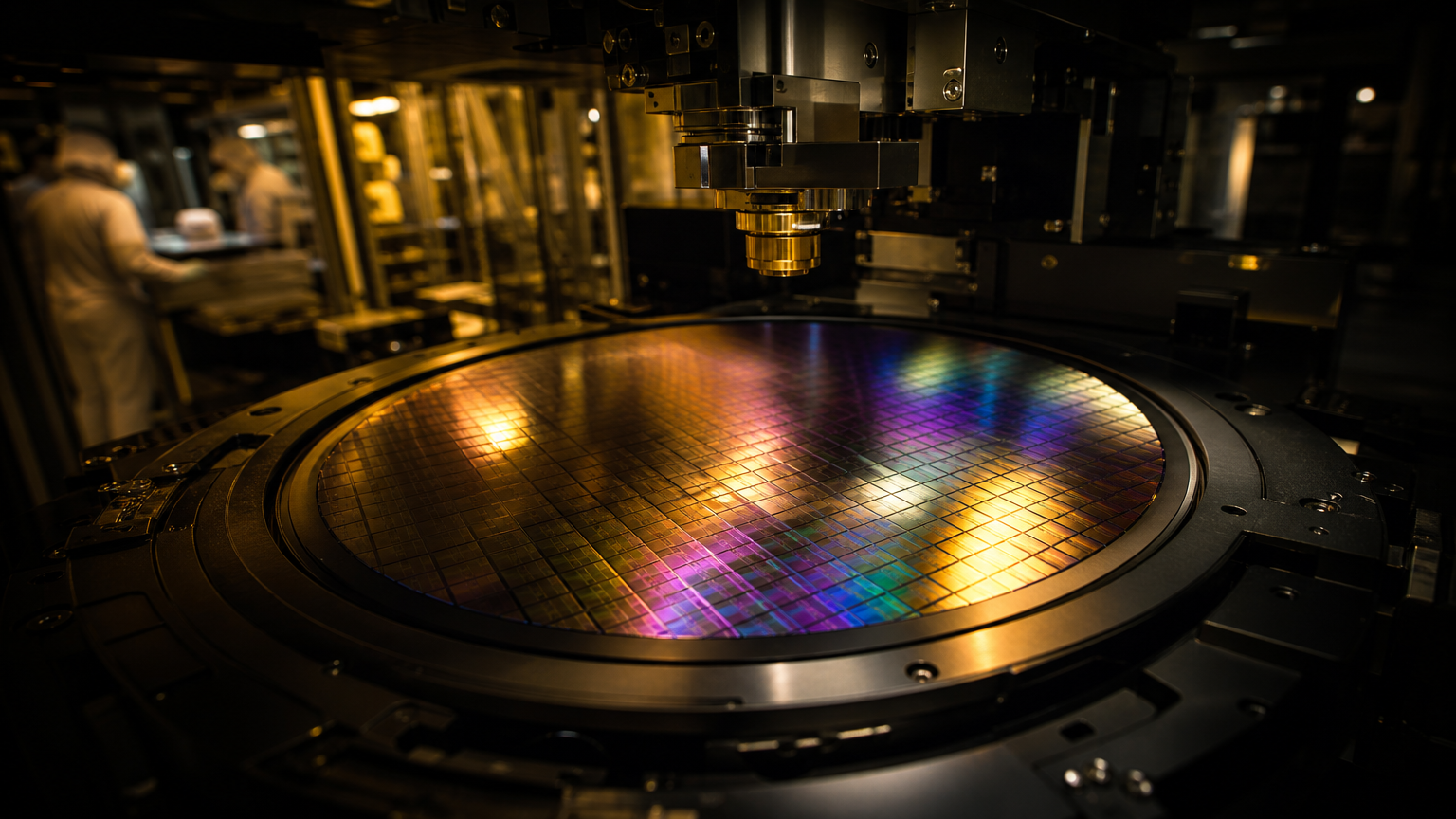
A record month with one unmistakable engine
South Korea’s export machine just printed a number that would have looked implausible in a normal electronics cycle. September exports reached $120.94 billion, up 83.5% from a year earlier, crossing the $120 billion monthly mark for the first time, according to reporting on the Ministry of Trade, Industry and Energy’s preliminary trade data . Imports rose 26.0% to $71.09 billion, leaving a record $49.85 billion trade surplus .
The more important figure sits inside the headline. Semiconductor exports surged 262.8% year on year to $60.3 billion, also a record and the first time the category has cleared $60 billion in a single month . In plain terms, chips supplied just under half of South Korea’s total September exports, making the country’s trade performance a direct proxy for the AI infrastructure cycle.
The numbers also show that this was not only a statistical rebound. Daily average exports reached $5.63 billion despite fewer working days because of the Chuseok holiday period, and cumulative exports from January through September reached $814.5 billion . That puts the government’s symbolic $1 trillion annual export target within view, but it also makes the economy more visibly dependent on a sector famous for violent upswings and painful corrections.
Memory pricing is doing the heavy lifting
The September result was driven by the part of the chip market most exposed to AI servers: memory. Memory semiconductor exports rose 358.6% to $54.07 billion, while system semiconductor exports rose 28.8% to $5.54 billion . That distinction matters. South Korea’s strength is not only in “chips” as an abstract category; it is especially in DRAM, NAND, high-bandwidth memory and storage products that feed large AI data centers.
Pricing helped. Seoul Economic Daily reported that the fixed price of 16-gigabit DDR5 rose to $48 in September from $37.5 in May, while 128-gigabit NAND flash climbed to $30.6 from $26.5 over the same period . When volume and price move together, exporters get operating leverage. That is exactly what the September data appears to capture.
The AI connection appears again in computers and storage. Computer exports jumped 435.3% year on year to a record $7 billion, with solid-state drive exports rising 532% to $6.77 billion . That makes the export boom broader than wafers alone: AI server demand is pulling on memory, enterprise SSDs, advanced packaging, power delivery and the systems needed to turn accelerators into usable compute.
Still, the breadth has limits. Exports excluding semiconductors rose 23%, but several traditional categories were weaker: automobiles, auto parts, displays and home appliances fell in September . Asia Business Daily also noted that car exports declined 5.5% year on year, while ship exports rose 29.9% and secondary batteries gained 14.0% . The result is a two-speed economy: AI-linked hardware is accelerating, while some older export pillars are merely stable or contracting.
The bottleneck is moving from chips to packages
The next phase of competition is not just about who can etch the smallest transistor. It is about who can assemble the largest, hottest and most memory-rich AI accelerators at acceptable yield. That is where interposers enter the story.
Samsung Electronics is preparing for volume production of seventh-generation HBM4E next year and is putting thermal management at the center of that plan, according to TechNewsReel . The report says Samsung has shipped 12-high HBM4E samples and is using a dual-track thermal strategy built around Hybrid Copper Bonding and Heat Path Block technology . Hybrid Copper Bonding is described as reducing thermal resistance by about 20%, while also supporting higher layer counts of 16 or more .
That focus reflects a structural change in AI semiconductors. In 2.5D packaging, compute chiplets and high-bandwidth memory are placed on an interposer, which acts as the dense connection fabric between logic and memory. As accelerators grow, the interposer becomes larger, the current density rises, and heat stops being a back-end engineering detail. It becomes a shipping constraint.
Samsung’s reported move to extend cooling from the chip level to the package and server-system level is therefore strategically important . HBM is no longer simply a memory product sold into someone else’s board. It is becoming part of a co-designed thermal, packaging and power-delivery stack. For South Korea, that is good news if Samsung and SK Hynix can defend leadership in high-bandwidth memory. It is also a warning: value is migrating toward integrated packaging and system-level reliability, not memory dies alone.
TSMC is expanding where AI chips get assembled
TSMC is pursuing the same bottleneck from the foundry and packaging side. A current industry roundup reported that TSMC plans to add five more advanced-packaging plants at Chiayi Science Park, which would bring the site’s total to 10 packaging plants and make it a major CoWoS hub for AI demand . The same report said demand from Nvidia, AMD and Apple has kept CoWoS capacity tight, with orders reportedly rising 10% to 20% .
This matters directly to South Korea even though TSMC is Taiwanese. The global AI accelerator supply chain is interlocked: Nvidia and other designers need leading-edge logic, advanced packaging, HBM stacks and substrate capacity. TSMC’s CoWoS packages integrate processors with high-bandwidth memory. Samsung and SK Hynix supply the memory. If packaging is constrained, HBM demand can be delayed; if HBM is constrained, packaging lines cannot be fully used.
In that sense, South Korea’s $60.3 billion chip month is not only an export record. It is a signal that the industry is operating near the edge of available capacity across several linked layers: memory, foundry wafers, interposers, substrates, cooling and server integration.
The export-control leak in the AI compute stack
The same AI demand that lifted South Korea’s exports is also intensifying geopolitical enforcement problems. The Edge Malaysia, citing Bloomberg, reported that Chinese state-backed Semi-Tech Leasing Group financed server purchases by Glory View Technology, including a contract for 32 Asustek servers equipped with Nvidia B300 Blackwell chips . The B300 is part of Nvidia’s Blackwell family, and U.S. rules prohibit sales to China without an explicit license .
The reported transaction is small compared with hyperscale AI infrastructure spending, but its significance is political and procedural. Semi-Tech Leasing is described as owned by local government entities, and the documents were filed with Beijing regulators . That shifts the export-control problem away from a simple model of hidden buyers and smugglers. It suggests that financing companies, leasing structures, server integrators and public filings may all become part of the enforcement perimeter.
For Nvidia, Asus and other suppliers, the risk is no longer limited to the direct customer. It extends to who finances the servers, who assembles them, how model numbers are recorded, and whether restricted chips can be identified after being embedded inside systems. The broader message for Washington is uncomfortable: export controls can restrict official sales channels, but frontier AI hardware is valuable enough that workarounds will keep appearing.
A boom with concentration risk
South Korea’s September data is a triumph for its semiconductor champions, but it is also a concentration story. Semiconductors accounted for nearly half of exports in the month . Exports to China, the United States and ASEAN all rose sharply, with chip shipments leading the gains . That makes national growth more sensitive to AI capex cycles, memory prices, U.S.-China restrictions and the capacity decisions of companies outside Korea.
The upside is clear. Record demand strengthens pricing, supports investment and gives Korean suppliers a stronger case for spending on HBM, advanced packaging and thermal technologies. The risk is just as clear. If hyperscaler spending slows, if memory customers digest inventory, if export rules tighten, or if packaging capacity shifts bargaining power elsewhere, the same exposure that lifted September exports could magnify the downturn.
For now, though, the direction is unmistakable. AI has turned semiconductors from an important South Korean export category into the central growth engine of a record month. The next contest will be fought not only in DRAM fabs, but across interposers, CoWoS lines, liquid cooling, export-control paperwork and every bottleneck between a memory stack and a working AI server.
Sources from the last 72 hours
- [1]Korea's September Exports Hit Record $120.9 Billion on Chip BoomOct 1, 2026, 2:07 AM
- [2]September Exports Reach $120.9 Billion... First-Ever Surpass of $120 Billion Mark (Update)Oct 1, 2026, 2:39 AM
- [3]Samsung Combats AI Heat Bottlenecks with HBM4E and Advanced BondingOct 2, 2026, 2:00 AM
- [4]Daily News Coverage: OpenAI's Cheaper GPT-6.1 Sol, Nvidia Chips on SpaceX. TSMC's ExpansionOct 1, 2026, 2:00 AM
- [5]Chinese state-backed firm discloses deal for Nvidia Blackwell chipsOct 2, 2026, 8:17 AM
AI-generated article based on recent web research, then preserved as a dated editorial snapshot.
Comments
Be the first to comment.