
Daily Podcast full article
Paramount-Warner Bros merger reshapes DC’s future
The Paramount-Warner Bros combination has turned DC Studios from a reboot project into a test case for Hollywood consolidation: James Gunn and Peter Safran appear set to keep steering the DC Universe, but they will do so inside a larger Skydance-run empire where franchise value, streaming strategy and studio hierarchy now matter as much as capes and continuity.
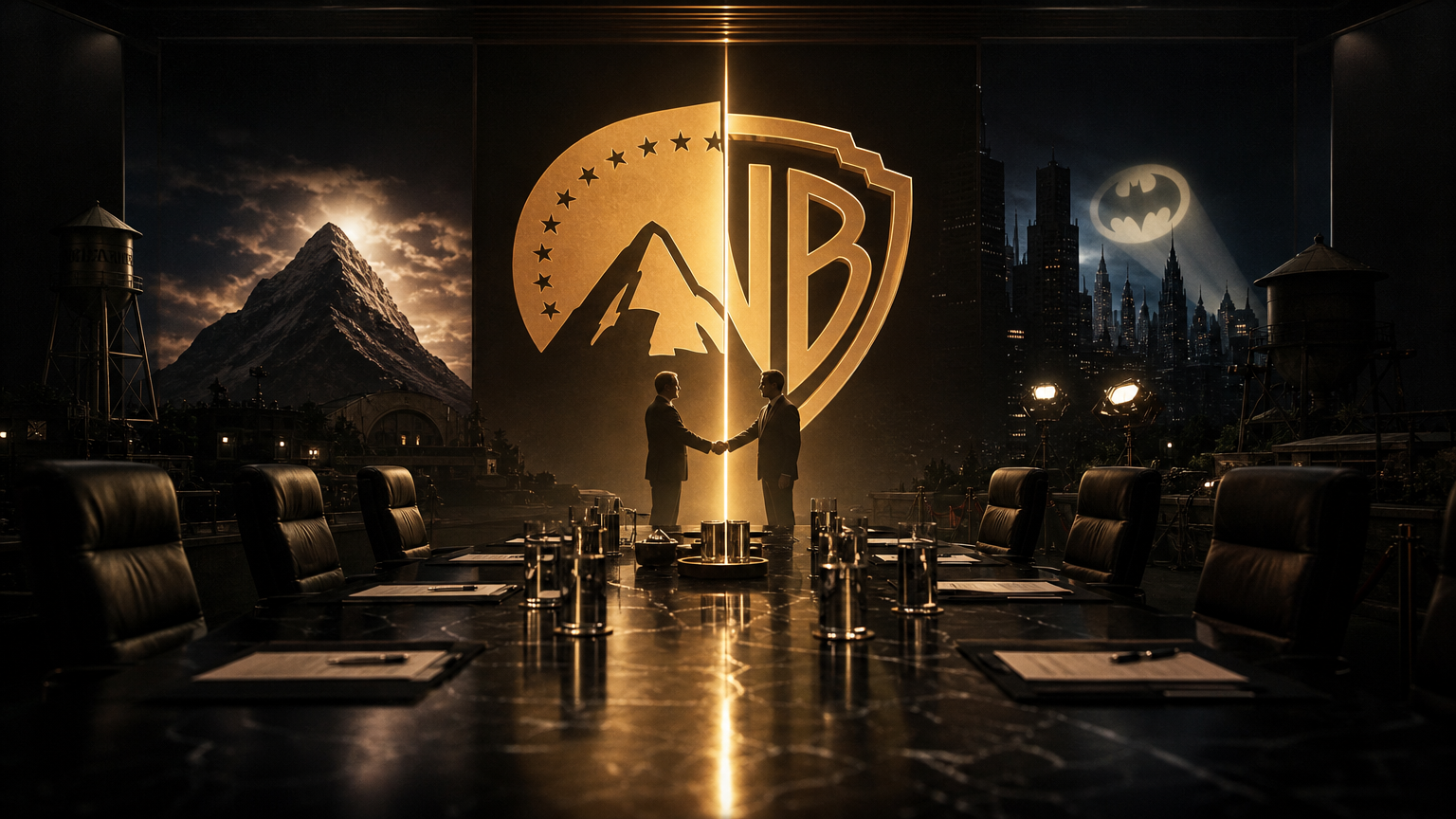
A superhero strategy meets a new corporate map
The working headline is simple because the stakes are: the Paramount-Warner Bros merger reshapes DC. The deal’s most immediate DC consequence is not a new Batman casting, a surprise Superman sequel, or a sudden continuity reset. It is organizational. Fresh reporting says James Gunn and Peter Safran are staying at DC Studios for now, even as the parent structure around Warner Bros. is being redrawn under David Ellison’s Skydance-led company .
That matters because DC’s modern problem has never been only creative. It has also been administrative. The brand has cycled through regimes, release strategies, tones and universe plans often enough that “reboot” became a business model rather than an event. Gunn and Safran were hired to impose a studio-hub structure on DC: one leadership team, one long-term architecture, and one pipeline spanning film, television, animation and comics. The merger now tests whether that model survives contact with a bigger balance sheet and a new chain of command .
Officially, the companies said the merger was expected to close on October 6, 2026, subject to customary closing conditions, after Paramount Skydance and Warner Bros. Discovery announced the anticipated closing date on September 30 . A federal judge’s approval of a settlement with 12 states removed a major late obstacle, with the companies then expecting to complete the transaction on that same October 6 timetable . In practice, Hollywood has already begun behaving as if the handover has arrived.
Gunn and Safran get continuity, not a blank check
The clearest DC signal is continuity. The Hollywood Reporter’s account says Gunn and Safran met with Ellison in person, that the meeting was positive, and that the pair were asked to stay and “keep doing what you’re doing” . That phrase is important because it sounds less like a coronation than a controlled extension. It suggests confidence in DC Studios’ current direction, but not immunity from the wider restructuring now hitting Warner Bros.
The same report stresses that key details remain unsettled, including how DC will fit into Skydance’s formal organization and whether Gunn and Safran report directly to Ellison or through Paramount film chiefs Josh Greenstein and Dana Goldberg . That ambiguity is the whole story in miniature. DC may keep its creative pilots, but the tower they fly from is moving.
For audiences, this likely means the current DCU slate continues rather than being ripped up again. That is no small outcome. A superhero universe depends on compounding trust: each film or series must teach viewers that the next installment matters. Another top-level reset would risk turning DC’s new continuity into another abandoned timeline. Keeping Gunn and Safran gives the reboot a chance to look like a plan rather than another expensive experiment.
Warner Bros. film leadership shows the pressure around DC
The contrast with the broader Warner Bros. film operation is sharp. Puck reported that Michael De Luca and Pamela Abdy, who have run the Warner Bros. film division, would not be part of the ride as the 103-year-old studio merges with Paramount . The same report placed Safran and Gunn among the Warner-side figures present in the anxious transition atmosphere around outgoing Warner Bros. Discovery leadership .
That difference is revealing. DC is not being treated as just another production label to be folded quietly into a combined studio bureaucracy. It is being treated as a strategic asset that needs continuity, even while other leadership posts change. The likely logic is straightforward: DC is both a film label and an intellectual-property engine. Its characters feed theatrical releases, streaming series, animation, games, consumer products and publishing. For a newly enlarged media company trying to justify integration, that kind of asset is too valuable to destabilize casually.
Still, stability should not be confused with creative independence without limits. If Greenstein and Goldberg gain authority over both Paramount and Warner Bros. film operations, DC’s budgets, dates and marketing priorities could become part of a more centralized portfolio conversation . Under that model, Superman, Batman, Wonder Woman and Green Lantern are not only mythic characters. They are capital-allocation decisions.
Why Skydance branding changes the mood
The new parent identity also matters. David Ellison said the combined Paramount-Warner Bros. company would be called Skydance, while arguing that the name would give the enlarged company its own identity without diminishing the Paramount and Warner Bros. brands . His announcement positioned the combined group as a “creative-first” home built to preserve iconic studio legacies while giving them a stronger engine .
That branding choice may sound cosmetic, but in Hollywood cosmetics are strategy. Calling the parent Skydance avoids choosing Paramount over Warner Bros. or Warner Bros. over Paramount. It also signals that Ellison’s company is not merely absorbing a library; it is trying to define a new operating system. DC sits inside that symbolic architecture as one of the clearest franchise pillars.
The AP noted that the transaction would put HBO Max, Warner’s library, Harry Potter, CNN, CBS, Paramount+, Paramount film franchises and other assets under the same roof . That scope is why DC’s fate matters beyond superhero fandom. The company is not just deciding whether Gunn’s Superman plans continue. It is deciding how a premium comic-book universe functions inside a consolidated entertainment-technology platform.
Streaming is the hidden battlefield
The most consequential DC changes may not appear first in theaters. They may appear in windows, bundles, international rights, app strategy and data. NewscastStudio reported that no immediate plan had been announced to combine Paramount+ and HBO Max, while noting that bundling could be an option and that the company was expected to pursue major cost savings, including possible technology consolidation across streaming platforms .
That is where DC becomes especially useful. Superhero brands are not only box-office bets; they are retention tools. A Lanterns season, a Batman spinoff, a Superman sequel documentary, animated DC programming and comics-driven specials can keep subscribers moving through an ecosystem. If Paramount+ and HBO Max remain separate but bundled, DC can help make the bundle feel essential. If technology or user accounts are eventually consolidated, DC can become one of the marquee lanes that guides subscribers through the new platform experience.
This is why the “corporate org chart” joke lands. The multiverse now has an administrative layer. A character’s future depends not only on canon, but on reporting lines, platform economics, debt management, theatrical calendars and whether a brand is valuable enough to protect during integration.
The real decision: patience or panic
For DC, the merger creates both danger and discipline. The danger is that every underperformance becomes evidence in a boardroom argument for cuts, delays or another reset. The discipline is that a larger Skydance-led company may demand clearer accountability: fewer disconnected projects, stronger franchise planning, and less tolerance for expensive ambiguity.
Gunn and Safran appear to have won the first round by remaining in place . But their real test begins after the corporate dust settles. They must prove that DC can be coherent without becoming rigid, commercially powerful without becoming creatively generic, and integrated into Skydance without losing the strange mythic charge that makes DC different from every other franchise library.
Batman may need admin permissions now. But the larger question is whether anyone at the new company understands that Gotham, Metropolis and Themyscira are not just assets to be managed. They are worlds that need stewardship. The merger gives DC a bigger machine. Gunn and Safran’s job is to make sure the machine does not flatten the mythology it was built to monetize.
Sources from the last 72 hours
- [1]Paramount Skydance and Warner Bros. Discovery Announce Anticipated Closing Date of Paramount MergerOct 1, 2026, 1:00 AM
- [2]James Gunn, Peter Safran to Stay at DC Studios as Brand Takes Key Position at SkydanceOct 2, 2026, 7:58 PM
- [3]The Mike & Pam Era at Warner Bros. Is EndingOct 2, 2026, 2:00 AM
- [4]Combined Paramount-Warner Bros. to Be Called Skydance, David Ellison RevealsOct 2, 2026, 3:12 PM
- [5]Judge approves Paramount’s settlement with states over Warner buyout, allowing merger to soon closeSep 30, 2026, 10:48 PM
AI-generated article based on recent web research, then preserved as a dated editorial snapshot.
Comments
Be the first to comment.