
Daily Podcast full article
Starship completes first orbital flight
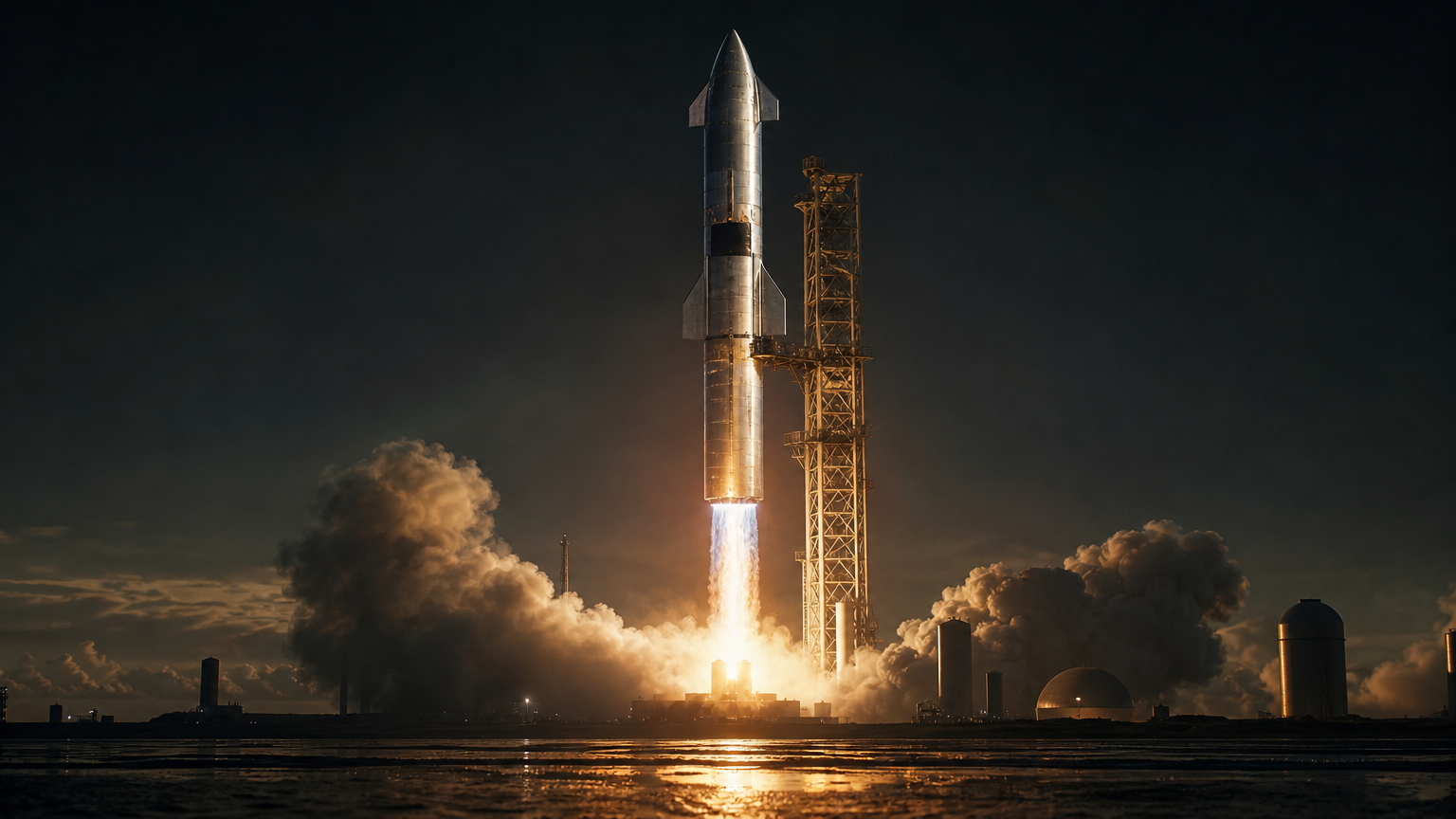
SpaceX’s Starship has crossed the line from experimental giant to orbital transportation system: Flight 14 reached orbit, deployed 26 Starlink V3 satellites and returned early after an engine issue, giving the company a powerful proof point while leaving reliability, reuse and economics as the next tests.
A prototype becomes orbital infrastructure
SpaceX’s Starship has completed its first orbital flight, a milestone that changes the program’s status from ambitious development project to the early version of a working heavy-lift transport system. On Flight 14, launched from Starbase, Texas, the vehicle reached orbit for the first time and deployed 26 Starlink V3 satellites, making the mission not only a flight test but also Starship’s first operational payload delivery to orbit . The achievement matters because Starship is designed as a fully reusable system with payload capacity far above current mainstream launch vehicles, and SpaceX has positioned it as the backbone for larger satellite networks, future crewed transportation and eventual Mars logistics .
The flight was not flawless. Fresh analysis published after the mission describes one upper-stage Raptor engine shutting down early, after which SpaceX still completed the orbital insertion plan with the engines available and later brought the ship back earlier than planned . That combination is the essence of the moment: Starship has earned its orbital badge, but the next phase is no longer about proving that the rocket can touch orbit once. It is about proving that it can do so repeatedly, safely, affordably and on a schedule customers can trust.
What happened on Flight 14
The mission lifted off on September 28, 2026, at 8:48 a.m. Eastern time, and SpaceX mission control cleared Starship to relight an engine and accelerate to orbital speed about 25 minutes after launch . The flight was the fourteenth integrated Starship test, and current reporting identifies it as the first in which the system reached Earth orbit after 13 earlier Starship flights that remained suborbital .
The payload was also important. Starship deployed 26 Starlink V3 satellites, described by analysts and space-industry trackers as the first real Starlink V3 deployment and the first operational payload Starship carried to orbit . According to NewSpace RFP’s post-flight report, the satellites were released within roughly half an hour after the burn that placed the ship in orbit, and the mission established a direct bridge between Starship’s test campaign and SpaceX’s revenue-generating Starlink network .
The original plan was longer. The ship was expected to remain up for about ten hours and six orbits before ending in the Pacific west of Chile, but it instead came down after about three hours and eight minutes north of Hawaii . That early return did not erase the core achievement, because the orbit and payload-deployment objectives had already been met, but it made clear that the system is still moving through engineering validation rather than entering mature commercial service .
Why the orbital milestone matters
Starship’s first orbital flight matters because mass is the currency of space infrastructure. SpaceX and outside analysts describe Starship as a vehicle capable of lifting more than 100 metric tons to low Earth orbit, with some industry commentary putting its intended low-Earth-orbit capacity in the 100- to 150-tonne range . If SpaceX can combine that capacity with rapid reuse, the cost per kilogram could fall sharply, opening missions that are too expensive or physically constrained on smaller rockets .
That scale is why the milestone has consequences beyond one company. Starlink is the immediate customer, because larger satellites and more satellites per launch could improve network capacity and deployment economics . Commercial satellite operators are also watching because a reliable Starship would raise the benchmark for payload volume, launch pricing and schedule flexibility. SpaceX’s rivals can still compete on specialization, responsive launch, government relationships and risk tolerance, but the competitive reference point has shifted: the market has now seen Starship reach orbit with working satellites aboard .
The milestone also strengthens SpaceX’s longer strategic narrative. The same architecture is central to the company’s ambitions for large in-space infrastructure, lunar operations and Mars transportation . One orbital flight does not make those plans routine, but it removes a major technical question that had hung over the program: whether the full system could pass from high-energy test flights to orbital payload delivery.
What investors saw
For investors, Flight 14 is a technical proof point for a capital-intensive strategy. The Motley Fool’s October 3 analysis framed the mission as evidence that SpaceX now has an orbital-class Starship system and argued that the vehicle is being prepared to succeed Falcon 9 and Dragon in major parts of the company’s future architecture . That matters because SpaceX’s valuation case rests not just on launch revenue but on whether launch capacity can support Starlink growth, possible orbital infrastructure businesses and future government or commercial missions.
Market reaction was more nuanced than a simple victory lap. FinanceFeeds reported that SpaceX closed at $158.96 on Friday, October 2, up 7.35 percent, after a week that began with Starship’s first orbital flight and later included three launches in less than 13 hours . The same report noted that analyst price targets leaned heavily on AI compute and other revenue narratives rather than rockets alone, a useful reminder that a launch milestone can strengthen confidence without answering every financial question .
The investor lesson is therefore balanced. Starship reaching orbit reduces engineering uncertainty, but it does not automatically prove margin, cadence or free cash flow. ACIS Research made that distinction clearly, describing Flight 14 as a successful crossing of the “orbital-payload gate” while warning that repeat reliability, reuse, turnaround and unit economics remain unresolved . In other words, the milestone improves the thesis; it does not complete it.
The caveats: engines, reuse and repeatability
The main caution is reliability. Reports after the flight described engine issues on both the booster and the ship, including the upper-stage engine shutdown that shortened the mission profile . The vehicle still achieved the orbital and deployment objectives, which is encouraging, but operational transportation infrastructure requires boring repetition, not heroic recovery from anomalies.
Reuse is the second caveat. Starship’s business case depends on using both the Super Heavy booster and the ship again and again. Flight 14 advanced the program by reaching orbit and delivering payload, but it did not yet prove high-frequency recovery, refurbishment and relaunch at commercial tempo . Until SpaceX demonstrates that loop repeatedly, Starship remains a breakthrough system with an unfinished economic proof.
The third caveat is schedule credibility for human spaceflight. NASA’s lunar lander architecture uses a Starship variant, and NewSpace RFP noted that NASA aims to include one or both contracted landers in an Earth-orbit mission in 2027 ahead of a planned 2028 landing . First orbit helps that road map, but crewed missions demand a higher evidence standard than satellite deployment. Engine-out tolerance is useful; root-cause closure is essential.
A new benchmark for the launch market
Even with those caveats, Flight 14 changes the market conversation. Starship has now moved from “if it reaches orbit” to “how often, how cheaply and how reliably can it reach orbit.” That is a different question, and a more threatening one for competitors. The payload scale alone could pressure legacy pricing models if SpaceX converts the demonstration into routine service .
The next proof points are clear: another orbital flight, clean engine performance, controlled recovery, faster turnaround, larger payloads and visible contribution to Starlink economics. If SpaceX can stack those results, Starship becomes more than the world’s most powerful rocket. It becomes transportation infrastructure for a larger space economy.
For now, the story is neither hype nor completion. Starship completed its first orbital flight, deployed real satellites and gave SpaceX a stronger technical and financial argument. The rocket has finally unlocked orbit; the harder challenge is making orbit routine.
Sources from the last 72 hours
- [1]SpaceX Starship Is Orbital: Here's What It Means for InvestorsOct 3, 2026, 2:08 PM
- [2]SpaceX (SPCX) Stock at $159 After a 7% Friday: Bull $235, Bear $145Oct 3, 2026, 2:00 AM
- [3]What Starship's first orbit means for SpaceX's NASA Moon landerOct 1, 2026, 2:00 AM
- [4]Starship Crosses the Orbital Payload Threshold, but Repeat Reliability Remains UnprovenOct 1, 2026, 2:00 AM
- [5]Starship Flight 14 launches new era for space industryOct 1, 2026, 6:42 PM
AI-generated article based on recent web research, then preserved as a dated editorial snapshot.
Comments
Be the first to comment.