
Daily Podcast full article
Crew-13 sets US docking record
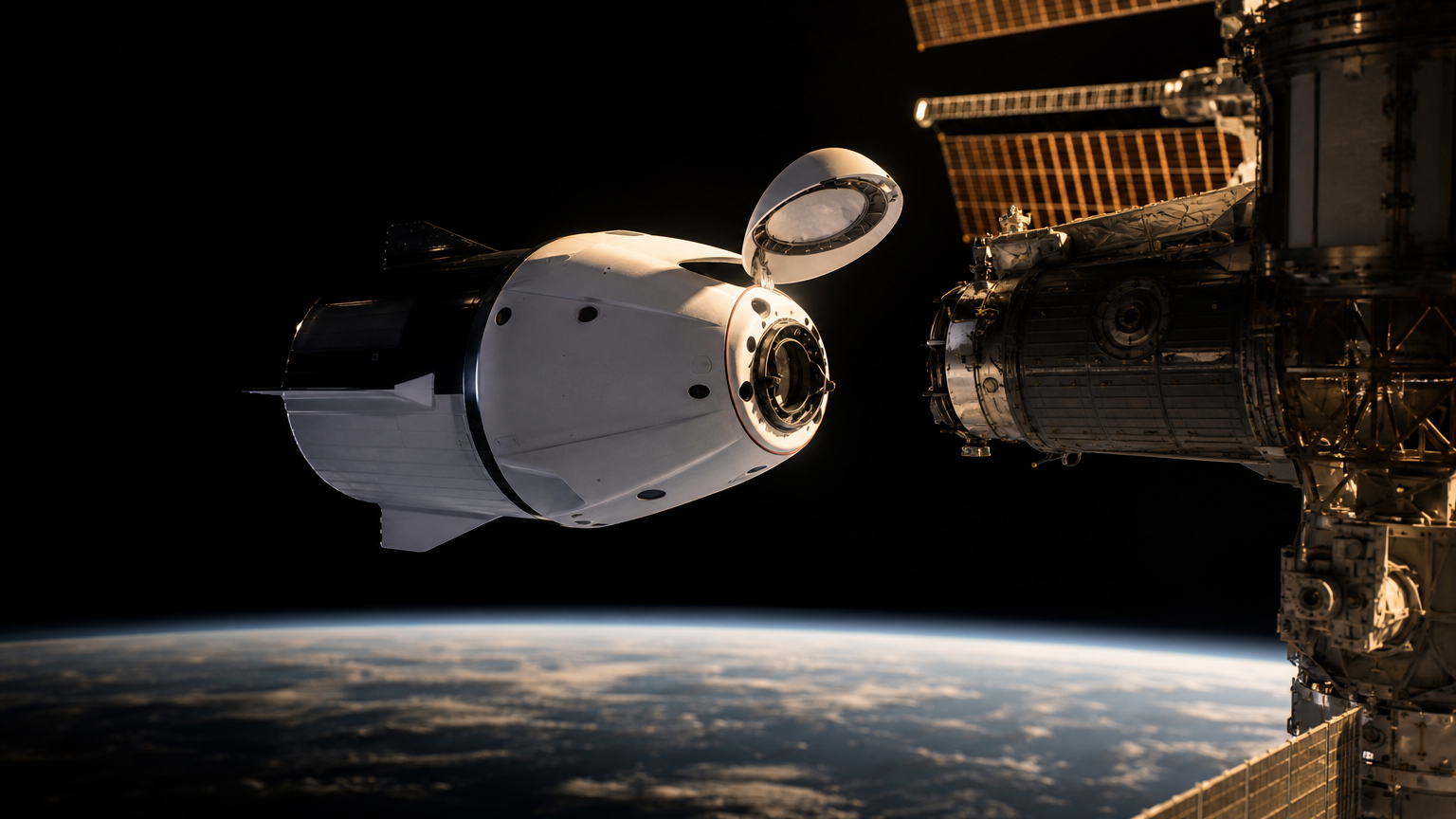
NASA and SpaceX’s Crew-13 turned a routine crew rotation into a timing milestone, reaching the International Space Station 7 hours and 55 minutes after launch and setting the fastest launch-to-docking mark for a U.S. spacecraft in ISS history [1].
A record measured in hours, not days
Crew-13’s headline number is simple: 7 hours and 55 minutes from launch to docking. NASA reported that the SpaceX Dragon carrying NASA astronauts Jessica Watkins and Luke Delaney, Canadian Space Agency astronaut Joshua Kutryk, and Roscosmos cosmonaut Sergey Teteryatnikov docked with the forward port of the station’s Harmony module at 7:05 p.m. EDT on Thursday, October 1, 2026 . That made the trip the fastest launch-to-docking by a U.S. spacecraft in the history of the International Space Station .
The flight began earlier that same day from Florida. Aero-News, summarizing the mission on Sunday, October 4, said Crew-13 lifted off at 11:10 a.m. EDT from Space Launch Complex 40 at Cape Canaveral Space Force Station aboard a Falcon 9, with the four-person international crew inside SpaceX’s Dragon spacecraft . The elapsed time between those two events is what gives the mission its place on the U.S. orbital “commute” leaderboard.
This was not a stunt flight. It was a crew-rotation mission, meaning the speed record came inside the normal machinery of International Space Station operations: launch, orbital insertion, automated rendezvous, docking, leak checks, hatch opening, safety briefings, and handover to the outgoing crew. That distinction matters. The more routine the fast profile looks, the more it says about the maturity of the system.
What actually happened after docking
Docking is not the same as arrival in the everyday sense. After Dragon attached to Harmony, the crews still had to confirm a safe seal, equalize pressure, open the hatches, and move the new arrivals into the station. NASA said Crew-13 entered the ISS after Dragon’s hatch opened at 9:19 p.m. EDT on October 1 . At that point, Watkins, Delaney, Kutryk, and Teteryatnikov formally joined Expedition 75 aboard the orbiting laboratory .
For a short handover period, the station became crowded by design. NASA’s October 2 update said the arrival of Crew-13 brought the number of people living aboard the ISS to 11 . That overlap is operationally useful: outgoing astronauts can brief incoming astronauts on experiments, station systems, emergency roles, vehicle configuration, and the many informal details that make life in orbit run smoothly.
NASA said the Crew-13 astronauts would spend their first days adjusting to weightlessness, familiarizing themselves with station systems, unpacking Dragon, transferring standard safety gear into the spacecraft, and reviewing emergency responsibilities . In other words, the record-setting sprint to the station was followed by deliberately methodical work. Speed got the crew to the front door; procedure took over from there.
Why the fast trip matters
The immediate benefit of a shorter launch-to-docking timeline is human. A crewed launch day is already long: suit-up, transport to the pad, ascent, orbital checks, rendezvous operations, docking, leak checks, hatch opening, and safety briefings. Reducing the time spent in the spacecraft before docking can lower fatigue and compress the period in which crew and controllers must manage a dense sequence of time-critical tasks.
The operational significance is broader. Crew-13 shows that NASA and SpaceX can align launch timing, Dragon automation, station phasing, and mission-control coordination tightly enough to produce an under-eight-hour rendezvous without making it the central purpose of the mission. Aero-News framed the event as another sign of NASA’s reliance on commercial spacecraft for human spaceflight and as a marker of a system that increasingly gets scientists to work rather than merely proving transportation is possible .
That is the point behind the record. Commercial crew transport is not just about reaching orbit; it is about doing so reliably, repeatedly, and with enough schedule confidence that science planning, crew handovers, and return operations can be arranged around it. A faster rendezvous profile is valuable only if it sits on top of safe launch, stable spacecraft performance, and disciplined station operations.
Not the world record, and not the only metric
Crew-13’s mark is a U.S. record, not the all-time fastest human trip to the ISS. Space.com’s live coverage noted that a Russian Soyuz crew reached the station in 3 hours and 3 minutes in 2020, demonstrating that more aggressive fast-track rendezvous profiles have existed for years . The comparison is useful because it keeps the Crew-13 achievement in scale: this was not the shortest ISS chase ever, but it was the fastest by an American spacecraft.
It also underlines a basic truth of orbital mechanics. A fast rendezvous is not mainly about raw rocket speed. It depends on where the ISS is when the spacecraft launches, the phasing of the orbit, the launch window, the allowed trajectory, vehicle readiness, and the risk posture mission managers are willing to accept. Space.com quoted SpaceX’s Julianna Scheiman as saying the station was in an especially favorable position and that the orbital mechanics worked out for an unusually short launch-to-docking time .
That is why reliability remains the decisive metric. A shorter commute is welcome, but no serious space program optimizes for speed ahead of safety. NASA’s post-arrival updates show the same hierarchy: once Crew-13 was aboard, attention shifted immediately to familiarization, safety gear, emergency roles, handover, and the return plan for Crew-12 .
What comes next on station
Crew-13’s arrival started the next phase of a carefully choreographed rotation. NASA said Crew-12 members would transfer responsibilities to their replacements on Sunday, October 4, and that station command would pass from NASA astronaut Jessica Meir to Roscosmos cosmonaut Pyotr Dubrov during a change-of-command and farewell ceremony . NASA and SpaceX then set Crew-12’s undocking for no earlier than 1:05 a.m. EDT on Wednesday, October 7, with splashdown targeted for October 8 if spacecraft readiness, recovery team readiness, weather, sea states, and other conditions cooperate .
That return planning is a reminder that the record is only one part of the mission. Crew-13 now begins a long-duration stay, while Crew-12 prepares to come home. NASA said the new crew’s research work includes investigations involving human tissues, plant growth, blood-flow issues in microgravity, and inflight medical diagnostics . Those experiments, not the stopwatch, are the reason the transportation system exists.
Still, the stopwatch matters. In an era when NASA increasingly buys routine astronaut transport from commercial providers, a 7-hour-and-55-minute docking shows how polished the choreography has become. Launch providers, spacecraft software, ground controllers, station teams, and international partners all had to line up. Crew-13 did not just arrive quickly; it arrived quickly inside a normal mission architecture. That is why this record is more than trivia. It is a sign that orbital commuting is becoming mature enough to have a speedrun leaderboard, even if safety remains the rulebook.
Sources from the last 72 hours
- [1]Dragon Docks Bringing SpaceX Crew-13 to StationOct 2, 2026, 1:13 AM
- [2]Crew-13 Members Enter Station, Join Expedition 75Oct 2, 2026, 4:01 AM
- [3]Station Crew Expands as NASA’s SpaceX Crew-12 Prepares to DepartOct 2, 2026, 8:14 PM
- [4]NASA SpaceX Crew-13 Reaches ISSOct 4, 2026, 6:00 AM
- [5]SpaceX Crew-13 NASA launch live updates: Crew Dragon astronauts arrive aboard ISSOct 2, 2026, 1:16 AM
- [6]NASA, SpaceX Set No Earlier Than Oct. 7 for Crew-12 DepartureOct 3, 2026, 9:19 PM
AI-generated article based on recent web research, then preserved as a dated editorial snapshot.
Comments
Be the first to comment.