
Daily Podcast full article
Quantum device reaches 90% visibility
A semiconductor quantum-dot experiment has pushed photon interference visibility to 90%, a stronger signal that successive photons can behave as near-identical carriers of quantum information. The advance, reported by researchers linked to Paderborn University, the University of Basel and Ruhr University Bochum, is still a laboratory result rather than a deployable network module, but it directly targets one of the stubborn timing problems in quantum photonics [1].
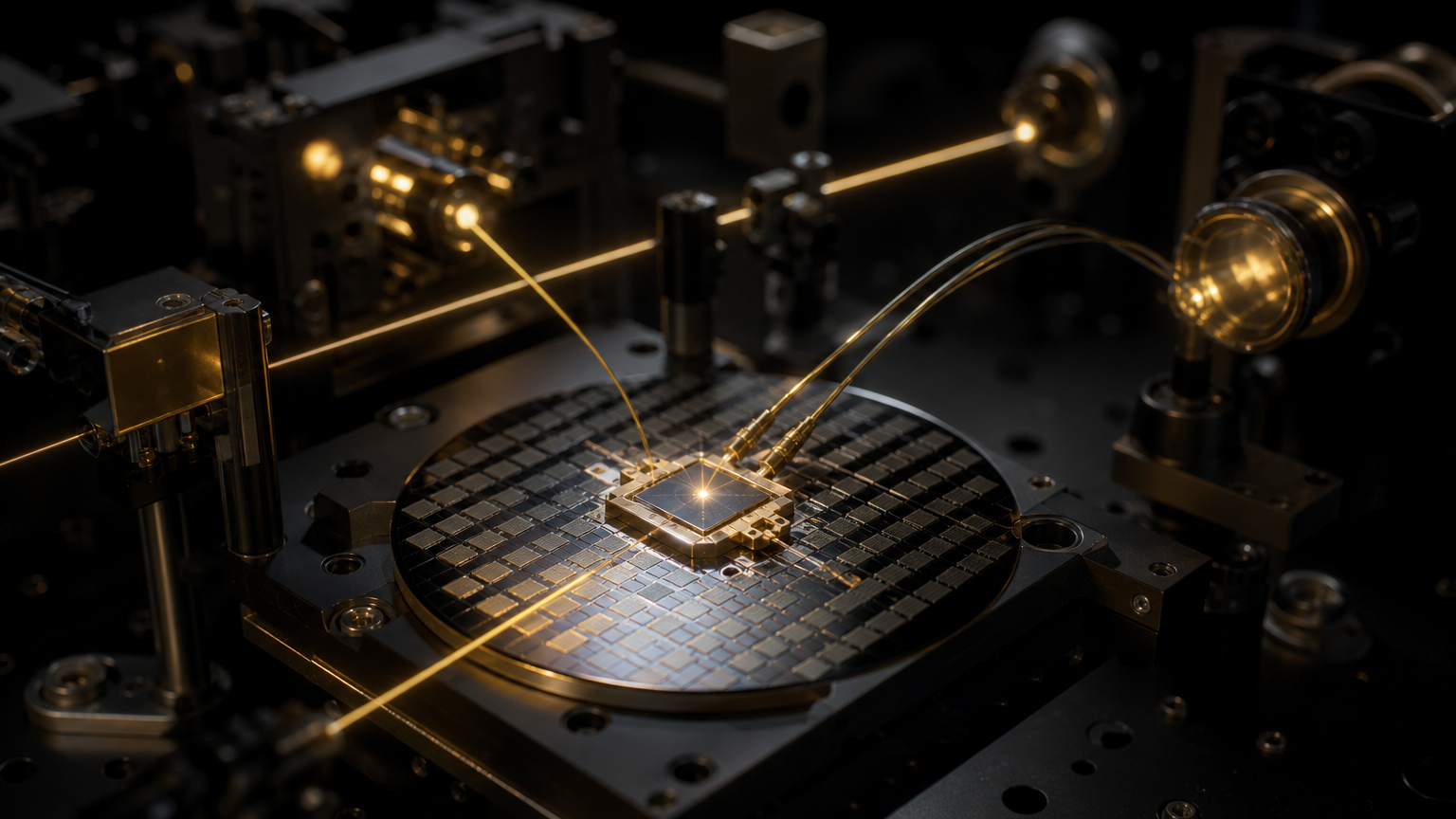
A small device, a large photonics problem
The working headline is the story: Quantum device reaches 90% visibility. The device is not a general-purpose quantum computer, nor a finished quantum internet node. It is a carefully engineered semiconductor quantum-dot system placed inside an optical cavity, designed to make emitted photons more alike and therefore more useful for interference-based quantum communication and computation .
That distinction matters. In photonic quantum technologies, photons carry information, but they are only useful for many protocols if separate photons are sufficiently indistinguishable. If two photons differ in timing, energy, polarization, or wave-packet shape, they do not interfere cleanly, and the resulting error rate rises. The latest reports describe an optical-cavity approach that raises the relevant quality measure from a typical 60% level to about 90% for the better-performing photon in the cascade .
The experiment was carried out by a collaboration involving Paderborn University, the University of Basel and Ruhr University Bochum, with the work reported in Physical Review Letters and amplified in recent science and quantum-technology coverage . The headline number is a raw two-photon interference visibility of 90%, with a stated uncertainty of two percentage points, for the biexciton-to-exciton photon; the second photon reached 80% visibility with a six-point uncertainty .
What “visibility” means here
Interference visibility is a practical way of asking whether two photons behave as though they are the same quantum object for the purpose of an interference experiment. Higher visibility means the photons overlap more cleanly in the relevant quantum degrees of freedom. In this story, the key measurement is tied to two-photon interference, often used to evaluate whether single-photon sources can support quantum networking or photonic computing schemes .
The underlying emitter is a semiconductor quantum dot, often described as an artificial atom because it confines electronic excitations in a tiny region of material . When the dot is excited twice, it forms a biexciton: a bound state related to two excitons. As that state decays, it emits two photons in sequence, first through a biexciton-to-exciton transition and then through an exciton-to-ground-state transition .
That sequence is attractive because it can generate photon pairs on demand, a useful property for quantum communication. But the same sequence creates a timing problem: the second photon cannot be emitted before the first, and uncertainty in when the first event happens spreads into the timing of the cascade . That timing uncertainty, often described as timing jitter, reduces the coherence and indistinguishability of the photons .
The optical cavity’s role
The new device uses an optical microcavity to reshape the environment around an indium gallium arsenide quantum dot . One mirror is integrated with the semiconductor structure, while a curved upper mirror completes the cavity and helps direct escaping light toward the collection optics .
By changing the separation between the cavity mirrors, the researchers can tune the cavity resonance and selectively accelerate one of the two optical transitions . That acceleration relies on the Purcell effect, in which the radiative decay rate of an emitter changes because of its optical environment .
The critical insight is that faster is not automatically better. The useful configuration accelerates the first step of the cascade, making the biexciton lifetime much shorter than the exciton lifetime . Quantum-optics theory predicts that this ratio should reduce timing jitter and improve indistinguishability, and the experiment reportedly tracked that prediction over a lifetime-ratio range spanning two orders of magnitude .
When the cavity instead accelerates the second transition, the improvement disappears or reverses: the exciton decays faster relative to the biexciton, the lifetime ratio moves in the wrong direction, and coherence falls . In other words, the device is not merely a brighter or faster light source. It is a timing-control device for a two-step quantum emission process.
Why 90% is meaningful
The 90% value is important because standard biexciton cascades are often limited near a theoretical visibility of about 60% when the timing relationship between the two photons is not engineered . Moving from 60% to 90% does not make the source perfect, but it is a large gain for protocols that depend on clean interference.
The result also clarifies that “pair source” and “perfect network component” are not the same thing. The experiment improved both photons under the same favorable cavity setting, but the two photons did not reach identical scores: the first measured 90% raw visibility, while the second measured 80% . Correcting for imperfect single-photon purity can push the inferred first-photon value higher, but the raw number is the more direct statement about what the apparatus produced .
For quantum communication, the practical significance is straightforward: the more indistinguishable and purer the emitted photons are, the lower the error rate in downstream processing can be . For photonic computing, indistinguishable photons are likewise central because multi-photon interference is not a decorative effect; it is the computational resource.
What still blocks deployment
The caveats are substantial. Recent reports emphasize that crystal-lattice vibrations, or phonons, still limit photon purity through a mechanism known as cavity feeding . In simple terms, the semiconductor host is not a silent background. Its vibrations can help route unwanted emission into the cavity mode, contaminating the clean single-photon output .
Collection efficiency is another barrier. The open cavity favors a narrow frequency range, so efficiently collecting the first photon does not automatically mean collecting the second photon with equal success . A practical entangled-pair source would need both photons extracted efficiently, while also preserving the optical properties that allow them to interfere with photons from other emission events.
The reports point to possible future design paths, including cavity or grating structures that could combine selective lifetime control with better collection of both photons . But those are next-step engineering routes, not capabilities already proven by this result.
The broader significance
The advance fits a larger push toward compact, semiconductor-based sources of high-quality quantum light. Quantum dots are attractive because they can, in principle, be manufactured using semiconductor fabrication approaches and triggered to emit photons on demand . That makes them appealing for scalable quantum photonic hardware, especially if their timing, purity and collection efficiency can all be controlled together.
The key lesson is not that quantum networks are suddenly solved. It is that a specific failure mode in quantum-dot photon cascades—temporal correlation that spoils indistinguishability—can be attacked by engineering the optical environment around the dot . The reported 90% visibility is therefore best read as an experimental milestone: a sign that semiconductor quantum-light sources can be made cleaner, more controllable and more compatible with future photonic systems.
Schrödinger’s packet still has a long route through the network stack. But in this experiment, at least, it appears to have fewer dropped packets.
Sources from the last 72 hours
- [1]New Method Generates Photons That Are Virtually IndistinguishableOct 2, 2026, 2:00 AM
- [2]A tiny semiconductor device lifts quantum photon interference visibility to 90%Oct 3, 2026, 6:07 PM
- [3]Optical Cavity Boosts Quantum Dot Photon Coherence to 90% Interference VisibilityOct 3, 2026, 2:00 AM
- [4]University of Basel Researchers Boost Quantum Dot Interference VisibilityOct 3, 2026, 9:50 PM
- [5]Quantum dot in optical microcavity reaches 90% photon interference visibilityOct 3, 2026, 2:00 AM
AI-generated article based on recent web research, then preserved as a dated editorial snapshot.
Comments
Be the first to comment.