
Daily Podcast full article
Tesla's New American Next-Gen Electric Motor Shocked the EV Industry!
Tesla’s latest powertrain story is not just about a new motor. It is about using a rare-earth-free Cybercab drive unit, sub-10-second automated production, and a redesigned Semi program to reduce exposure to fragile magnet supply chains while chasing lower cost at industrial scale.
Why this motor matters now
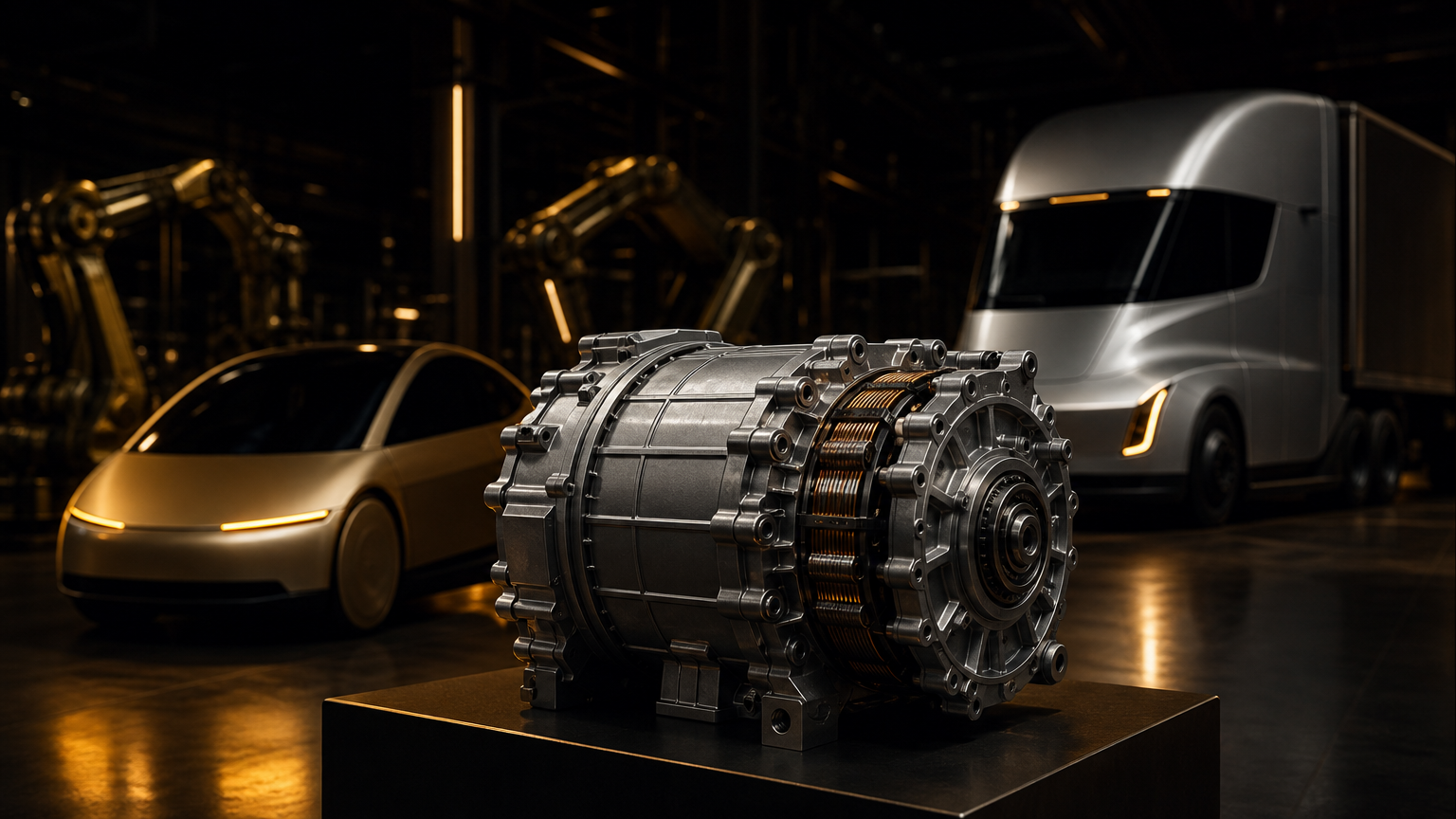
Tesla’s new American next-generation electric motor has become a supply-chain story as much as an engineering story. The current account centers on a Cybercab drive unit that is described as rare-earth-free and designed around an automated production cycle of less than 10 seconds, paired with a broader Tesla push to scale the redesigned Semi through vertically integrated manufacturing . That combination matters because the motor is not being presented as a one-off technology demo; it is being framed as a manufacturing system for robotaxis, heavy trucks, and eventually high-volume autonomy hardware .
The strategic problem is clear. Tesla moved to neodymium permanent-magnet motors in the Model 3 era because they are compact and efficient, particularly for steady-speed driving, but high-performance permanent magnets often depend on small amounts of heavy rare earths such as dysprosium and terbium . Those grams matter because China dominates rare-earth processing and magnet manufacturing, turning even a small motor material into a potential production bottleneck . In that context, removing rare earths from a drive unit is not simply a materials substitution; it is an attempt to design around geopolitical fragility.
From scarce magnets to abundant design
The current report says Tesla previously committed to a next-generation permanent-magnet motor using zero rare earth elements, and that the Cybercab version now being discussed is reported to be 18% smaller and 25% lighter than earlier high-performance drive units while improving efficiency . Tesla has not publicly identified the exact magnet chemistry, but industry analysis cited in the briefing points to ferrite as the leading theory because ferrite is abundant, inexpensive, and free of rare earths . The challenge is that ferrite magnets have much lower magnetic energy than neodymium magnets, so the breakthrough would be less about discovering a miraculous material and more about designing a motor that compensates for weaker magnets .
That is where the engineering becomes interesting. The Cybercab unit is described as using a three-phase AC permanent-magnet synchronous layout, hairpin copper windings with high slot fill, speeds above 15,000 rpm, a single-speed gearbox, and regenerative braking, with peak output reported at 163 kW . A Halbach-style arrangement is cited as one plausible way to concentrate magnetic flux where the motor can use it, which would help explain how a weaker magnet material could still support competitive power density . In plain language, Tesla appears to be trying to replace rare-earth intensity with geometry, copper packing, rotational speed, thermal management, and automated assembly discipline.
The 10-second factory claim is the real shock
The most disruptive claim may not be the absence of rare earths. It may be the production cadence. The drive-unit line is described as fully automated, with a cycle time under 10 seconds, meaning one completed unit could leave the line roughly every 10 seconds . If sustained at high yield, that kind of cycle time changes the economics of the motor from a premium component to a mass-produced autonomy part.
This is why the Cybercab is the logical first application. A robotaxi needs low operating cost, simple maintenance, high utilization, and repeatable manufacturing more than it needs extreme acceleration. The Cybercab is described as using roughly 165 Wh per mile, a weight near 1,412 kg, and a battery pack of about 48 kWh, making efficiency central to the business case . Because rare-earth magnets can represent a meaningful share of EV motor material cost, eliminating them could improve margins if Tesla reaches very high production volumes .
A current prediction-market summary updated on October 4 also reflects the market’s skepticism that Tesla will quickly turn the Cybercab into a cheap retail car: it noted no official sub-$30,000 consumer order page or MSRP and described the current focus as fleet expansion rather than immediate mass retail availability . That distinction is important. The motor may be designed for scale, but scale does not automatically mean instant consumer sales.
Semi shows the same manufacturing philosophy
The second half of the story is the Semi. Tesla’s Semi update is described as a move from pilot deployment toward mass production, with a dedicated plant spanning 1.8 million square feet and designed for up to 50,000 trucks a year, or about 1,000 per week at peak . The same report says the site is organized for deep vertical integration, including steel stamping, 4680 battery production, drive axles, cooling modules, and seats . That resembles the Cybercab motor logic: reduce suppliers, reduce interfaces, and bring more of the cost stack inside Tesla’s own factories.
The Semi has also reportedly been reworked for volume production. The update describes a move from 2170 cells to 4680 cells, a steel-sleeved rotor replacing a carbon-fiber design, stator technology shared with Cybertruck, and aerodynamic changes that improve efficiency by about 7% while cutting vehicle weight by nearly 1,000 pounds . Tesla says the truck can travel 500 miles at 82,000 pounds gross weight and nearly 600 miles at 60,000 pounds, with test-fleet uptime reportedly above 98% .
The economics are aimed squarely at fleets. Reported pricing places the Semi around $260,000 for standard range and $290,000 for long range, but the argument is operating cost rather than sticker price . At about 1.7 kWh per mile and electricity near $0.12 per kWh, the energy cost is estimated around $0.20 per mile, compared with about $0.67 per mile for diesel at $5.35 per gallon and 8 mpg . Over 100,000 annual miles, that spread approaches $47,000 in energy savings .
The bigger industrial signal
A separate October 3 materials-and-manufacturing analysis argued that value is shifting from finding more constrained materials to engineering products that avoid those materials altogether . That framing fits Tesla’s Cybercab motor. If automakers can design around rare earths, they reduce exposure to mines, export controls, refiners, and magnet suppliers . The same analysis described “scarcity alpha” moving from discovery of constrained atoms to engineering their absence, which is exactly the strategic premise behind a rare-earth-free drive unit .
For Tesla, the opportunity is not merely technical elegance. It is leverage. If the company can build rare-earth-free motors rapidly, assemble Cybercabs with fewer expensive materials, and use Semi factories to internalize more heavy-truck components, it could compress costs across multiple product lines. FOBI’s October 3 analysis also described Tesla’s vertical stack and funding for Cybercab, Semi, and Optimus as part of a broader attempt to push physical autonomy toward mass-market pricing .
What still needs proof
The claims remain dependent on execution. Tesla must prove that the rare-earth-free motor can be built at high yield, cooled reliably, and operated for fleet duty cycles without hidden durability costs. It must also prove that a sub-10-second drive-unit cycle is sustainable outside a controlled demonstration environment. For the Semi, the unanswered questions are charging availability, real-world payload tradeoffs, service economics, and whether the reported uptime holds across many customers rather than a test fleet.
Still, the direction is unmistakable. Tesla is attacking the EV cost problem from the inside out: fewer scarce inputs, more automated production, more shared architectures, and more vertical integration. If the Cybercab motor and redesigned Semi deliver at volume, the shock to the EV industry will not be that Tesla found a better magnet. It will be that Tesla made the magnet less important.
Sources from the last 72 hours
- [1]Tesla's New American Next-Gen Electric Motor Shocked the EV Industry!Oct 3, 2026, 1:33 PM
- [2]Frontline · Biotech · 2026-10-03 · fobiOct 3, 2026, 2:00 AM
- [3]Will Tesla sell a Cybercab for 30k or less in 2026?Oct 4, 2026, 7:01 AM
- [4]Everything About Elon Musk's Tesla Semi Revealed in 10 MinutesOct 2, 2026, 1:30 PM
AI-generated article based on recent web research, then preserved as a dated editorial snapshot.
Comments
Be the first to comment.