
Daily Podcast full article
Tesla Roadster 2.0's Crazy Secret Just Leaked! Flying Mode Revealed!
Tesla’s latest Roadster mystery is less about a car literally flying and more about a car trying to defeat the first few feet of acceleration: a newly discussed Tesla fan-car patent describes powered airflow hardware that could create downforce before speed-based aerodynamics can help.
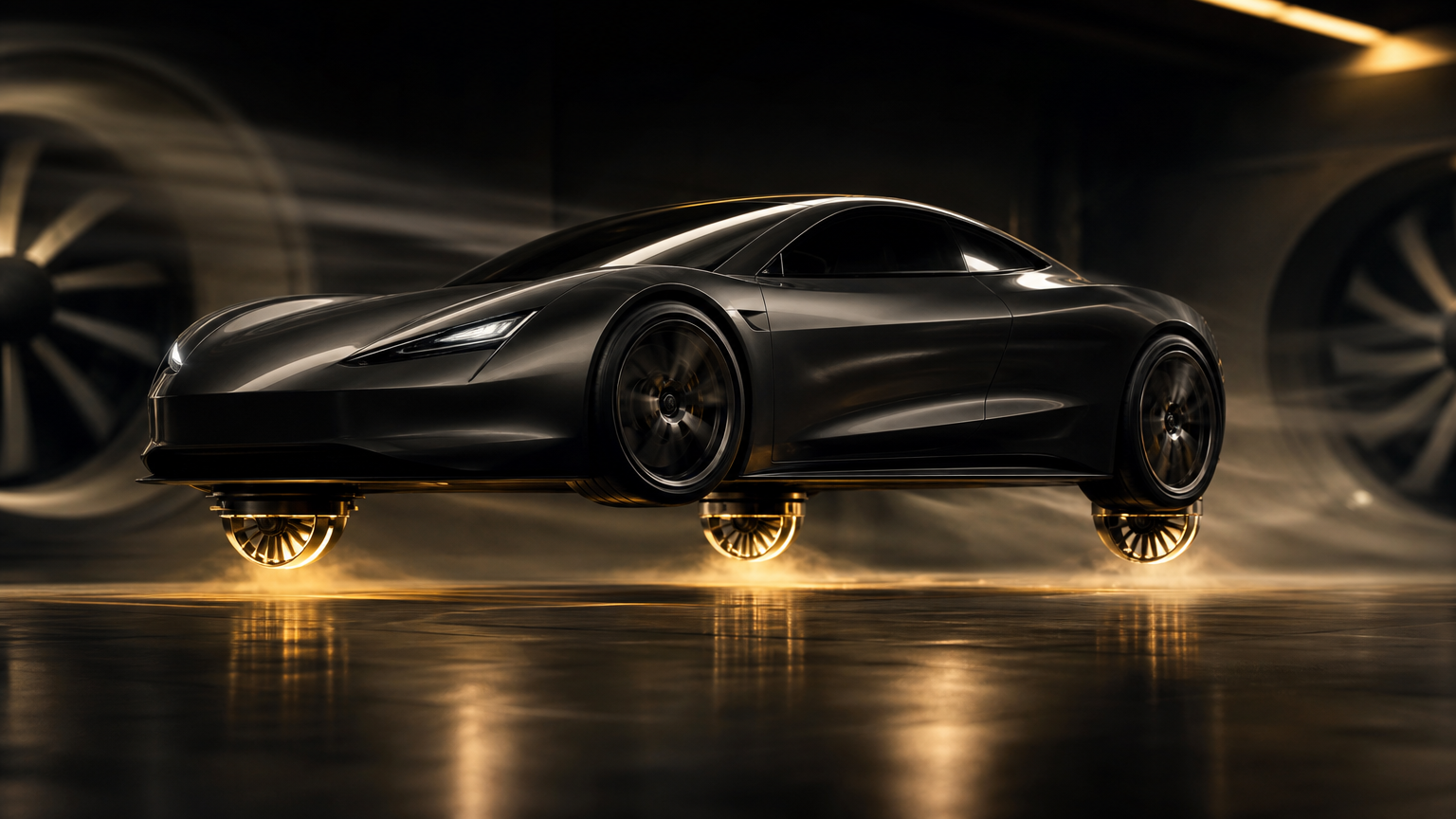
A “flying mode” rumor with a down-to-earth mechanism
The phrase “flying mode” is doing the work that viral headlines always do: it makes the new Tesla Roadster 2.0 sound like a spacecraft. The engineering clue now circulating is more subtle, and arguably more important. Fresh coverage of Tesla’s “Electric Fan Car” patent describes a system that uses ducted fans, underbody airflow and a rear diffuser to pull a vehicle down toward the pavement rather than lift it away from the road . In other words, the most credible “secret” here is not a hovercraft function; it is active low-speed downforce.
That distinction matters because Tesla’s Roadster promise has always lived at the edge of traction. Electric motors can deliver enormous torque instantly, but tires can only convert that torque into acceleration if they remain loaded and controlled. Conventional wings and diffusers become useful as airspeed rises. At launch, when a car is barely moving, passive aero contributes very little. A fan system changes the order of operations: it can move air even while the car is stationary, creating pressure differences before the vehicle has built road speed.
What the patent appears to describe
The most cautious fresh reporting says the patent is broader than the four-fan Roadster interpretation. iNews Zoombangla notes that the USPTO grant is identified as U.S. Patent No. 12,746,987 B1, assigned to Tesla, and that its first claim covers “one or more” electric ducted fans in an underbody-to-rear airflow path rather than specifically promising a four-fan Roadster package . The same report describes an underside inlet, a rear outlet, an air path between them, and vertical strakes between adjacent fans at the outlet .
The viral image, however, comes from the drawings and interpretations around the filing. HelloBro’s subject report describes an intake under the rear of the car, between the rear wheels, feeding a curved duct toward a broad rear diffuser outlet containing four axial electric fans . AOL’s fresh SlashGear republication similarly says the described system would feed air from an underbody inlet through four powered fans mounted in the rear diffuser, rapidly expelling air from beneath the car to create high downforce independent of vehicle speed .
That is why this story has latched onto the Roadster 2.0. The filing may not name the Roadster, and the drawings reportedly show a different Tesla body style, but the engineering target fits the Roadster narrative: extreme acceleration, dramatic launch behavior, and a need for grip before ordinary aero wakes up . EV News Daily’s recent summary captures the same caution, saying the patent appeared before a planned Roadster showing but does not confirm installation on the Roadster or any production Tesla .
Why fans could be the missing traction piece
For a high-performance EV, the launch problem is not “can the motors make torque?” but “can the tires use it?” More vertical load on the tire generally increases the force it can transmit before slipping. At high speed, a wing can add that load. At zero or low speed, an electric fan can theoretically create it by pulling air from beneath the floor and throwing it out the back.
That is the heart of the new Roadster speculation. HelloBro frames the patent as a plausible way to add downforce at very low speed, directly addressing the traction issue behind Tesla’s claimed sub-one-second 0-60 mph ambition . It also notes a key limitation: the patent does not provide enough data to confirm any acceleration figure . That caveat should stay attached to every version of this story. A patent can show an idea, a layout and an engineering direction; it does not prove a finished car can hit a target.
Still, the physics case is credible. A fan-assisted diffuser could preload the tires for a standing start. If the fans spool quickly enough, and if the ducting avoids wasteful leakage, the Roadster could apply more of its available torque before wheelspin or traction control intervention cuts power. That would not be “flying” in the airborne sense. It would be the opposite: using powered airflow to make the car behave as if it were heavier to the tires without adding static mass.
Why the wording is important
The strongest editorial point is also the least sensational one: the claim language does not equal the drawing. According to iNews Zoombangla, Claim 1 does not require exactly four fans; it uses broader wording and does not identify a specific production model . That means the patent can protect a family of airflow arrangements, while the drawings illustrate one detailed embodiment.
That difference is essential for readers. Tesla could use four fans, fewer fans, a different outlet geometry, or no production version at all. Companies routinely patent ideas that never reach showrooms. Some patents are defensive. Some preserve optionality. Some cover prototypes that solved one problem but created too many others: heat, noise, debris ingestion, packaging, cost, reliability or regulatory concerns.
The same caution applies to the Roadster connection. The fresh reports agree on the basic theme: the patent is real, the fan-car concept is concrete, and the Roadster link remains unconfirmed . So the fair headline is not “Tesla Roadster will fly.” It is closer to: “Tesla has patented fan-assisted downforce hardware that could explain how a future Roadster might launch harder than passive aerodynamics allow.”
Fans, thrusters and the “SpaceX package”
The public imagination also blends two separate ideas: fan downforce and rocket-style thrusters. Fan downforce moves air through the car to press the tires into the ground. Thrusters would expel gas to push the car directly, potentially helping acceleration, braking or lateral movement. Both concepts sound aerospace-adjacent, but they solve different problems.
The patent story currently being discussed is about aerodynamic downforce, not confirmed flight hardware. AOL’s fresh article makes that distinction directly: speculation may involve hovering or flying, but the ducted fans described in the patent are designed to keep the car glued to the road . HelloBro also emphasizes that the patent does not prove Tesla can deliver a sub-one-second Roadster or that the production car will use four fans .
That makes the “flying mode revealed” line best understood as a popular shorthand for the Roadster’s extreme-tech aura. If anything, the fan patent points to an anti-flying mode: a system designed to stop the car from unloading its tires when the driver asks for brutal acceleration.
The biggest unanswered questions
The most important unknown is power. Four fans capable of meaningful downforce would require serious electrical energy, and that energy ultimately comes from the vehicle’s high-voltage battery. HelloBro notes that the patent leaves open the fan power draw, operating speed, pressure targets and duty cycle, which means energy consumption and thermal load remain unresolved public questions .
The second unknown is control. A useful Roadster implementation would need to decide when the fans activate, how hard they run, and how they blend with traction control, suspension, battery temperature and motor output. A launch mode might demand maximum suction for a few seconds. A track mode might use the fans through low-speed corners. A highway mode might reduce or disable them to avoid drag, noise and energy waste.
The third unknown is durability. Any underbody intake must survive water, dust, stones, road debris and imperfect pavement. A sealed race-car system can be maintained constantly; a customer Tesla must work after grocery runs, rainstorms and potholes. That is likely why the patent’s integration into the rear aerodynamic structure matters: Tesla would need a solution that looks and behaves like a production car, not an exposed track experiment.
What we can say now
As of the latest fresh reports, the Roadster 2.0 secret is real only in the patent-and-speculation sense. Tesla has a newly discussed fan-car patent. Multiple current reports describe a system that could create low-speed downforce through powered fans and rear-diffuser airflow . Multiple current reports also warn that the patent does not confirm a production Roadster feature .
That leaves the story in a fascinating middle ground. The “crazy secret” is technically plausible and directly relevant to Tesla’s extreme acceleration claim. But until Tesla shows production hardware, publishes specifications or demonstrates the system on the Roadster, the safest conclusion is this: the patent reveals a credible path to launch traction, not proof of a flying car.
Sources from the last 72 hours
- [1]Tesla Patent Teases 'Electric Fan Car' That Sucks Itself To The Road At Any SpeedOct 3, 2026, 10:45 PM
- [2]Tesla’s fan-car patent claims a system, not a Roadster promiseOct 4, 2026, 2:00 AM
- [3]ev.news Briefly: Range Rover Sport, EVgo, Trump & more | 30 Sep 2026Oct 2, 2026, 2:00 AM
- [4]Tesla Roadster 2.0's Crazy Secret Just Leaked! Flying Mode Revealed!Oct 4, 2026, 1:32 PM
AI-generated article based on recent web research, then preserved as a dated editorial snapshot.
Comments
Be the first to comment.