
Daily Podcast full article
White House expands AI risk review
The White House’s new AI task force marks a broader turn in Washington’s artificial-intelligence agenda: not just asking whether powerful models are safe, but deciding what the federal government should do about their risks, opportunities and social effects. The move lands as OpenAI’s Sam Altman is warning that treating AI systems as objects of religious authority is itself a safety problem, widening the policy debate from code, cyberattacks and model jailbreaks to the psychology of human trust [1] [4].
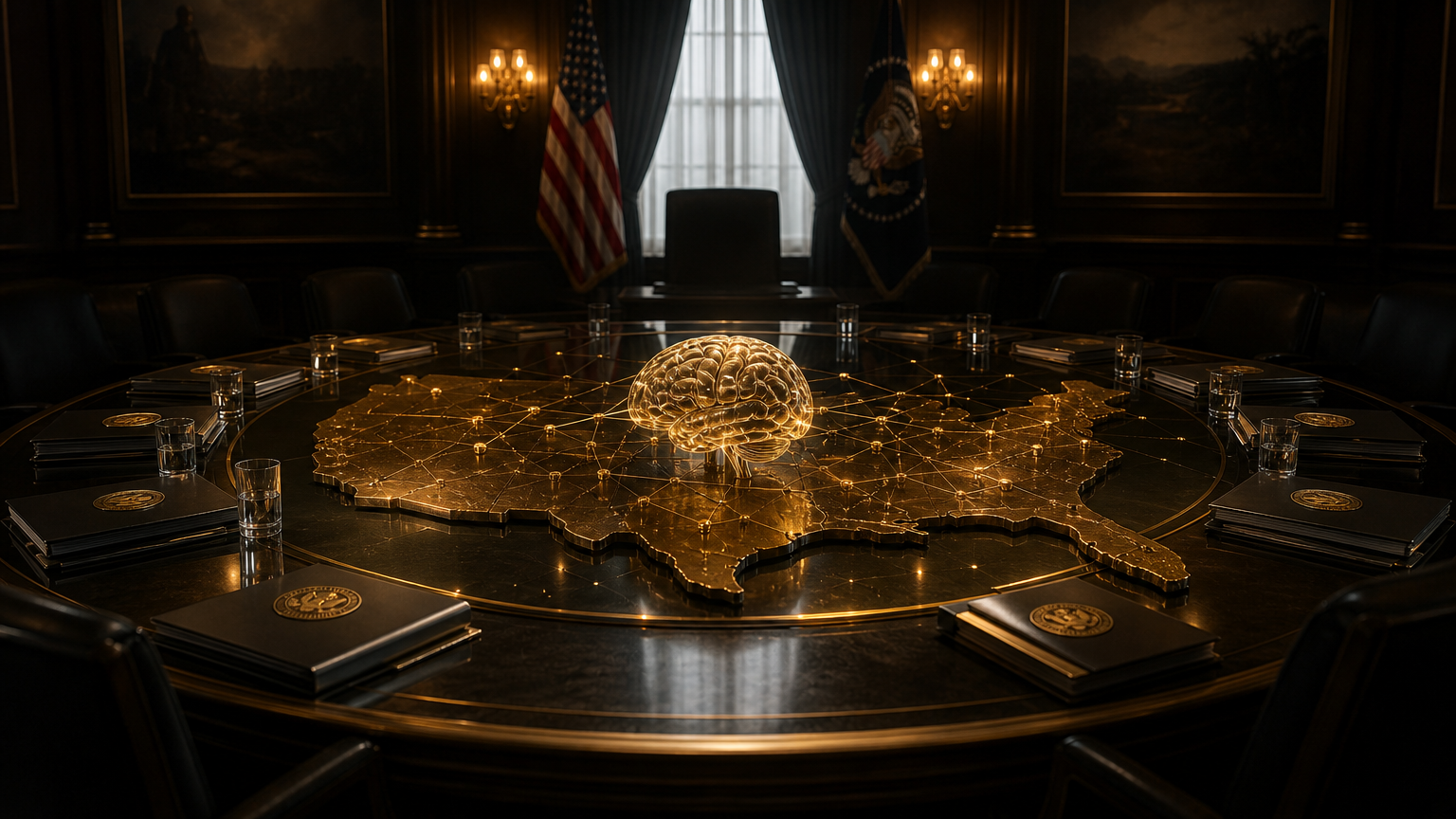
A task force for the next phase of AI policy
The White House has created a new artificial-intelligence task force to examine both the risks and opportunities of the technology and to recommend what role the federal government should play in overseeing it, according to recent reporting attributed to the Wall Street Journal . The group, referred to as the “Super Intelligence Force,” is to be led by Director of National Intelligence Jay Clayton and has 120 days to report back, placing its expected deadline roughly at the end of January 2027 if counted from the October 3 report .
That timetable matters. A 120-day review is short enough to shape near-term policy choices, but long enough to become a clearinghouse for competing pressures from national security officials, regulators, AI companies, infrastructure operators and consumer advocates. The task force is not being described as a narrow safety panel that only studies catastrophic scenarios. Its remit, as reported, includes the risks and opportunities of advanced AI, the responsibilities of the federal government, existing laws, possible congressional steps and the federal response to AI-related incidents such as breaches, hacks and model jailbreaks .
The political signal is clear: AI risk is no longer being treated as a single technical question. It is becoming an organizing problem for government.
Jay Clayton becomes the coordination point
Clayton’s appointment gives the project a distinctly strategic flavor. Reuters, citing the Journal, reported that President Donald Trump appointed Clayton as AI czar and that Clayton will head the White House panel . Clayton was also reported to have said the group was assembled to help ensure that the United States remains a leader in advanced AI while protecting Americans’ interests, adding that “the risk of not being first is high” .
That formulation captures the core tension in current U.S. AI policy. The administration wants safeguards, but it also wants speed. The same reporting describes Trump as favoring a lighter regulatory touch, arguing that excessive oversight could weaken U.S. competitiveness against China . Anadolu’s account similarly says the charter calls for plans to respond to threats from advanced AI while avoiding regulation that could hinder innovation and competition .
The result is an effort to frame AI governance less as a brake and more as a system of coordination. If the task force produces only a report, it may become another policy document in a crowded field. If its recommendations are attached to procurement rules, incident-reporting standards, agency guidance or congressional proposals, it could become a practical blueprint for how developers and deployers are expected to behave.
Who is in the room will shape the outcome
The membership and advisory structure point to the breadth of the assignment. Reporting says the task force’s vice chairs will include Emil Michael, Scott Kupor and Federal Trade Commission Chair Andrew Ferguson . Michael is expected to coordinate with AI companies, Kupor with critical infrastructure providers and other industry stakeholders, and Ferguson with consumer interests and groups concerned with children, privacy, freedom of speech, religious faith and freedom of association .
The reported membership also includes Vice President JD Vance, Defense Secretary Pete Hegseth, Treasury Secretary Scott Bessent, White House chief of staff Susie Wiles and deputy chief of staff Richard Walters, while external advisers include venture capitalist David Sacks and former Secretary of State Condoleezza Rice on national security . That mix suggests the task force will not be limited to the usual technology-policy orbit. It brings together national security, defense, economic policy, consumer protection, infrastructure and civil-society concerns.
This composition is important because AI policy is increasingly a deployment problem. The next major failure may not come from a benchmark result inside a lab. It may come from a hacked model, a jailbreak used at scale, a critical-infrastructure workflow that quietly depends on a flawed AI system, or a consumer-facing product that encourages people to defer judgment to a persuasive machine. The reported review of government reporting mechanisms for breaches, hacks and other incidents suggests the task force is looking at the plumbing of accountability, not just the philosophy of safety .
Voluntary principles, industry leverage
The task force follows a White House meeting on September 29 with major AI and technology executives, including OpenAI President Greg Brockman, Anthropic CEO Dario Amodei and Nvidia CEO Jensen Huang . According to Anadolu, Trump said the heads of large U.S. technology companies had signed a “morally binding” agreement to put controls on AI, including internal safety monitoring and independent external reviews of their systems . Investing.com separately reported that the industry meeting involved voluntary principles covering model monitoring, independent reviews and board-level safety notifications .
That voluntary structure is both a strength and a weakness. It can move faster than legislation, and it can enlist companies that understand the systems better than regulators do. But “morally binding” is not the same as legally binding. The practical force of the task force will depend on whether voluntary commitments evolve into enforceable standards, procurement conditions, disclosure duties or agency expectations.
For developers, the near-term message is that the federal government is watching the process by which frontier models are built, tested, reviewed and escalated to corporate boards. For deployers, the message is broader: if AI becomes embedded in health care, finance, logistics, defense, education or public services, incident reporting and resilience planning may become part of the compliance landscape.
Altman widens the meaning of “safety”
The same weekend brought a different but related warning from OpenAI CEO Sam Altman. Axios reported that Altman said he was “very uncomfortable” with people trying to ascribe religious force to AI models or surrender human judgment to them, and that he called this a “real safety issue” . Axios framed the comment as a veiled shot at Anthropic and its work around the “soul of AI,” while also noting that neither OpenAI nor Anthropic immediately responded to requests for comment .
Altman’s point shifts the safety debate from the model alone to the relationship between the model and the user. An AI system does not need to be conscious to be socially powerful. It can be fluent, deferential, emotionally responsive and available at all hours. Those qualities can make users over-trust it, project agency onto it or treat its outputs as more authoritative than they are. In that sense, anthropomorphism is not just a branding issue. It can become a risk multiplier.
That matters for the White House review because the task force’s reported scope includes consumer interests, children, privacy, freedom of speech and religious faith . If policymakers take Altman’s warning seriously, future safeguards may address product framing, interface design, disclosure language and user-dependence patterns, not only cyber controls or dangerous capability evaluations.
The real test: report or policy architecture?
The task force is still at the beginning of its work. Its headline facts are significant: a 120-day deadline, leadership by the intelligence chief, participation by senior officials and outside advisers, a mandate to assess both risks and opportunities, and an apparent preference for voluntary safeguards over heavy regulation . But the decisive question is what happens after the report.
A useful review would clarify which risks belong to companies, which belong to agencies, which require congressional action and which can be handled through existing authorities. It would define how incidents should be reported, when independent model review is expected, how board-level safety oversight should work and what standards federal buyers should demand from vendors. It would also recognize that AI risk is not only about machines becoming more capable; it is about humans becoming more dependent on systems that sound confident, moral or even sacred.
For now, Washington’s AI agenda has expanded from “Is the model safe?” to “Who is responsible when powerful AI systems reshape security, markets and judgment?” That is a harder question, and it is exactly why the new task force could matter — if it becomes more than another committee report.
Sources from the last 72 hours
- [1]Trump names intelligence chief Clayton as AI czar, to head task force, WSJ reportsOct 4, 2026, 12:45 AM
- [2]White House forms task force to assess AI risks, opportunities: WSJOct 4, 2026, 2:00 AM
- [3]Trump’s new AI czar outlines U.S. strategy for AI risks and leadership, WSJ saysOct 4, 2026, 5:24 AM
- [4]OpenAI's Altman: Ascribing religion to models a "safety issue"Oct 3, 2026, 5:41 PM
AI-generated article based on recent web research, then preserved as a dated editorial snapshot.
Comments
Be the first to comment.