
Daily Podcast full article
Quantum chips stretch qubit communication
A newly reported quantum-chip architecture proposes using phonons — sound-like quasiparticles — as on-chip links between distant hole-spin qubits, reframing scalability as a connectivity problem rather than a simple race for higher qubit counts.
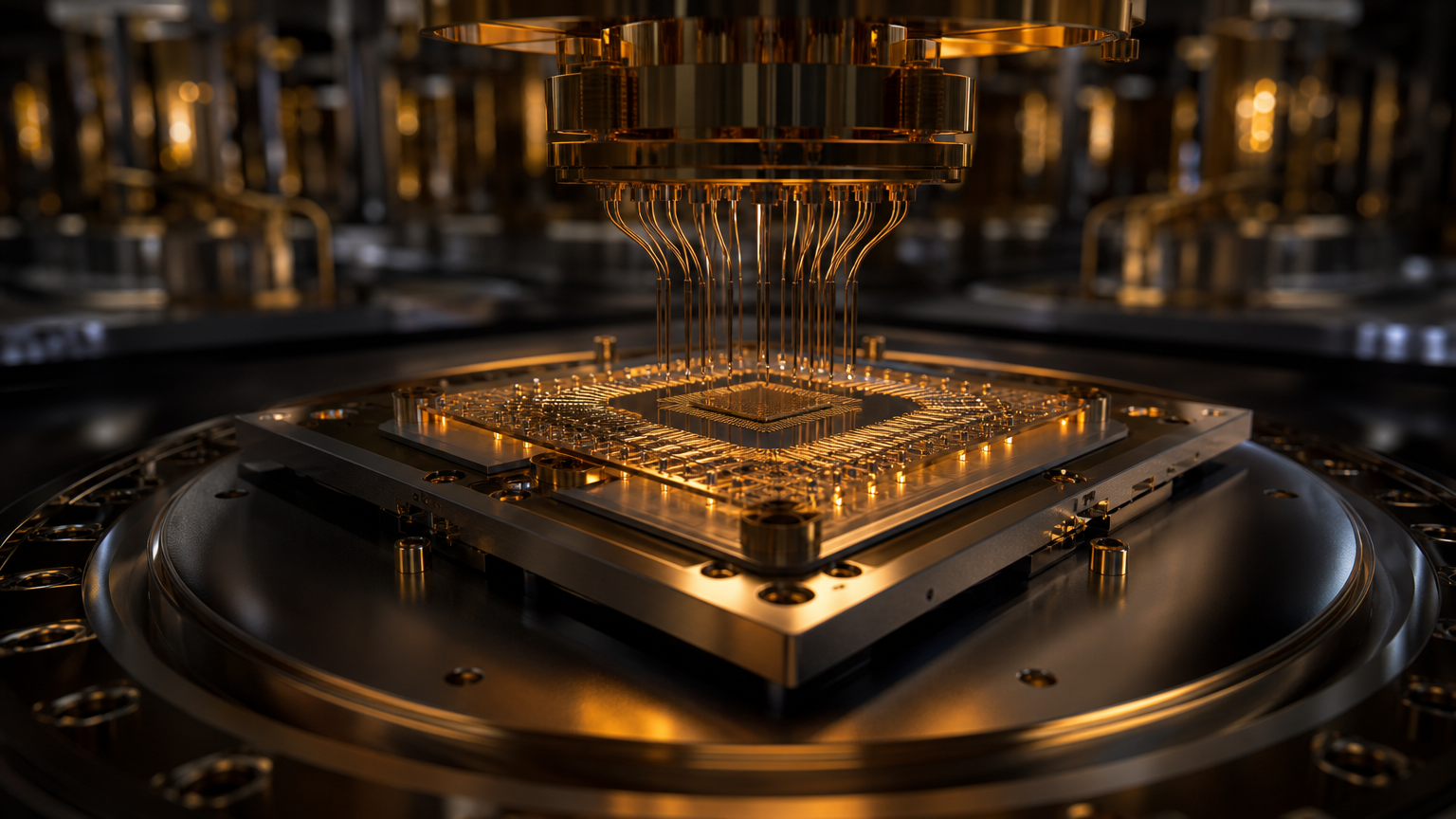
A chip-scale networking problem
The latest development in this story is not a bigger quantum processor, but a proposed way for qubits on a chip to talk across much larger separations. In a report published on October 5, Live Science described a quantum-computing architecture based on Quantum Phononic Links, or QPLs, designed to move quantum information between qubits that are not immediate neighbors . The article was also surfaced by science-news aggregation feeds the same morning, confirming that the fresh news cycle around the work centers on long-range qubit communication rather than a separate quantum-computing announcement .
That distinction matters. Quantum computing coverage often treats scale as a raw-number problem: more qubits, bigger machines, larger roadmaps. But hardware teams know that useful scale also depends on whether qubits can interact in the patterns required by algorithms and, especially, by error correction. If a chip can only couple nearby qubits efficiently, then designers must spend area, wiring and control complexity moving information through chains of intermediate operations. Each extra step can add error, latency and layout pressure.
The proposed QPL approach targets that bottleneck directly. According to the October 5 report, the architecture uses phonons — quasiparticles associated with vibrational energy — to carry quantum information through engineered structures on a semiconductor platform . Instead of treating the chip as a flat grid where only neighbors exchange information, the idea is to create an acoustic quantum bus that can link separated qubits while remaining compatible with semiconductor manufacturing concepts .
What is actually new here
The architecture described in the current report is built around hole-spin qubits in compressively strained germanium on silicon, abbreviated cs-GoS . A “hole” is not a particle in the everyday sense; it is the absence of an electron in a material, but in semiconductor physics it can behave like a particle with a spin state suitable for encoding quantum information . The October 5 coverage presents that hole-spin platform as attractive because it combines long coherence potential with electrical controllability, yet still faces the familiar challenge of coupling distant qubits .
QPLs are proposed as engineered phononic waveguides and cavities within the same material system . In simpler terms, the chip would guide carefully controlled sound-like vibrations through an ultrathin germanium layer, using those vibrations to mediate interactions between spin states. The report states that the researchers considered links from sub-micrometer separations up to distances across a full 300-millimeter semiconductor wafer, about 11.8 inches . That range is what pushes the story beyond a routine device tweak: it suggests a route from local two-qubit interactions toward chip-wide connectivity.
The practical appeal is not that phonons are exotic for their own sake. It is that phonons can, in principle, be shaped by the same kind of materials engineering that already underpins semiconductor manufacturing. The Live Science report contrasts QPLs with approaches such as externally generated surface acoustic waves or other long-range coupling schemes that can require additional hardware and more complex layouts . If the phononic link can be integrated into the qubit-hosting material, the communication fabric becomes part of the processor rather than an awkward add-on.
Connectivity is as important as coherence
Quantum computers fail when they lose coherence, but they also fail architecturally when qubits cannot be connected without too much overhead. Error correction, the central requirement for useful large-scale machines, does not merely need many qubits. It needs many qubits interacting in disciplined, repeated patterns. If the hardware graph is too local or too expensive to route, then the theoretical code may become physically impractical.
That is why the long-range claim in the QPL work is significant. The October 5 report says today’s leading quantum chips typically allow direct communication only between neighboring qubits, while useful machines may need to coordinate vast numbers of qubits spread across a chip . A connection method that can stretch across larger distances could simplify layouts, reduce swap operations and make it easier to distribute error-correction tasks across a processor.
Still, the emphasis should remain on “could.” The coverage describes a new concept and prototype architecture, not a finished million-qubit machine . The path from a promising coupling mechanism to a fault-tolerant processor includes difficult demonstrations: reproducible fabrication, high-fidelity two-qubit gates mediated through the phononic channel, thermal management, crosstalk suppression, control electronics and integration with measurement systems. A chip-scale quantum bus is valuable only if it preserves the fragile quantum states it is meant to connect.
Why quasiparticles keep returning to quantum hardware
The story also illustrates a broader trend in quantum engineering: researchers keep turning to quasiparticles when ordinary wiring becomes too blunt an instrument. Phonons are not elementary particles. They are collective vibrational excitations of a material. But in the right engineered environment, treating them as information carriers can be more useful than treating the chip as a collection of static components.
In this case, the quasiparticle is attractive because hole spins in strained germanium are sensitive to lattice deformation . That sensitivity, often a source of noise in less controlled settings, becomes a design feature if the vibrations are engineered precisely. The same physical interaction that could disturb a qubit can also be used to couple it to a controlled phononic mode.
This is the hardware version of a familiar quantum trade-off: isolation protects coherence, but interaction enables computation. A qubit that is perfectly isolated is hard to use. A qubit that interacts too strongly with everything around it decoheres. Long-range coupling schemes try to open and close a communication path on demand, giving qubits enough isolation to remember and enough connectivity to compute.
The parallel lesson from exchange-based circuits
The second strand of this subject points in the same direction from the theory side. Separate work on XQP circuits, built around the Heisenberg exchange interaction, asks whether quantum computation can be organized with a simpler physical control layer while still retaining meaningful computational power. In that model, the exchange interaction and postselection are used to keep operations aligned with decoherence-free structures, reducing some of the complexity that appears when every qubit demands heavy individual control.
The link between QPL-style hardware and XQP-style circuit thinking is conceptual rather than a claim that they are the same platform. Both attack the scaling problem by asking what the physical layer should naturally do. QPLs ask whether a semiconductor material can carry long-range quantum interactions through phonons. XQP circuits ask whether exchange interactions can define a leaner computational model. In both cases, the goal is not just “more qubits,” but a cleaner relationship between physics, layout and computation.
That matters because scaling quantum systems is not a single breakthrough. It is a stack of compromises. Better materials help only if control remains feasible. Better control helps only if coherence survives. More qubits help only if the connectivity graph supports useful computation. The QPL story is therefore best read as an architectural proposal: a possible way to make the chip itself participate in routing quantum information.
What to watch next
The next tests should be concrete. First, the field will need experimental evidence that phononic links can mediate high-fidelity coupling between distant hole-spin qubits under realistic operating conditions. Second, the architecture must show that the same channels that carry useful interactions do not also create damaging crosstalk. Third, fabrication must be repeatable across the sizes implied by the 300-millimeter-wafer discussion . Finally, the link mechanism must fit into the cryogenic and electronic control stack of a real processor.
For now, the importance of the October 5 report is that it shifts attention to a stubborn but sometimes underappreciated bottleneck: communication inside the chip . Quantum processors will not become useful merely by packing qubits closer together. They will need a network plan that lets fragile quantum states interact at the right time, across the right distance, with tolerable error. Phononic links are one candidate for that plan. If they work as hoped, the future quantum chip may look less like a crowded island of isolated qubits and more like a processor with an internal quantum transit system.
Sources from the last 72 hours
- [1]New quantum chip taps into weird quasiparticles to get qubits to communicate over long distancesOct 5, 2026, 11:00 AM
- [2]Wetenschap en Technologie BL - 2 - Mijn Web NieuwsOct 5, 2026, 11:00 AM
- [3]New quantum chip taps into weird quasiparticles to get qubits to communicate over long distances - livescience.comOct 5, 2026, 11:00 AM
AI-generated article based on recent web research, then preserved as a dated editorial snapshot.
Comments
Be the first to comment.