
Daily Podcast full article
Samsung stakes $260B on six Yongin fabs
Samsung’s six-fab Yongin plan is no longer just a distant megaproject. Fresh reporting from South Korea says the company has put a 360 trillion won, or more than $260 billion, blueprint in front of local residents, tied the first fab to a 2028 construction start and an October 2029 operating target, and framed power and water infrastructure as central to whether the cluster can scale.
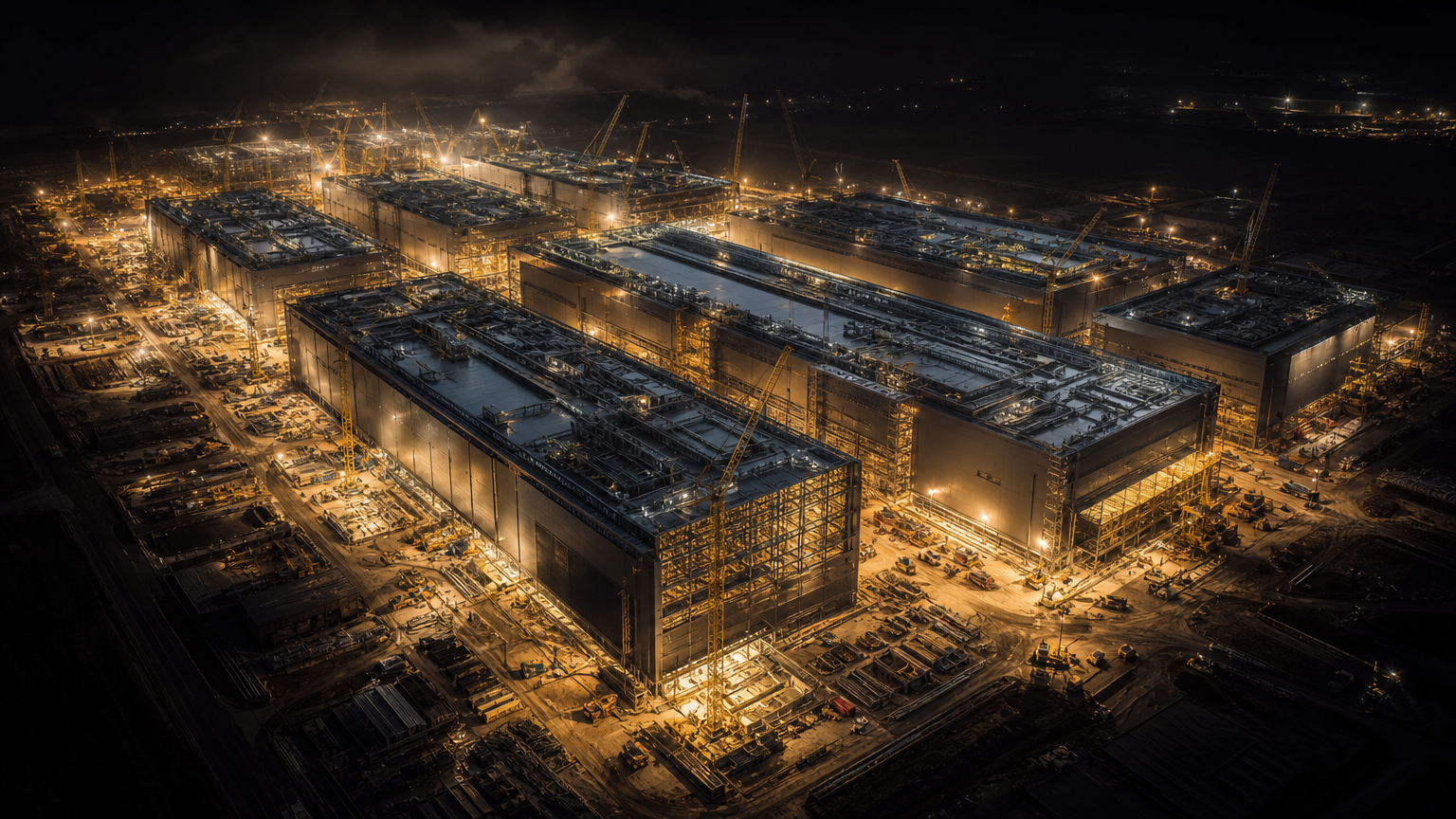
A $260 billion signal from Yongin
Samsung’s latest Yongin presentation turns a huge semiconductor ambition into a more concrete industrial schedule. The company is preparing to invest roughly 360 trillion won, described in English-language coverage as more than $260 billion, in the Yongin Advanced System Semiconductor National Industrial Complex, where the plan calls for six new semiconductor fabrication plants . The working headline remains the one that matters: Samsung is staking $260 billion on six fabs.
The update came through Samsung’s participation in the 2026 Yongin Cyber Science Festival, held October 3–4 at Yongin Mir Stadium, where the company used four exhibition booths to explain the industrial complex, local infrastructure and sustainability plans to residents . That public-facing venue is important. Rather than presenting the cluster only to investors, Samsung is putting a factory-city proposition in front of the community that will have to host roads, pipes, power lines, workers and suppliers for years.
The numbers are vast even by semiconductor standards. Reports say about 70 materials, components, equipment and fabless-chip companies are expected to move in alongside Samsung once the complex is built out . The projected employment effect is about 1.6 million direct and indirect jobs, a figure repeated across Korean business outlets covering the festival presentation . Those figures should be read as long-range economic-impact projections, not as a near-term hiring plan. Still, they show how Samsung wants Yongin to be seen: not as a standalone fab site, but as a semiconductor ecosystem.
The schedule is being pulled forward
The clearest operational development is timing. The Korea Land and Housing Corporation completed contractor selection for the first section of the Yongin National Industrial Complex on September 30, two months ahead of the original schedule, enabling site preparation to begin in October . Financial News described that step as a milestone because the project has entered an actual construction phase involving the government, local authorities, LH and Samsung .
The current target is for Samsung to begin construction of its first fab in 2028 and start operations in October 2029 . That would bring the first fab online about a year earlier than the previous second-half 2030 target cited by multiple reports . For the chip market, that matters because semiconductor capacity is not created with a press release. The process moves from land preparation to clean rooms, tools, utilities, process qualification and customer ramp. Pulling the first operating date forward narrows the window between today’s AI-driven demand signals and tomorrow’s actual wafer output.
Even so, the schedule remains a long game. A 2029 operating target means this is not a quick response to a single product cycle. It is a bet that advanced logic, memory-adjacent demand, AI infrastructure, automotive electronics and national industrial policy will continue to justify immense capital intensity through the end of the decade. The six-fab plan is Samsung’s answer to a world in which chip demand is increasingly treated as strategic infrastructure rather than a normal manufacturing cycle.
Power is part of the fab
Samsung’s Yongin pitch makes clear that a modern fab is not just a building filled with tools. It is an energy system. The company’s festival exhibition included energy infrastructure plans, with three liquefied natural gas power facilities slated for the Yongin complex . Seoul Economic Daily reported that the cogeneration section emphasized both semiconductor power supply and local community use, with electricity and heat potentially serving nearby apartments, hospitals, schools, sports facilities and welfare centers .
That matters because the grid can become the invisible bottleneck in any megacluster. A six-fab complex needs highly reliable electricity at industrial scale, and the company is presenting cogeneration as both a resilience and efficiency measure. Seoul Economic Daily reported that cogeneration can raise energy efficiency to around 80%, compared with about 55% for a typical LNG combined-cycle plant . The local-benefit framing is also political: if residents see only construction disruption and industrial load, resistance can grow; if they see shared heat, infrastructure and tax-base expansion, Samsung’s social license becomes stronger.
The tension is obvious. LNG is not “clean” in the same sense as zero-carbon power, and chipmakers face increasing scrutiny over emissions embedded in AI and semiconductor supply chains. But the immediate engineering challenge is reliability. Samsung is telling Yongin that the energy system is part of the fab plan from the start.
Water is the other constraint
Water is the second major infrastructure pillar. Samsung says it is working with the government and local authorities to purify effluent from public wastewater treatment facilities and reuse it as industrial water for semiconductor plants . Reports specify daily reuse volumes of 120,000 tons from Hwaseong, 120,000 tons from Osan and 210,000 tons from Suwon . Seoul Economic Daily framed the pledge as a plan to recycle hundreds of thousands of tons of treated wastewater a day .
That detail is more than public relations. Semiconductor plants consume large volumes of ultra-pure water, and communities near major fabs often worry about water withdrawals, wastewater and competition with residential use. By emphasizing reuse, Samsung is trying to show that Yongin’s growth will not depend only on new water intakes. MK’s report also says Samsung highlighted internal process optimization, recycling used process water for cooling towers and air-pollution reduction equipment, and purifying high-concentration wastewater for reuse in semiconductor manufacturing .
The broader message is that infrastructure discipline now belongs at the center of semiconductor strategy. In previous cycles, investors often looked first at node roadmaps, yields and customer wins. Yongin shows that for the next wave of fabs, power and water planning may be just as decisive.
What the six-fab bet means for competition
Samsung’s plan lands in a market where leading-edge capacity is both commercial weapon and geopolitical asset. Six fabs at Yongin would give Samsung a larger domestic base from which to challenge competitors in advanced manufacturing, while also anchoring a Korean supplier ecosystem around materials, tools, components and design . The plan to cluster roughly 70 related companies around the site is therefore not secondary; it is part of the competitive design .
The impact will not be immediate. TSMC, Intel and other foundry or integrated-device rivals will not feel six new Yongin fabs in quarterly share numbers tomorrow. But the industry will price the intention before the wafers arrive. Equipment suppliers, construction firms, power providers and materials companies will treat the schedule as a demand signal. Customers looking for supply diversification will watch whether Samsung can execute the 2028 construction and 2029 operation targets. Local governments will watch whether the promised infrastructure and employment effects materialize.
The risk is execution. A $260 billion-plus plan can be delayed by land work, utilities, equipment bottlenecks, cost inflation, labor shortages or demand shifts. The first milestone now is mundane but crucial: site preparation beginning in October after LH’s contractor selection . If that proceeds cleanly, Samsung’s six-fab promise becomes less like a strategic slogan and more like a factory calendar.
The bottom line
Samsung has moved the Yongin story from ambition to implementation. The company is putting a 360 trillion won, six-fab plan in front of residents, aiming to start the first fab in 2028 and bring it online in October 2029 . Around it, Samsung is packaging a broader system: suppliers, jobs, roads, housing, energy, cogeneration and wastewater reuse .
That is why the story matters beyond Samsung. The next semiconductor race will not be won only by transistor design. It will also be won by whoever can coordinate land, utilities, talent, suppliers and community consent at unprecedented scale. Yongin is Samsung’s declaration that it wants to choreograph all of that at once. If it works, six fabs could turn a Korean industrial complex into one of the defining chipmaking platforms of the next decade.
Sources from the last 72 hours
- [1]Samsung to Break Ground This Month on Yongin National Semiconductor Industrial Complex… Unveils Blueprint to Local ResidentsOct 3, 2026, 11:00 PM
- [2]Samsung Electronics announced on the 4th that it participated in the "2026 Yongin Cyber Science Fest..Oct 4, 2026, 5:49 AM
- [3]Samsung Electronics Unveils Blueprint for 360 Trillion Won Yongin Semiconductor Complex to Local Community, Pushes Ahead with Goal of Starting Operations in 2029Oct 3, 2026, 11:00 PM
- [4]Samsung Pledges 360 Trillion Won Yongin Chip Investment, Wastewater RecyclingOct 3, 2026, 11:00 PM
- [5]Samsung to Build Six New Semiconductor Fabs with an Investment of Over $260 BillionOct 5, 2026, 2:00 AM
AI-generated article based on recent web research, then preserved as a dated editorial snapshot.
Comments
Be the first to comment.