
Daily Podcast full article
SpaceX reaches orbit, Musk tops $1T
Starship Flight 14 has turned SpaceX’s giant rocket from a spectacular test vehicle into a demonstrated orbital payload launcher, while a fresh SpaceX-led stock rally has pushed Elon Musk’s estimated fortune back above $1 trillion.
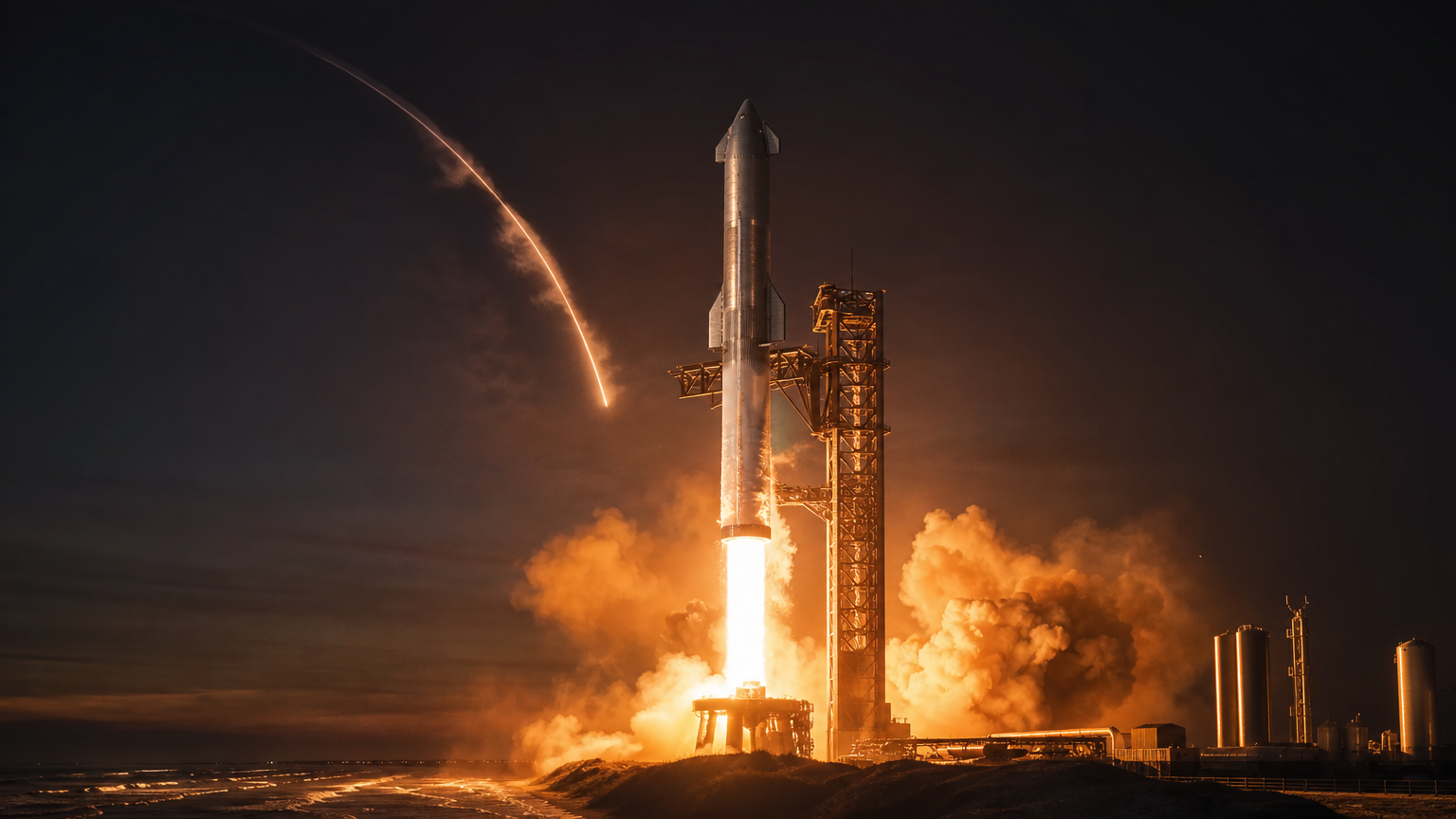
The orbit badge finally unlocked
SpaceX’s Starship has crossed the line that mattered most: Flight 14 reached orbit, deployed 26 Starlink V3 satellites and returned from space in a shortened mission that ended in the Pacific. Aviation Week’s October 5 issue summarized the mission as Starship-Super Heavy’s first orbital test run, noting that the vehicle managed two orbits of Earth and released 26 Starlink V3 satellites . The result moves Starship beyond the realm of impressive but still suborbital demonstrations and into the more consequential category of orbital payload delivery.
That distinction matters because Starship’s economic promise has always depended on more than liftoff spectacle. A huge rocket that can rise, stage and return is impressive; a huge rocket that can place operational satellites in orbit is commercially different. Investor-focused coverage on October 4 described Flight 14 as the moment Starship reached orbit for the first time, overcame engine problems, and deployed 26 Starlink V3 satellites at roughly 275 kilometers altitude . In other words, SpaceX did not merely fly a taller test article; it demonstrated a delivery path for the company’s next generation of satellite capacity.
The mission was not flawless. The same October 4 market analysis noted that SpaceX reported engine stoppages during the flight, a reminder that the vehicle remains in a development campaign rather than a routine launch service . But the mission’s importance comes from what happened despite those complications: orbital insertion, satellite deployment and a controlled decision to shorten the flight rather than chase every planned objective. That is often how reusable space systems mature: not through one perfect showcase, but through flights that turn unknowns into engineering work.
From splashdown to service
The clearest sign that Flight 14 was more than a headline is what happened after deployment. On October 5, Basenor reported that all 26 Starlink V3 satellites from the Group 31-1 mission had begun raising their orbits, with most staging near 295 kilometers for differential orbital plane drift before continuing toward operational altitude . That post-deployment behavior is critical. It indicates that the satellites were not simply released for publicity; they entered the checkout-and-maneuver phase that connects a launch event to actual network expansion.
The low initial orbit also explains why the story did not end at splashdown. Basenor reported that the satellites were inserted into an orbit with a perigee of roughly 262 kilometers and an apogee of roughly 275 kilometers, meaning they would need to climb under their own propulsion before entering service . That is normal for many Starlink deployments, but the Starship context adds a new scale question: if the vehicle can routinely release large batches of more capable satellites, SpaceX can change both the cadence and unit economics of its broadband network buildout.
The V3 generation is central to that equation. Basenor described each Starlink V3 satellite as designed to contribute 1 terabit per second of capacity, a major increase over earlier generations . Even if those figures are design targets rather than immediate live throughput, the logic is straightforward: Starship’s value rises if it can carry heavier, higher-capacity spacecraft that Falcon 9 cannot deploy as efficiently. Flight 14 therefore links launch economics with broadband economics. The rocket and the network become two sides of the same capital machine.
A technical milestone with financial gravity
That capital machine is now directly tied to Elon Musk’s personal balance sheet. Forbes, republished by Yahoo Finance on October 5, reported that Musk’s net worth topped $1 trillion on Monday morning as SpaceX and Tesla shares climbed after the market opened . The same report said the move restored Musk’s trillionaire status after he first reached that milestone in June . The timing is hard to ignore: Starship’s orbital breakthrough has landed in the same news cycle as a rally that again put Musk into a wealth category no other executive occupies.
Forbes estimated Musk’s net worth at $1 trillion on Monday, up $30.6 billion from Friday, according to the Yahoo Finance republication . That change underscores the central feature of modern ultra-wealth: it is less a pile of cash than a mark-to-market reflection of concentrated equity. When SpaceX and Tesla rise, Musk’s paper wealth can move by tens of billions in a single trading session. When they fall, the same mechanism works in reverse.
That is why Flight 14’s technical outcome matters to markets. SpaceX is valued not only as a launch provider, but as an integrated space infrastructure company: rockets, Starlink broadband, satellite manufacturing, government contracts, lunar ambitions and eventually Mars logistics. A Starship that has finally delivered satellites to orbit makes the company’s future capacity less theoretical. It gives investors a new data point for the idea that SpaceX can increase payload mass per launch, reduce marginal launch costs over time, and support a larger Starlink network with fewer bottlenecks.
The caveat: orbit is not routine yet
Still, the successful mission should not be confused with full operational maturity. Aviation Week framed Flight 14 as a first orbital test run after a decade of development . A first orbital payload mission is a breakthrough, not a finished transportation system. The engine issues reported around the flight, the shortened orbital stay and the Pacific splashdown all point to the same conclusion: SpaceX has proved a major capability, but it still has to prove repeatability.
Repeatability is the threshold that competitors, customers and regulators will watch next. Satellite operators will care less about one triumphant flight than about cadence, insurance risk, payload integration, schedule reliability and price. NASA will care about how Starship’s orbital performance translates into lunar lander milestones. Investors will care about whether the vehicle can create revenue fast enough to justify the valuation embedded in Musk’s fortune.
The post-flight satellite maneuvers are therefore an important bridge between test and service. Basenor reported that the newly deployed satellites are unlikely to contribute live customer traffic before late November at the earliest, while noting that SpaceX has not published a specific activation timeline for the batch . That caveat matters. The mission succeeded at deployment, but the business case still depends on the satellites completing checkout, reaching useful orbits and eventually adding capacity customers can feel.
Why this week changes the story
The combined headline — SpaceX reaches orbit, Musk tops $1T — is not just coincidence. It captures the feedback loop that defines Musk’s empire. Technical progress at SpaceX supports confidence in future revenue. Confidence lifts equity value. Equity value expands Musk’s personal wealth and gives him more strategic influence across launch, satellites, AI, robotics and electric vehicles. That influence then reinforces the market’s belief that his companies can finance very large bets.
Flight 14 does not settle every question about Starship. It does not prove rapid reuse, full payload cadence, orbital refueling, lunar landing operations or Mars logistics. But it does remove one of the biggest doubts: whether the world’s largest rocket system could actually reach orbit and deploy operational satellites. It did.
Musk’s return to trillionaire status is the financial mirror of that technical moment. The number is volatile, symbolic and deeply dependent on stock prices. But symbols move markets, and this one says investors are once again pricing SpaceX as a company whose most ambitious hardware is becoming real. The rocket finally unlocked the orbital achievement badge; the scoreboard of capitalism updated almost immediately after.
Sources from the last 72 hours
- [1]Elon Musk Becomes A Trillionaire—Again—After SpaceX Stock JumpsOct 5, 2026, 4:15 PM
- [2]As Starship Finally Reaches Orbit, Here’s How You Should Place SpaceX StockOct 5, 2026, 1:25 AM
- [3]Aviation Week & Space Technology, October 5, 2026Oct 5, 2026, 2:00 AM
- [4]Starship's First Starlink Payload Begins Orbital ClimbOct 5, 2026, 2:00 AM
AI-generated article based on recent web research, then preserved as a dated editorial snapshot.
Comments
Be the first to comment.