
Daily Podcast full article
Starlink Gen3 reaches 10 Tbps
SpaceX’s newly disclosed Starlink Gen3 architecture points to satellites that are not merely bigger broadband relays, but high-power orbital network nodes with onboard AI compute. At the same time, the company was preparing an early-Monday Falcon 9 launch from Vandenberg for the Space Development Agency’s fourth Tranche 1 transport mission, tying commercial network scale and national-security resilience into the same orbital story.
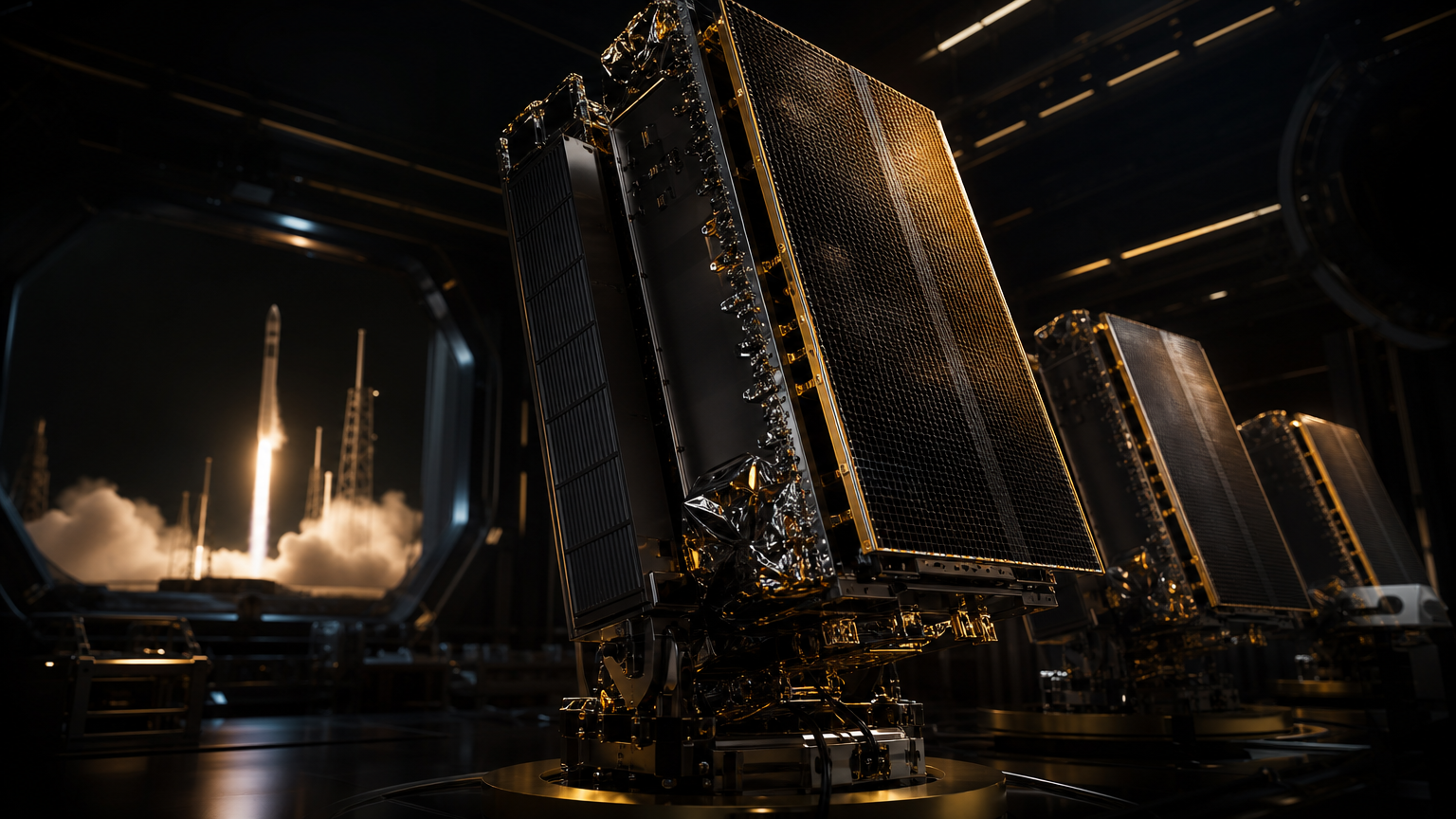
A bigger Starlink, and a different kind of satellite
The working headline is straightforward: Starlink Gen3 reaches 10 Tbps. The important part is what sits behind that number. SpaceX’s next-generation Starlink “Gen3” architecture was described as targeting 10 terabits per second of bidirectional capacity per spacecraft, with a 250-kilowatt power system and onboard edge compute built around a SpaceX-designed Nvidia Vera Rubin NVL72 computer . That is not just a faster satellite. It is a proposal for an orbital platform that combines communications, routing, signal processing and AI inference much closer to the user than a conventional cloud region.
In today’s Starlink model, satellites mainly act as moving network infrastructure: they connect user terminals, route traffic through gateways or laser links, and deliver broadband at global scale. The Gen3 description shifts the center of gravity. If the satellite can process data onboard, perform digital beamforming, allocate radio-frequency power dynamically and reduce the amount of traffic that must immediately be hauled back to Earth, then the satellite becomes a small orbital edge site, not only a relay .
That distinction matters. Terabit-scale capacity answers the bandwidth question, but onboard compute answers the latency and backhaul question. In remote areas, maritime corridors, aviation routes, disaster zones and defense theaters, the fastest route to an answer may not always be “send everything to a data center first.” Some workloads can be filtered, classified or inferred in orbit, with only the result sent onward. That could mean lower latency for time-sensitive tasks and less pressure on ground gateways.
The power number may be as important as the throughput
The 10 Tbps figure will get the attention, but 250 kW per satellite may be the harder engineering clue. SatNews reported that the Gen3 platform is engineered around a 250 kW solar array and power distribution system, a large step up from earlier Starlink generations . More power enables stronger links, denser beams, more compute and more flexible radio operation. It also creates harder problems.
Power becomes heat. Heat becomes thermal design. Thermal design becomes mass, surface area, pointing limits and cost. A satellite running serious compute cannot simply borrow the assumptions of a lightweight broadband spacecraft. It needs power conditioning, thermal rejection, radiation-aware hardware strategy and enough reliability to survive in low Earth orbit without a technician ever swapping a card.
That is why the 10 Tbps claim should be read as both a network ambition and a launch-economics challenge. A bigger, power-hungry satellite has to fit into a constellation business model. It needs to be manufactured repeatedly, launched economically and replaced on a schedule. SatNews notes that deployment of the 250 kW platforms is tied to Starship cadence and to regulatory approvals, including modified orbital authorizations and spectrum coordination . In other words, the satellite spec is only one side of the story. The factory, the launch vehicle, the license and the replenishment plan are the other side.
Edge AI in orbit: useful, but not magic
The phrase “AI satellite” can easily become marketing fog. The practical version is narrower and more interesting. Onboard AI compute could help a satellite manage its own network more intelligently: identify demand spikes, steer beams, prioritize traffic classes, pre-process sensor or network data, and reduce wasteful round trips to terrestrial infrastructure . It could also support remote inference where a user, device, vehicle or field unit needs a fast answer but has limited terrestrial connectivity.
Still, the current claim should not be mistaken for a proven in-orbit service. The reported Gen3 specifications describe a target architecture and a roadmap, not a fully validated deployed constellation. SatNews says initial orbital testing would focus on validating power distribution, thermal management for the Nvidia compute payload and optical inter-satellite link throughput . Those are exactly the right tests, because they address the difference between an impressive spec sheet and a durable operational network.
There is also a business question: what workloads truly belong in orbit? Caching, routing, signal processing and time-sensitive inference have obvious reasons to sit near the user. Large-scale AI training, by contrast, is much less obviously suited to space unless launch cost, power generation, cooling, bandwidth and hardware replacement economics all line up. Gen3’s most credible near-term value may therefore be in inference, network intelligence and backhaul reduction rather than in turning every satellite into a full cloud data center.
The defense layer: SpaceX’s other network story this week
While the Gen3 disclosure points toward commercial broadband and orbital compute, SpaceX was also preparing a separate national-security communications mission. The company was targeting 1:17 a.m. Pacific time on Monday, October 5, 2026, for a Falcon 9 launch from Space Launch Complex 4-East at Vandenberg Space Force Base in California . Because that target time is 08:17 UTC, it fell after the freshness cutoff for this snapshot; at the time covered here, the mission was still a planned launch, not a confirmed liftoff .
The payload was described as 21 Tranche 1 satellites for the U.S. Space Development Agency, marking the fourth of nine batches SpaceX is helping deliver for a planned 154-satellite layered network . Edhat separately described the mission as the SDA’s fourth Tranche 1 data transport mission and said the satellites would form the fourth orbital plane in the Proliferated Warfighter Space Architecture, a mesh network intended to support military tactical communications and missile warning, indication and tracking capabilities .
That architecture explains why the mission matters even if Falcon 9 launches now feel routine. The strategic premise is proliferation: many satellites in low Earth orbit can create resilience that a few exquisite satellites cannot. A distributed transport layer can route around failures, complicate an adversary’s targeting problem and provide lower-latency connectivity to forces that cannot rely on fixed terrestrial infrastructure.
Routine launch, non-routine consequences
The planned booster profile also underlines how normalized SpaceX launch operations have become. Edhat reported that the Falcon 9 first-stage booster assigned to the mission was making its sixth flight and was expected to return to Vandenberg’s Landing Zone 4 roughly eight to ten minutes after liftoff, with possible sonic booms in Santa Barbara, San Luis Obispo and Ventura counties depending on atmospheric conditions . USA Today’s coverage, republished by AOL, also noted that SpaceX was targeting a return-to-launch-site landing rather than an offshore droneship recovery .
That routine is part of the strategic picture. Proliferated military constellations and high-capacity commercial constellations both depend on launch cadence. If satellites are numerous, cheaper and refreshed often, then launch stops being an occasional ceremonial event and becomes part of network operations. SpaceX’s advantage is not only that it builds satellites or flies rockets; it is that it tries to make those two cycles reinforce each other.
What to watch next
The next checkpoints are practical. For Starlink Gen3, watch whether SpaceX turns the 10 Tbps, 250 kW and onboard-compute architecture into regulatory filings, test vehicles and operational satellites with measured performance . Watch Starship cadence, because very large Gen3 spacecraft need launch economics that Falcon 9-class deployment cannot easily provide at scale . Watch spectrum coordination, because high-capacity networks depend as much on rights to transmit as on hardware.
For the SDA mission, watch whether the planned October 5 launch proceeds, whether the booster return succeeds and how the 21 satellites enter checkout. The story is not only one company launching one rocket. It is the convergence of two orbital futures: commercial satellites becoming edge-compute infrastructure, and defense satellites becoming a resilient mesh rather than a small set of vulnerable crown jewels. If Gen3 works as described, the cloud does not just need a region. It needs a launch window.
Sources from the last 72 hours
- [1]SpaceX Unveils 250 kW Starlink Gen3 AI Satellites Featuring 10 Tbps Throughput and Onboard Edge ComputeOct 4, 2026, 2:00 AM
- [2]SpaceX plans early morning Monday rocket launch. Track liftoff in CAOct 4, 2026, 9:00 PM
- [3]SpaceX Falcon 9 Set to Launch Military Satellites from Vandenberg Early Monday MorningOct 4, 2026, 2:00 AM
AI-generated article based on recent web research, then preserved as a dated editorial snapshot.
Comments
Be the first to comment.