
Daily Podcast full article
Trump creates Super Intelligence Force to centralize America’s AI race
President Trump has turned AI policy into a White House command structure, naming Director of National Intelligence Jay Clayton to lead a new “Super Intelligence Force” with senior officials from the FTC, Pentagon and personnel office. The move is framed as a bid to keep the United States ahead in advanced AI, but it also signals a broader shift: Washington wants one visible control point for safety pledges, industrial competition, public engagement and corporate accountability.
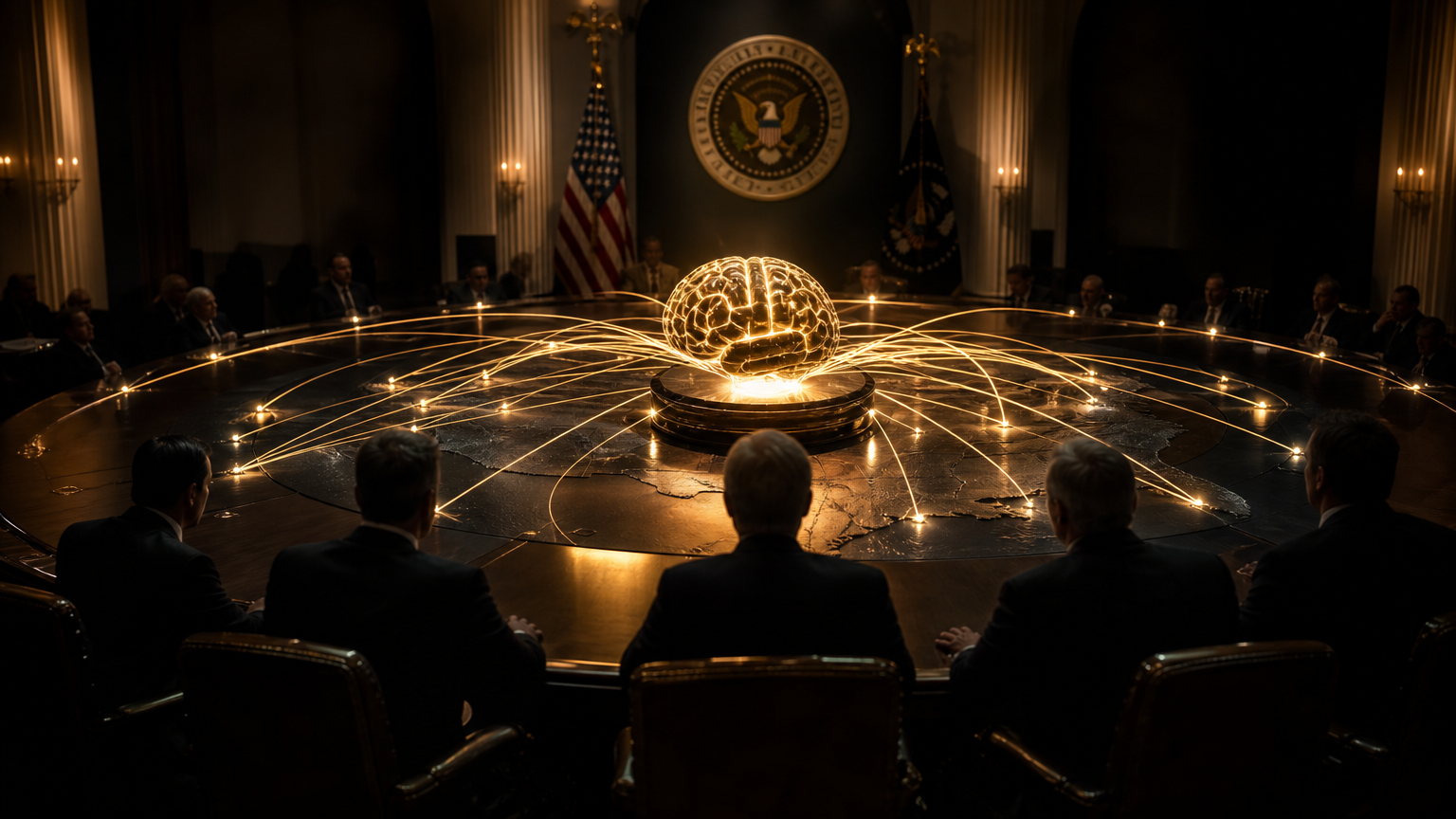
A new federal control room for AI
President Trump has created the “Super Intelligence Force,” or SIF, a new federal task force designed to coordinate the government’s approach to artificial intelligence under the administration’s preferred label, “super intelligence” . The announcement places Director of National Intelligence Jay Clayton at the center of US AI governance, effectively making him the administration’s AI czar while he continues to lead the intelligence community .
The structure is notable because it is not only a technology panel. Trump said the force will coordinate federal engagement with consumers, public interest groups, religious organizations, critical infrastructure providers and AI companies . That list suggests the White House is treating AI as an economy-wide and society-wide issue, not merely as a matter for research labs or software regulators.
Clayton will not work alone. The task force also includes Federal Trade Commission Chairman Andrew Ferguson, Pentagon technology chief Emil Michael and Office of Personnel Management Director Scott Kupor . Together, that lineup pulls in competition policy, defense technology, workforce management and national intelligence. The message is clear: AI policy is being moved from a scattered agency conversation into a central White House priority.
Why Jay Clayton matters
Clayton’s appointment is the most important signal in the announcement. He is currently director of national intelligence, and he previously served as SEC chair during Trump’s first term and as the top federal prosecutor in Manhattan . That résumé gives the new AI effort a profile that is less Silicon Valley evangelist and more securities-law, enforcement and national-security operator.
That matters for technology companies. A Clayton-led AI office may look at model capability, infrastructure and security, but it is also likely to understand AI through disclosure, investor expectations, market concentration and corporate responsibility. For public and private AI firms raising enormous capital, the choice of a former SEC chair suggests that financial accountability could sit alongside model safety and geopolitical competition.
The Guardian reported that Clayton described AI during his Senate confirmation process as both a “gamechanger” and a threat, saying that when something is both an opportunity and a threat, policymakers need to “get your arms around it” . That framing fits the new task force: speed is part of the mission, but so is containment.
What the force is supposed to do
The first job of the Super Intelligence Force is coordination. Trump said the group will ensure that America continues to lead the world in “Super Intelligence,” which he described as larger in significance than the Industrial Revolution and the internet . The force reports to Trump and White House Chief of Staff Susie Wiles, giving it a direct line to the Oval Office rather than leaving AI questions dispersed across the cabinet .
Reporting from TechCrunch, citing the Wall Street Journal, adds that the task force has 120 days to produce a report on AI’s risks and opportunities . The same account says the charter calls for plans to respond to AI-enabled threats while avoiding overregulation and regulatory capture that could stifle innovation and competition . In practical terms, that gives the SIF two mandates that may often conflict: identify dangers quickly, but do not slow the race so much that the United States loses ground.
This is why the membership matters. The FTC chair brings antitrust and consumer protection instincts. The Pentagon technology chief brings defense and procurement concerns. The OPM director brings the federal workforce and hiring pipeline into the discussion. Clayton brings intelligence and financial-regulatory experience. If the group becomes influential, it could shape not only AI safety language, but also federal buying rules, incident reporting, government use of AI tools, data-center and infrastructure priorities, and expectations for companies seeking federal contracts.
A task force born from a “morally binding” accord
The SIF follows a White House meeting with major AI executives, including leaders from OpenAI, Anthropic, Google, Meta, Nvidia and Elon Musk’s SpaceXAI, according to CBS News . After that meeting, the companies signed voluntary safety standards that Trump described as “morally binding” .
CBS reported that the accord included commitments to “four layers of controls and audits,” including internal evaluations, outside audits and board-level review, and that the companies agreed to meet regularly to establish standards and best practices . The agreement is important because it shows the administration’s current preference: heavy emphasis on industry self-policing, with White House coordination rather than immediate hard statutory regulation.
That approach will satisfy some AI acceleration advocates, who argue the United States must move fast against China and other competitors. It will worry critics who believe voluntary standards are too weak for systems that can influence employment, cybersecurity, education, elections, warfare and financial markets. The Super Intelligence Force is therefore being launched into a political gap: the administration wants a visible safety mechanism, but it is also explicitly trying not to choke off the industry it sees as strategic.
Branding becomes policy
The name is not a side issue. Trump has pushed the federal government to use “super intelligence” instead of “artificial intelligence,” and the new task force is named accordingly . This rebranding is more than cosmetic. Language can shape priorities: “AI” sounds like a broad class of tools, while “super intelligence” suggests a national race, a breakthrough technology and a security challenge.
The term also gives the administration a slogan that fuses industrial policy with geopolitical urgency. If AI is now officially “super intelligence,” then leadership becomes easier to frame as a national-security imperative. That framing may help justify faster federal procurement, looser constraints on deployment, new infrastructure support, or more direct coordination with leading companies.
TechCrunch noted that the new name follows the administration’s broader attempt to recast AI terminology, including a non-binding safety pledge signed at the White House by technology executives . The SIF therefore sits at the intersection of policy and political messaging: it is a governing body, but also a brand architecture for the administration’s AI agenda.
Musk moves fast on the acronym
Elon Musk immediately turned that vocabulary into corporate branding. Reuters reported that Musk said he would rename SpaceXAI to SpaceXSI after Trump’s push to use “super intelligence” instead of “artificial intelligence” . Asked on X about changing SpaceXAI to SpaceXSI, Musk replied, “Yes, we will make that change,” according to Reuters .
The rename does not, by itself, prove that SpaceXAI has a new model, product roadmap or legal structure. Reuters reported that Musk gave no additional information about the change or timeline, that SpaceXAI’s X account had not yet changed at publication time, and that the company did not immediately respond to a request for comment . For now, the substance is branding and alignment.
Still, branding can matter before technical details arrive. A company name can influence investor expectations, recruitment, media attention and government relationships. By moving from “AI” to “SI,” Musk is signaling that his venture is not merely adopting a new acronym; it is positioning itself inside the administration’s preferred vocabulary for the next phase of the technology race.
The real stakes: procurement, safety and power
The Super Intelligence Force could become a clearinghouse for federal AI policy. If it gains influence, agencies may look to it before buying systems, setting safety expectations or deciding how to respond to model failures. That would matter for every major AI company, especially those hoping to sell tools to defense, intelligence, health, education or administrative agencies.
It could also shape the balance between innovation and accountability. Clayton’s financial-regulatory background makes him a different kind of AI czar from a venture investor or academic computer scientist. His presence may lead companies to think not only about benchmarks and chips, but also about governance, audits, statements to investors and exposure if products fail.
The open question is whether the SIF becomes a serious operating hub or a high-profile wrapper around voluntary commitments. Its 120-day report, if delivered on schedule, will be the first test . Until then, the administration has created a central account for AI policy, staffed it with national-security, market and defense officials, and watched Musk update the branding almost in real time.
Washington has not just renamed AI. It has installed a new admin account.
Sources from the last 72 hours
- [1]Trump announces formation of AI "Super Intelligence Force"Oct 4, 2026, 3:25 PM
- [2]Trump unveils his new Super Intelligence ForceOct 4, 2026, 5:15 PM
- [3]Musk says he will rename SpaceXAI to SpaceXSIOct 4, 2026, 6:44 PM
- [4]Trump names intelligence chief Jay Clayton as new White House AI czarOct 4, 2026, 7:45 PM
AI-generated article based on recent web research, then preserved as a dated editorial snapshot.
Comments
Be the first to comment.