
Daily Podcast full article
US chip buildout races past $630B
America’s semiconductor construction boom has moved from policy ambition to deadline-driven execution: more than $630 billion in projects are racing to show real construction before the CHIPS Act tax-credit cutoff, while fresh AI supply-chain data from Foxconn and Nvidia shows why the capacity race keeps intensifying.
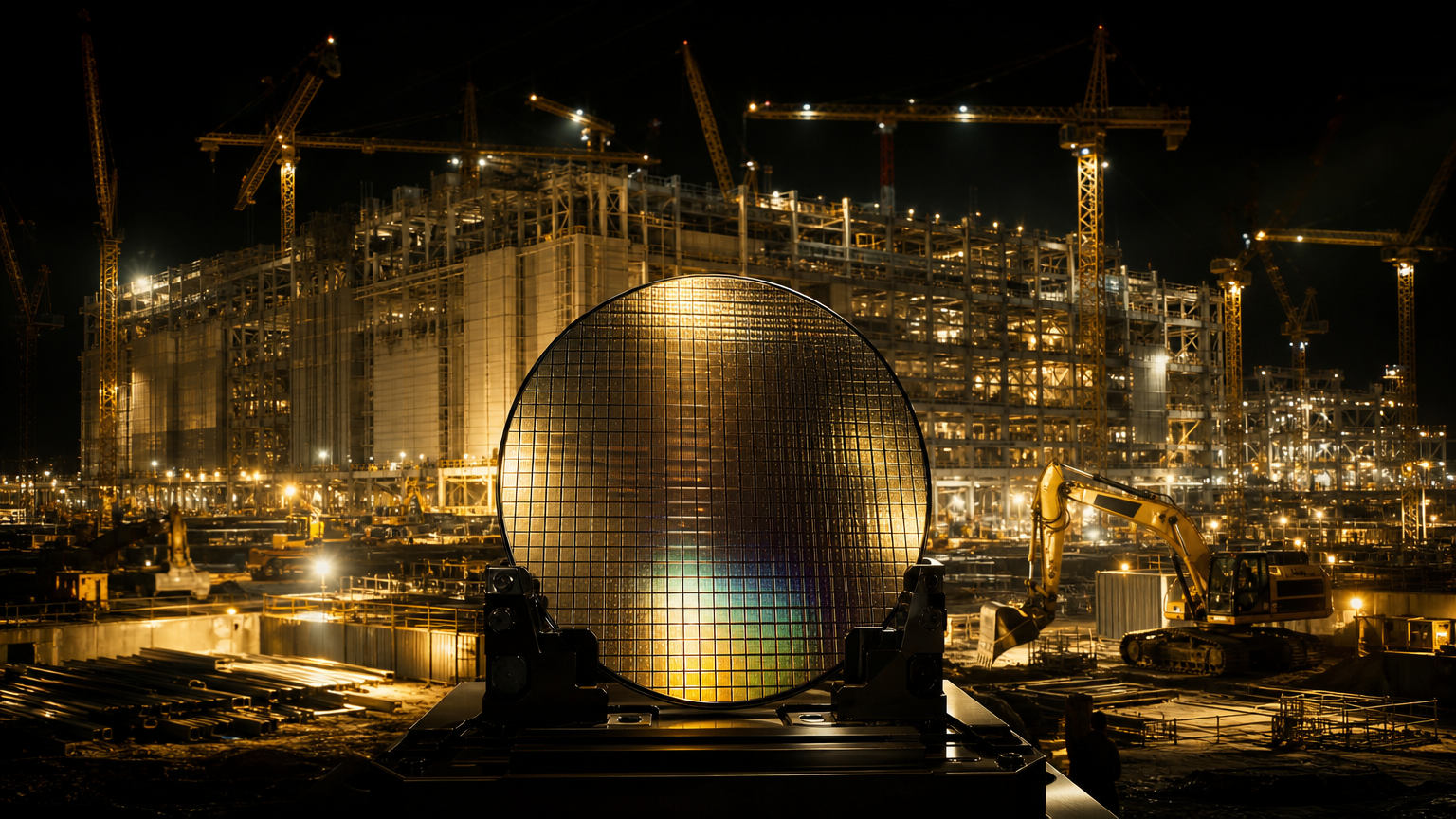
A subsidy clock is now setting the pace
The U.S. chip buildout has crossed into a new phase: not simply “announced investment,” but a race to convert announcements into qualifying construction before the end of 2026. Construction Review reported on October 5 that more than $630 billion in U.S. semiconductor megaprojects are rushing to break ground ahead of the CHIPS Act deadline, with developers seeking to preserve access to Section 48D advanced manufacturing investment credits . The timing matters because the current credit framework rewards projects that can prove construction has begun, turning the calendar itself into a strategic variable for chipmakers, suppliers, utilities, contractors and state economic-development teams .
The incentive is large enough to change behavior. The report says Section 48D now offers a 35% credit rate for qualified advanced manufacturing investment, and that companies must move before the current cutoff unless Congress extends it . That does not mean every project must be fully completed by December 2026; the critical issue is whether the taxpayer can demonstrate the kind of construction start that qualifies under the rules . In practice, that transforms site work, procurement, financing and construction sequencing into tax strategy.
“Breaking ground” is not a press release
The difference between a ceremonial groundbreaking and a qualifying start is central to the story. Construction Review says developers can rely on either a Physical Work Test or a 5% Safe Harbor, but preliminary activity such as environmental surveys or early contracts is not enough on its own . Pouring concrete, building foundations or committing enough capital to meet the safe-harbor threshold are the kinds of moves that matter . That is why the rush is visible in construction planning rather than only in corporate announcements.
This is also why the $630 billion figure should be read as a pipeline under stress, not as instant capacity. Semiconductor fabrication plants are among the most complex industrial assets in the world: they require ultra-clean environments, specialized tools, dense power connections, water systems, gas infrastructure, trained technicians and long ramp periods before they reach competitive yields. The current race may accelerate shovels into the ground, but it cannot eliminate the physics, labor constraints and process-learning curves that determine when a fab actually produces usable chips at scale.
AI demand is validating the buildout
The demand side of the story is not hypothetical. Foxconn, formally Hon Hai Precision Industry, reported third-quarter revenue of T$3.03 trillion, or about $95.4 billion, up 47% year on year and above an LSEG SmartEstimate of T$2.83 trillion, according to Reuters reporting published on October 5 . Reuters said the result was fueled by strong AI-related demand, especially in cloud and networking products . That matters for U.S. fab policy because the argument for domestic chip capacity depends on sustained end-market demand, not only on geopolitical concern.
The same signal appears in Foxconn’s own market disclosure. A London Stock Exchange RNS notice published October 5 shows Hon Hai’s September revenue at NT$1.1586 trillion, up 38.42% from the same month a year earlier, and year-to-date revenue at NT$7.6698 trillion, up 39.53% . Those are not abstract AI projections; they are assembly-chain receipts. When the company building servers, racks and electronics around advanced processors posts records, it strengthens the case that the AI infrastructure cycle is now reaching factories rather than remaining confined to chip-design headlines.
Nvidia’s market signal and Foxconn’s factory signal are connected
Nvidia’s stock-market momentum is the financial mirror of the same industrial trend. A Dow Jones report carried by Tiger Brokers on October 5 said Nvidia was pushing toward a new all-time high, with Foxconn’s AI-server results giving investors another reason to believe AI hardware demand could keep expanding . The report said Nvidia shares were up 0.9% at $236.02 in premarket trading and would surpass a prior all-time closing high of $235.74 if that move held . It also noted that Foxconn makes AI servers that house Nvidia chips, linking Nvidia’s valuation story to a manufacturing partner’s revenue data .
That linkage is important. The AI boom has often been described through the lens of chip designers, model developers and hyperscalers. But capacity expansion becomes more credible when the surrounding manufacturing chain also accelerates. Foxconn’s September-quarter revenue, record monthly sales and expectation that AI-related operations will keep growing in the fourth quarter suggest that server demand is flowing through the physical supply chain . Focus Taiwan also reported that Hon Hai’s September sales passed NT$1 trillion for the first time, driven largely by cloud and networking performance in the current AI era .
The U.S. buildout is strategic, but execution is the hard part
Washington’s objective is clear: rebuild more of the semiconductor supply chain onshore, reduce vulnerability to overseas production bottlenecks and secure capacity for AI, defense, automotive and industrial electronics. The $630 billion-plus construction race shows that tax incentives and security policy can redirect corporate timing . But the test now shifts from announcing capacity to executing it.
The bottlenecks are practical. Fabs need electricians, pipefitters, tool-installation specialists, process engineers and technicians. They need substations, backup power, specialty gases and water treatment. They also need equipment that often comes from a narrow group of global suppliers with long lead times. Even after a shell is complete and tools are installed, a fab must qualify processes, tune yields and win customer confidence. A subsidy can pull forward a groundbreaking; it cannot automatically create a mature node, a stable yield curve or a trained local workforce.
The structure of the tax credit may also shape the geography and ownership model of the buildout. Construction Review notes that Section 48D can support infrastructure on contiguous parcels and may allow split-ownership arrangements in which one taxpayer owns equipment used in another company’s manufacturing plant . That flexibility could matter for projects that require adjacent gas plants, utility systems, materials processing or other support assets. In effect, the industrial campus becomes part of the semiconductor strategy.
The deadline creates urgency and risk
The deadline is doing exactly what industrial policy often aims to do: compress decision cycles. Companies that might otherwise stretch planning over years now have reason to lock down land, financing, contractors and early work packages before the credit window closes . That urgency can accelerate domestic capacity, but it also raises the risk of rushed sequencing, cost inflation and bottlenecked labor markets.
The policy question is whether the United States can turn a deadline-driven surge into a durable manufacturing ecosystem. If many projects begin construction but struggle to staff, power, equip or ramp, the headline number will look more impressive than the output. If the projects coordinate suppliers, infrastructure and training well, the U.S. may emerge with a broader semiconductor base suited for AI and strategic industries.
For now, the market is sending two simultaneous signals. On the supply side, more than $630 billion in U.S. semiconductor megaprojects is racing to qualify before the CHIPS Act construction deadline . On the demand side, Foxconn’s record AI-linked revenue and Nvidia’s stock momentum show that the appetite for compute infrastructure remains powerful . America has queued the build command; the next challenge is turning subsidy-timed concrete into competitive silicon.
Sources from the last 72 hours
- [1]$630bn+ US Semiconductor Megaprojects in Rush to Break Ground before CHIPS Act DeadlineOct 5, 2026, 2:00 AM
- [2]Foxconn third-quarter revenue soars on AI demand, beats market forecastOct 5, 2026, 9:47 AM
- [3]Un-Audited Monthly Sales Ended September30, 2026Oct 5, 2026, 12:13 PM
- [4]Nvidia Set for Stock Record as Key Supplier Celebrates Booming AI DemandOct 5, 2026, 10:50 AM
- [5]Hon Hai reports first monthly sales over NT$1 trillion in SeptemberOct 5, 2026, 3:02 PM
AI-generated article based on recent web research, then preserved as a dated editorial snapshot.
Comments
Be the first to comment.