
Daily Podcast full article
AI Crosses the Prescribing Line
A Utah acne pilot, new pediatric AI guidance from the American Academy of Pediatrics, and Nvidia’s breast-cancer workflow pitch all point to the same shift: medical AI is no longer just suggesting what clinicians might do. It is moving closer to regulated action, where prescriptions, triage and treatment planning depend on software that must be validated, supervised and accountable.
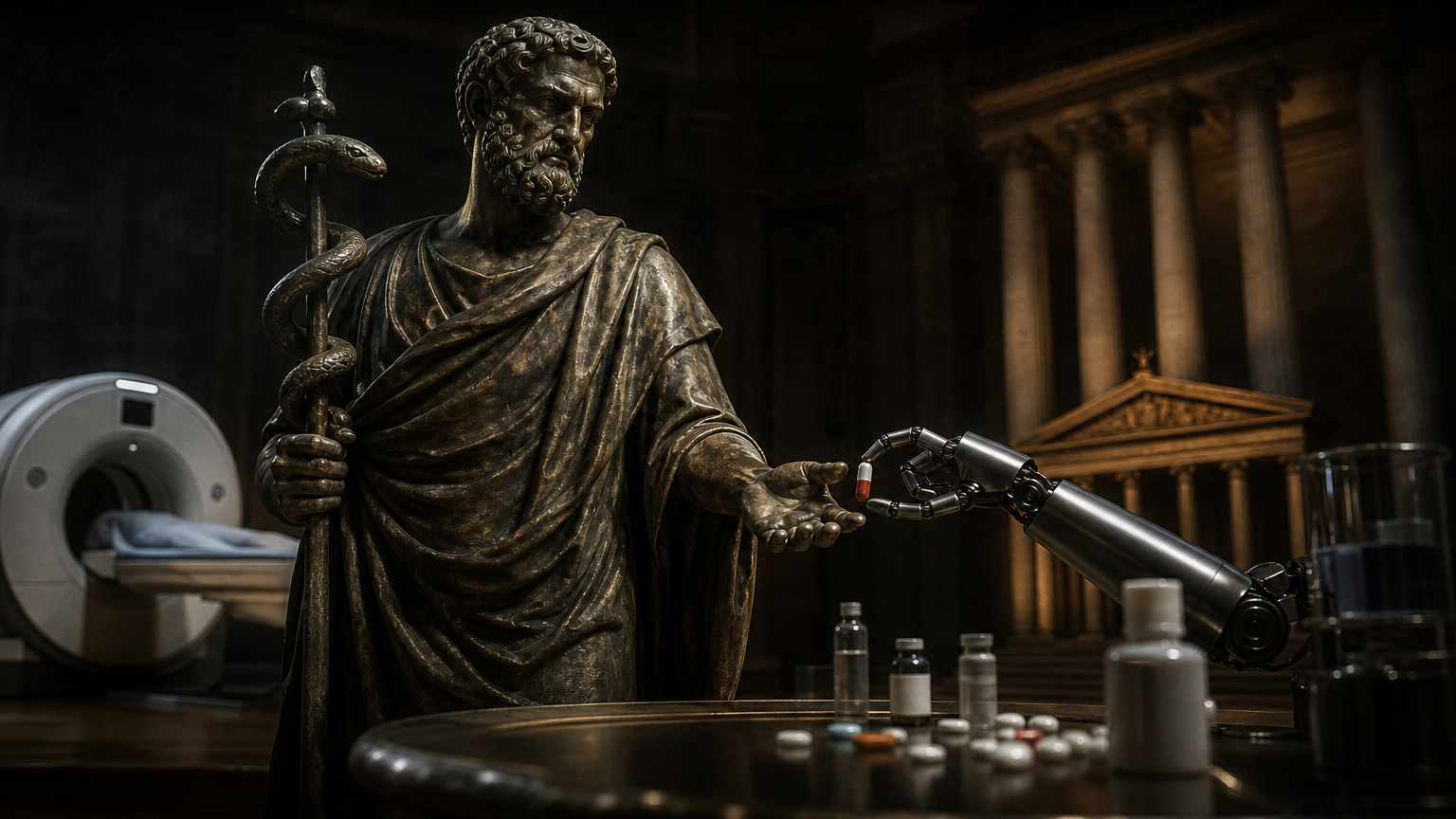
The line that medicine has long protected
The working headline is the story: AI crosses the prescribing line. Until now, the most defensible role for clinical AI has been advisory. It could flag a possible abnormality on an image, draft a note, prioritize a work queue, or summarize a chart. A licensed professional still made the medical act legible: diagnosis, prescribing, referral, treatment plan.
That boundary is now being tested in Utah. Nolla Health announced on October 5, 2026, that its Nolla Derm app is launching what it describes as the nation’s first state-authorized pilot for AI-issued initial prescriptions, beginning with acne treatment for Utah adults . The Verge reported the same day that users in Utah can scan their faces in the app, have the AI analyze acne severity, and receive an acne prescription through the pilot .
This is not a general-purpose “AI doctor,” and that distinction matters. The launch is narrow: adults in Utah, mild-to-moderate acne, a structured intake, a five-angle face scan, topical treatment plans, and escalation when the system cannot confidently select a treatment . But the principle is large. The software is not merely telling a doctor, “consider this.” It is being placed in a workflow where the clinical decision can become the prescription.
Guardrails first, autonomy later
The most important detail is the staged oversight model. In Nolla’s first phase, two licensed physicians independently review and approve every AI-generated prescription before it reaches the patient . In the second phase, covering up to 500 patients, Nolla says prescriptions can be issued directly, with physician review after the fact at least weekly . In the third phase, physicians review at least 10% of prescriptions each month, along with every escalation or side-effect case .
That structure makes the pilot less sensational than the phrase “AI doctor,” but more consequential for policy. The question is not whether an app can produce a plausible prescription. The question is whether regulators, clinicians and patients can tolerate a system in which human review moves from universal pre-approval to retrospective audit and sampling.
The pilot also uses safety thresholds. Nolla says stage one must run for at least four weeks and stage two for at least eight weeks; moving forward requires safety targets including 95% agreement with physicians, zero serious adverse events, and written approval from the state . Nolla also says the system is not free-form: it selects from pre-approved topical treatment plans using structured clinical inputs and a face-scan assessment .
That design reflects a broader lesson for medical AI. The first autonomous clinical acts are unlikely to come from open-ended chatbots making broad diagnoses. They will come from constrained systems in low-acuity domains, with limited formularies, hard stops and audit logs. Acne is a logical proving ground because many first-line therapies are topical, common, and comparatively low risk. It is also a politically useful proving ground because access problems are real: Nolla cites a 61-day average wait for a dermatology appointment in Utah and says eleven Utah counties have no dermatologist .
Pediatrics issues the caution label
The timing is striking because the American Academy of Pediatrics published a policy statement on October 3, 2026, calling for pediatric-specific guardrails around generative AI in clinical care . The AAP’s frame is not anti-AI. It recognizes potential uses in clinical decision support, documentation and education, but warns that real-world validation remains limited and that accuracy, bias, reliability, privacy and durability remain live concerns .
Children make the problem sharper. Pediatric care is not adult care in smaller doses. Developmental stage, physiology, family dynamics, consent and data sensitivity all change the risk calculation. The AAP says developers should prioritize diverse pediatric data sets, address bias proactively, implement strong privacy and security safeguards, and validate tools across relevant pediatric subpopulations . It also calls for clear human oversight, reasonable disclosure of AI involvement, pediatric-specific evaluations and postmarket surveillance .
The Nolla pilot is not pediatric; it applies to Utah residents 18 and older . But the juxtaposition is the point. As one part of medicine begins testing AI that can move from recommendation to prescription, pediatricians are formalizing the guardrails for a population where algorithmic mistakes can have longer and less visible consequences. The AAP policy effectively says: if AI is entering clinical workflows, it must be designed for the patients in front of it, not retrofitted from adult or generic systems .
From scan to treatment plan
The same week, Nvidia highlighted another side of medical AI: not prescribing, but linking detection to downstream care in breast cancer. Its October 5 post describes companies in its Inception startup program applying AI across imaging, risk assessment and treatment decisions [4]. The emphasis is important. Healthcare does not need another isolated demo that detects something on a scan but leaves the patient waiting. The value increasingly lies in shortening the chain from screening to diagnosis to treatment plan.
Nvidia points to several bottlenecks: many women over 40 skip recommended annual screening, roughly 40 million mammograms are performed annually in the United States, radiology capacity is strained, and genomic assays that inform treatment can take weeks [4]. It then profiles companies working at different points in the pathway: iSono Health’s FDA-cleared ATUSA automated 3D ultrasound system, Whiterabbit.ai’s FDA-cleared WRDensity breast-density tool, Ataraxis AI’s pathology-based treatment-response models, and SimBioSys’ AI-powered 3D tumor modeling [4].
That is a different kind of “prescribing line,” but it belongs in the same story. If an AI system can reduce time to imaging, clear low-risk studies, estimate long-term risk, predict response to chemotherapy, or model a tumor for surgery, it is not just classifying data. It is shaping the timing and options of care. Nvidia notes that some technologies described are investigational and not approved by the U.S. FDA for commercial use [4]. That caveat should travel with every ambitious medical AI claim.
The new clinical question: who owns the action?
For years, the safest answer was that AI should support doctors, not replace them. That answer is no longer specific enough. In a staged prescribing pilot, a physician may approve every first case, then review cases after the fact, then sample a minority of decisions. In an oncology workflow, a model may help decide which scan gets attention, which patient is at higher risk, or which treatment path looks promising. Responsibility becomes distributed across developers, clinicians, health systems, pharmacists, regulators and insurers.
The old model of accountability presumed a human decision-maker at the point of action. The emerging model has software doing more of the sorting, selecting and initiating. That does not remove the need for clinicians. It changes where clinicians sit in the loop.
The best version of this future is not “no doctor needed.” It is “no avoidable delay tolerated.” AI could handle routine, low-risk, tightly bounded tasks and free scarce specialists for complex patients. It could make breast screening more accessible, reduce radiology bottlenecks, and turn treatment planning from a weeks-long sequence into a more integrated workflow. But that future depends on evidence, transparency and the right to escalate to a human before harm is normalized.
The acne pilot is small. The precedent is not. Once software can issue an initial prescription under regulatory supervision, medicine has crossed a threshold. The next question is whether the permissions system around that software is strict enough for the body it is about to treat.
Sources from the last 72 hours
- [1]Nolla Health Launches the Nation's First AI-Powered Prescriptions, Starting in UtahOct 5, 2026, 2:00 AM
- [2]From Scan to Treatment Plan, AI Helps Close Breast Cancer’s Deadliest GapsOct 5, 2026, 2:00 AM
- [3]This startup is issuing AI-generated acne prescriptionsOct 5, 2026, 10:14 PM
AI-generated article based on recent web research, then preserved as a dated editorial snapshot.
Comments
Be the first to comment.