
Daily Podcast full article
Google Puts AI Compute in Orbit
Google’s Project Suncatcher prototype has moved orbital AI infrastructure from whiteboard architecture to flight hardware. The satellite is tiny by data-center standards, but its job is large: prove whether Google’s TPUs can survive launch, radiation, heat and remote operation in an environment where replacing a failed server is not a support ticket.
A data-center idea gets a spacecraft
Google’s first Project Suncatcher prototype is now in orbit, giving the company a real hardware test for an idea that has often sounded more like science fiction than cloud infrastructure planning . The spacecraft was built with Planet and launched aboard SpaceX’s Transporter-18 rideshare mission, with recent reporting identifying the flight as the October 1 Falcon 9 mission from Vandenberg Space Force Base in California and the October 5 news cycle as the point when the story became a broader technology milestone .
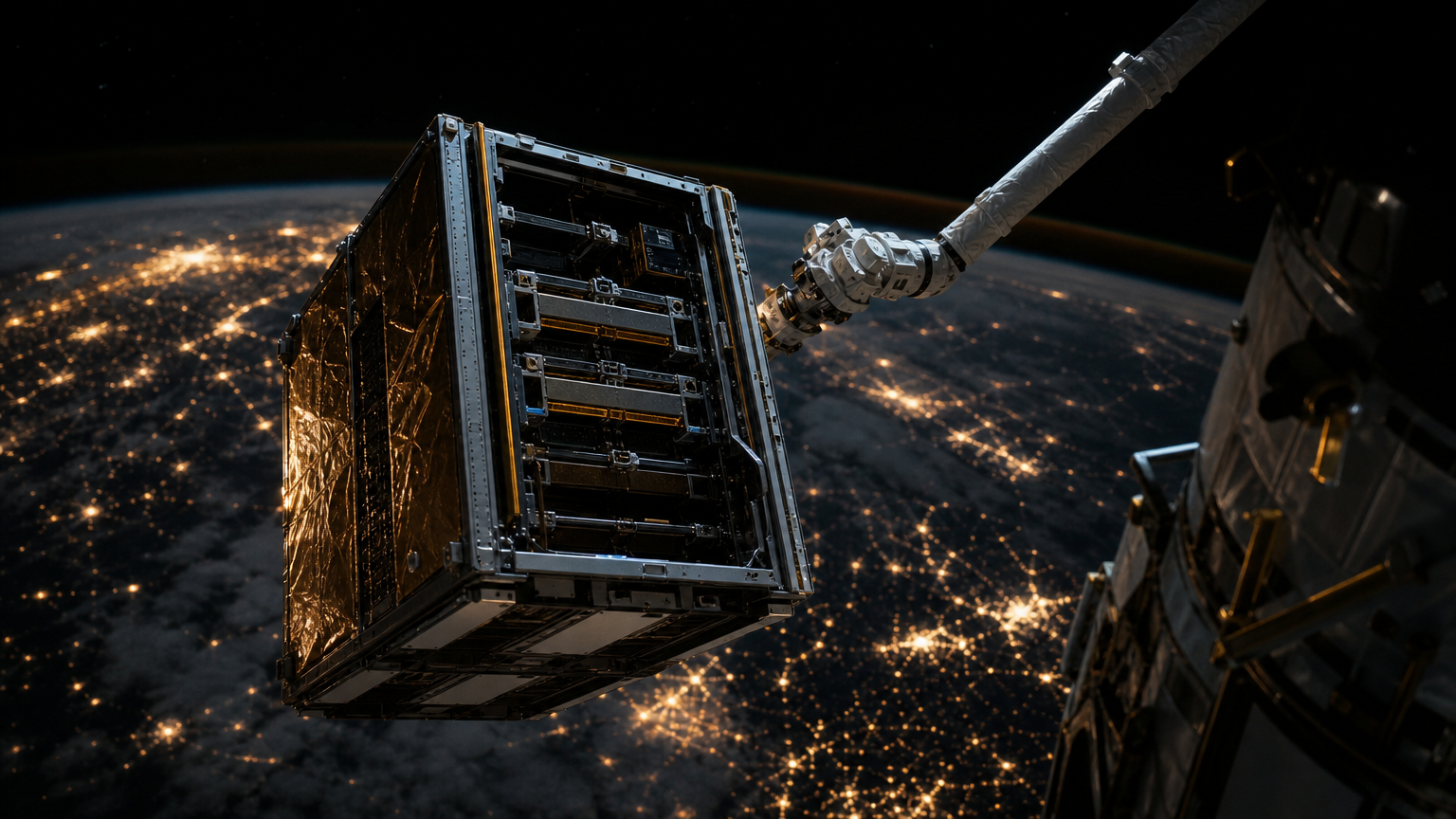
The prototype is not a hyperscale data center in space. It is a refrigerator-sized satellite, referred to as MVP, carrying four of Google’s Tensor Processing Units, or TPUs, for an early test of whether AI accelerators can operate reliably in low Earth orbit . Google has confirmed contact with the spacecraft, and recent coverage says it is operating as expected while engineers begin collecting data from the mission .
That distinction matters. The experiment is less “cloud region in orbit” than “can the essential server hardware behave predictably after a rocket ride and during orbital exposure?” The answer will shape whether orbital compute remains a research moonshot or becomes a plausible addition to future AI infrastructure.
Why put AI compute in orbit at all?
The strategic appeal is straightforward: AI data centers on Earth require huge amounts of power, cooling, land, grid interconnection and water, and they increasingly face public resistance and permitting pressure . In orbit, solar panels can receive far more continuous sunlight than a comparable installation on Earth, and Project Suncatcher is built around the idea that machine-learning infrastructure might eventually be powered by that abundant solar energy .
Recent coverage of Google’s plan says suitable orbital solar panels could generate up to eight times more power than equivalent panels on Earth, because they avoid weather, atmosphere and much of the day-night interruption that affects ground systems . That does not automatically make orbital data centers economical, but it explains why cloud engineers are studying the idea seriously.
There is also a data-locality argument. Satellites already collect enormous volumes of Earth-observation and communications data. If some processing can happen nearer to where that data is created, operators might reduce downlink bottlenecks and send back more compact, higher-value outputs rather than raw streams. That is not yet what Google’s MVP is doing at scale, but it is one reason orbital compute is technically interesting.
What the prototype is actually testing
Project Suncatcher’s first orbital job is to measure how TPUs behave under launch vibration, radiation, temperature swings and vacuum conditions . Those are not edge cases in space; they are the baseline environment. A chip that is mundane in a terrestrial data center becomes a systems-engineering problem when it is bolted to a satellite bus.
The launch environment alone is brutal. Orbital Pulse’s October 4 analysis notes that Suncatcher hardware must survive the violent mechanical loads of launch before it can even begin computing in orbit . Once there, the hardware must tolerate radiation and thermal cycles without the protective infrastructure available in a ground data center.
Radiation is one of the headline risks, but recent reporting frames heat as the more immediate bottleneck. The vacuum of space prevents ordinary airflow cooling, and JQJO’s October 4 summary notes that conventional cooling assumptions break down when there is no air to carry heat away . Orbital Pulse reported that the TPUs are expected to run a version of Google’s Gemma model for about 15 minutes at a time because of heat limits, then pause to cool .
That 15-minute duty cycle is the experiment in miniature. If radiators and heat pipes perform better than expected, Google gains design margin. If they underperform, the company learns early that the thermal architecture must change before the project can scale. Either result is useful; what matters is that the answer now comes from orbit rather than simulation.
The maintenance problem no cloud engineer can ignore
Project Suncatcher also tests an uncomfortable operational truth: in orbit, failed infrastructure is not easily repaired. A terrestrial server can be swapped. A satellite server must be designed to tolerate faults, degrade gracefully or wait for an expensive replacement launch. That constraint changes the culture of cloud design.
Recent reports emphasize that the current mission is a prototype, not a commercial service . That is important because hyperscale computing depends not only on chips and power, but also on maintenance workflows, network reliability, spare capacity, security, observability and predictable replacement cycles. Space removes the simple fixes.
The communications challenge is equally central. Google’s longer-term Suncatcher concept involves satellites connected by high-bandwidth optical links, and multiple recent reports point to 2027 as the next stage for laser interconnection tests . A real orbital AI cluster would need fast links between satellites, reliable links to Earth and precise formation management, all while spacecraft move at orbital speed.
The economics are still unresolved
Launch cost is the other giant variable. Orbital Pulse summarized Google’s launch-cost arithmetic: if launch prices eventually fall near $200 per kilogram, orbital compute could begin to approach the annualized power-cost range of terrestrial data centers under some assumptions . That is a major “if,” not a business case.
The same analysis notes that reaching such prices depends on a launch cadence and cost decline that would likely require very high-volume reusable launch operations . In other words, Suncatcher’s economics are tied not only to Google’s chips, but also to the pace at which SpaceX and the broader launch market can reduce the cost of putting mass in orbit.
That is why the October milestone should be read carefully. Google has not solved orbital data centers. It has started gathering the kind of evidence required to know whether the idea deserves more investment. For a moonshot, that is the difference between a pitch deck and an engineering program.
Why this moment matters
The reason this story matters is not that four TPUs in space will change AI capacity overnight. They will not. The reason it matters is that a major cloud company has now put part of the AI infrastructure stack into orbit and begun testing it under real conditions .
If the mission shows that commercial AI accelerators can operate predictably in space, Project Suncatcher could influence future satellite design, edge-AI processing, and the long-term geography of compute. If cooling, radiation, networking or launch economics prove too difficult, the experiment will still provide a valuable boundary: it will show where orbital compute stops being romantic and starts being too expensive or fragile.
For now, Google has put AI compute in orbit. The next question is not whether the satellite can make a headline. It is whether the hardware can keep working, cooling, communicating and surviving long enough to make orbital infrastructure feel less like a stunt and more like a system.
Sources from the last 72 hours
- [1]Google Launches AI Data Center Prototype Into Orbit on SpaceX RocketOct 6, 2026, 12:58 AM
- [2]Google completes Project Suncatcher prototype launch for orbital AI computeOct 5, 2026, 2:00 AM
- [3]Google Unveils Project Suncatcher to Explore Solar-Powered AI Computing in OrbitOct 5, 2026, 2:00 AM
- [4]Google plans first test of AI chips in space under Project SuncatcherOct 4, 2026, 10:18 PM
- [5]Google Puts Four TPUs in Orbit on Its First Suncatcher SatelliteOct 4, 2026, 2:00 AM
AI-generated article based on recent web research, then preserved as a dated editorial snapshot.
Comments
Be the first to comment.