
Daily Podcast full article
Google signs $4.3B nuclear pact
Google’s 20-year agreement with Constellation Energy is more than another clean-power purchase: it is a direct attempt to turn electricity supply into a core piece of AI infrastructure, adding 890 megawatts of new nuclear capacity to the PJM grid while giving Constellation the revenue certainty to fund more than $4.3 billion in upgrades.
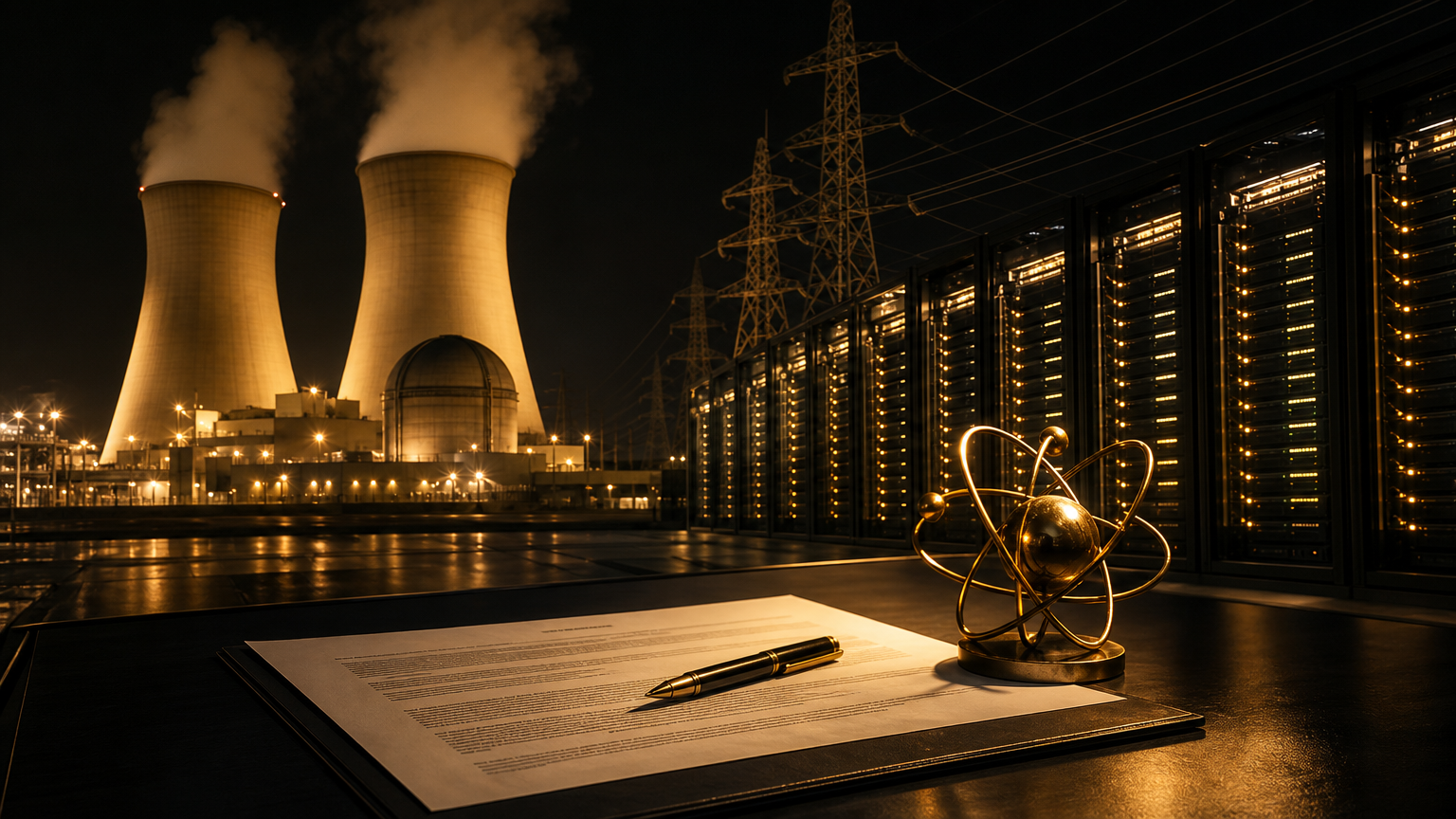
A 20-year bet on firm power
Google and Constellation Energy announced a 20-year power purchase agreement on October 6, 2026, designed to bring 890 megawatts of new nuclear capacity onto the PJM Interconnection grid, the largest regional electricity market in the United States . The companies say the capacity will come from investments in new equipment and technology at 11 Constellation-owned nuclear units in Illinois, Pennsylvania and New Jersey, with upgrades aimed at improving thermal and electrical efficiency rather than building an entirely new plant from scratch .
The headline number is striking, but it needs a precise reading. The agreement represents more than $4.3 billion of new investment by Constellation, enabled by Google’s long-term offtake commitment, rather than a simple one-time check from Google for that amount . Reuters framed the broader commercial arrangement as a 3,590-megawatt power deal, with the 890 megawatts of new nuclear capacity accounting for roughly a quarter of the total and a separate long-term supply agreement covering another 2,700 megawatts in PJM .
That structure matters because it shows how hyperscalers are trying to solve a two-sided problem. Google needs large volumes of dependable electricity for AI data centers, while grid operators and generators need confidence that new capacity will be paid for over many years . By signing for 20 years, Google is effectively helping Constellation justify capital spending on uprates that would be harder to finance on short market signals alone .
Why nuclear uprates are the shortcut
The deal is built around nuclear uprates, a less flashy but potentially faster path than waiting for new reactors. Google describes uprates as modernization work on turbines, steam generators and digital control systems that allows existing reactors to produce more electricity . In the joint announcement, Google and Constellation said the first uprate is expected to be delivered by 2028, and Google’s own blog says the full set of projects should add 890 megawatts of firm, 24/7 clean power before the end of 2032 .
That timing is central to the logic. A new nuclear plant can take many years to permit, finance, interconnect and build; an uprate uses operating assets that already have sites, workforces, grid connections and regulatory histories . Google and Constellation argue that the 890 megawatts are comparable to the output of a large new conventional reactor, but with a timeline that can be materially shorter than greenfield construction .
The geography is also important. PJM spans the Mid-Atlantic and parts of the Midwest, and Google says the grid serves 67 million people across 13 states . Data-center growth has become a major concern in PJM because electricity demand is rising at the same time that reliability, affordability and interconnection constraints are politically sensitive . The companies explicitly connect the agreement to PJM’s “Bring Your Own Power” concept, a framework meant to push large new loads to help bring additional supply rather than simply drawing from an already stressed grid .
The AI build-out now includes the grid
For years, the AI infrastructure conversation centered on chips, servers, cloud campuses and fiber. This agreement makes the power layer just as visible. Google says the financing is driven by its data center growth and is intended to unlock more power from the existing energy system for all customers, not only for Google’s own operations . The company also says the arrangement is designed so that other grid customers do not bear the costs of the uprates tied to Google’s demand .
That language reflects a broader shift in the politics of data centers. Communities increasingly ask whether AI facilities are crowding out local power, raising bills or forcing new fossil-fuel generation. Google and Constellation are positioning the pact as the opposite: a private-sector contract that adds new carbon-free capacity, sustains nuclear jobs and strengthens the grid . The joint announcement says the work will help sustain roughly 4,400 existing jobs and create about 7,200 construction jobs during the build-out period .
The deal also goes beyond electrons. Constellation selected Google Cloud and Gemini Enterprise under an expanded five-year technology alliance to build what the companies call an “AI for Energy” blueprint, with applications in capacity delivery, asset dispatch and protection of critical infrastructure . Yahoo Finance reported that Gemini Enterprise will be used for functions including site selection, outage management and infrastructure protection .
This creates an interesting loop: Google needs nuclear power to scale AI, while Constellation plans to use Google’s AI tools to run and expand energy infrastructure more efficiently . If it works, the model could become a template for other large power users that need firm clean capacity but do not want to wait for distant new-build projects.
A competitive moat made of megawatts
The agreement also sharpens the competitive landscape among cloud and AI platforms. Reuters noted that major technology companies have been racing to secure large electricity supplies for data centers across the United States, including nuclear-linked agreements involving Constellation, Microsoft and Google in recent years . Yahoo Finance also pointed to a broader Big Tech turn toward nuclear power as companies look for clean, reliable capacity to support the AI build-out .
This is why the Google-Constellation pact should be read as a strategic infrastructure move, not just a sustainability announcement. Access to firm, carbon-light power increasingly sits alongside accelerators, networking equipment, land, water and permitting as a constraint on AI growth. A cloud provider that can secure dependable power for decades may have an advantage over a rival that can buy chips but cannot energize enough data-center capacity where it is needed.
Google says this agreement brings the new nuclear capacity it has enabled in the U.S. energy system through uprates and restarts to more than 1.5 gigawatts . The company cited other nuclear-related efforts in Georgia, Iowa and Tennessee as part of a broader portfolio, including uprates, restarts and advanced nuclear deployment . The Constellation pact is therefore not an isolated experiment; it is one of the clearest signs yet that Google is assembling an energy strategy around the physical demands of AI.
What to watch next
The key milestones are practical rather than rhetorical. The first is whether the initial uprate arrives in 2028 as planned . The second is whether the full 890 megawatts are delivered before the end of 2032, as Google says . The third is whether PJM and regulators accept this kind of privately backed supply expansion as a durable answer to data-center load growth .
There is also a financial question: if 20-year contracts become the norm, only the largest technology companies may be able to secure the clean firm power needed for the next generation of AI infrastructure. That would make electricity procurement part of the hyperscaler moat. In that sense, Google has not merely bought power. It has added a nuclear layer to its AI supply chain.
Sources from the last 72 hours
- [1]Google and Constellation Announce Landmark Agreement to Bring 890 MW of New Nuclear Capacity to PJM Grid as Part of Long-Term Power DealOct 6, 2026, 2:00 AM
- [2]Why we're backing America's existing nuclear plantsOct 6, 2026, 2:00 AM
- [3]Google enters massive 3.6-GW power deal with Constellation EnergyOct 6, 2026, 8:36 AM
- [4]Google signs $4.3 billion nuclear power deal with ConstellationOct 6, 2026, 1:19 PM
- [5]Google signs 20-year nuclear deal with Constellation Energy to power AI build-outOct 6, 2026, 3:11 PM
AI-generated article based on recent web research, then preserved as a dated editorial snapshot.
Comments
Be the first to comment.