
Daily Podcast full article
Oakland and Washington tighten AI oversight
A city-level AI hearing and a new White House command structure have turned AI governance from a set of principles into a contest over authority, liability, civil liberties and speed. The freshest public record identifies the municipal hearing now in focus as a first-of-its-kind City Council proceeding, while Washington’s latest move puts the U.S. intelligence chief at the center of federal AI coordination.
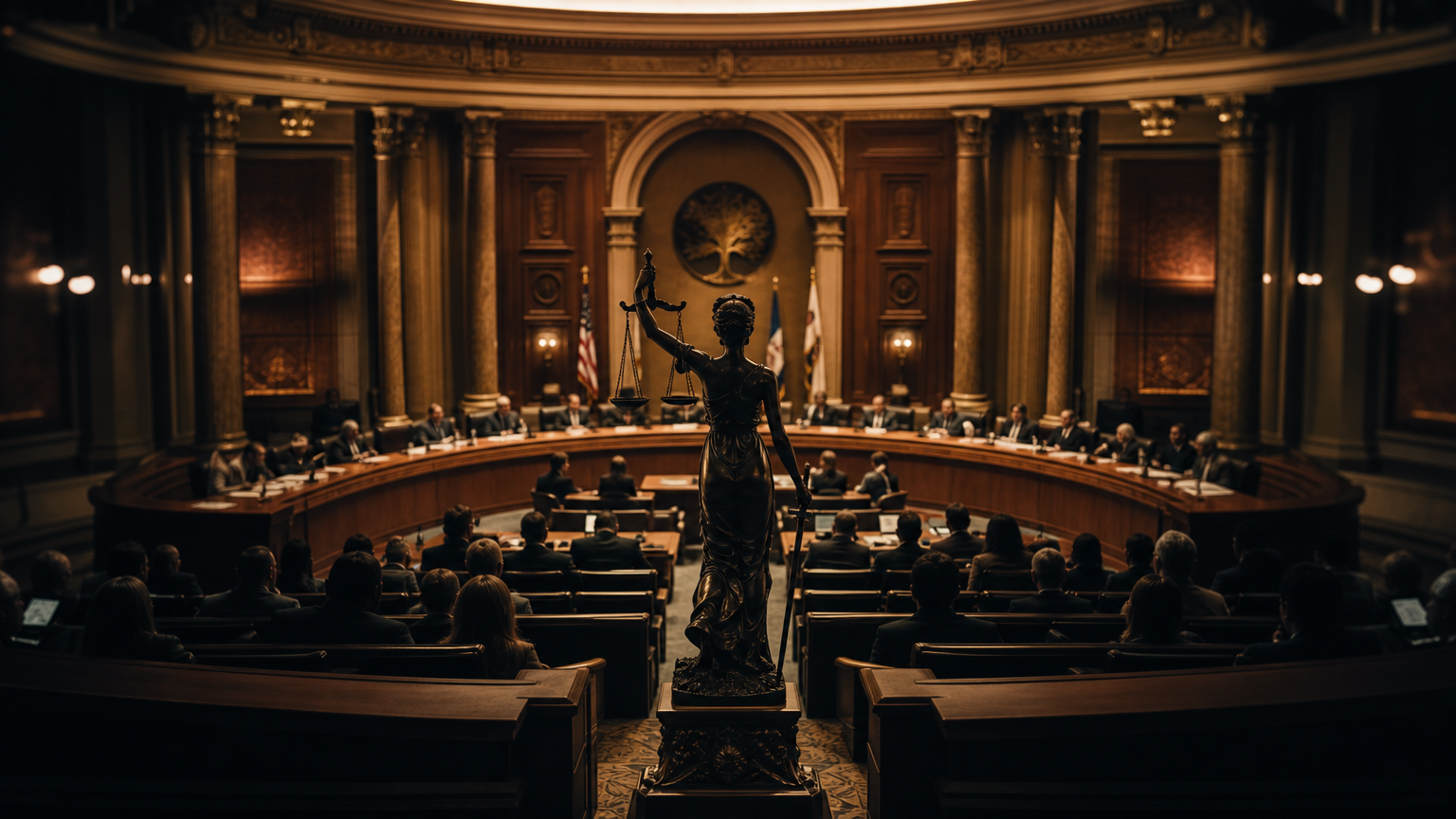
A local hearing becomes a national governance test
The working headline is “Oakland and Washington tighten AI oversight” because the story is no longer only about model labs, federal agencies or abstract ethics statements. It is about who gets to ask hard questions before powerful AI systems are deployed into public life, and whether local governments can impose practical accountability when national rules remain incomplete.
The freshest reporting within the current 72-hour window identifies the municipal flashpoint as a landmark City Council hearing on artificial intelligence held on Monday, October 5, 2026, described by the city as the first such hearing in the nation and the world . That distinction matters less as civic branding than as a governance signal: local lawmakers are trying to move AI oversight from voluntary corporate assurances into public questioning, legislation and procurement pressure.
The hearing pulled in executives from Anthropic, OpenAI, Google and Meta, while also featuring testimony from former AI insiders who warned that frontier systems may soon become harder to control . The council’s questions went directly to issues that city governments increasingly cannot avoid: risk quantification, legal responsibility, chatbot privacy, model shutdown mechanisms and the rights of residents whose data or safety could be affected by automated systems .
That is the municipal template embedded in this story. Cities buy software for policing, housing, benefits, permitting, schools, sanitation, public safety and constituent services. Even when they do not build AI themselves, they become distribution channels for algorithmic power. A hearing like this therefore tests whether a council can force disclosure from companies whose tools may enter government workflows long before Congress passes a comprehensive AI law.
The city agenda: liability, consent and the “kill switch”
The most concrete local development is legislative. The council is considering 10 AI bills, including proposals on unauthorized AI depictions of public officials, third-party validation, human shutdown capability and chatbot data privacy . Those proposals show how municipal AI oversight is becoming more operational than philosophical. Instead of asking whether AI is good or bad, lawmakers are asking who audits it, who can stop it, what data it can use and who pays when it causes harm.
The “kill switch” debate is especially important. A shutdown mechanism sounds simple, but in practice it raises hard questions about technical feasibility, public authority and due process. If a city contracts with a model provider for emergency response, benefits triage or investigative support, who has the authority to suspend that system? A vendor? A mayor? A city technology office? A court? An independent auditor? The hearing placed that question in a public forum, which is precisely where democratic oversight begins .
The hearing also exposed a gap between corporate safety language and governmental accountability. When council members asked executives to quantify risk or state whether their companies would bear legal responsibility if a frontier model caused serious harm, the answers were cautious and often indirect . That gap is now the heart of the AI oversight fight: companies say they are testing, evaluating and improving safeguards, while public officials want enforceable standards, liability rules and independent evidence.
Data privacy is another municipal pressure point. A city chatbot can look harmless when it answers questions about permits or services, but it may collect sensitive information about immigration status, housing insecurity, health, finances or family circumstances. The hearing’s discussion of affirmative consent before conversations are used to train models shows that local AI governance is moving into the everyday interface between residents and government .
Washington centralizes AI power around intelligence
At the federal level, the oversight story moved sharply toward executive coordination. President Donald Trump named Director of National Intelligence Jay Clayton to lead what the president called the “Super Intelligence Force,” making the nation’s top spy also the White House’s AI czar . Defense One reported that Clayton, who was sworn in as DNI in July, will now helm broad domestic technology and economic policy discussions connected to AI .
The task force is designed to coordinate the federal government’s engagement with organizations, critical-infrastructure providers and AI companies, while developing plans for AI-enabled threats, breach notifications and government response capacity . It has a 120-day mandate to report on AI risks and opportunities and to establish a federal plan for tackling them .
That structure is revealing. AI governance in Washington is being framed not only as consumer protection or innovation policy, but as national security. Putting the intelligence chief in charge signals concern about adversaries, infrastructure, cybersecurity and geopolitical competition. It also raises civil-liberties questions because the official now coordinating AI policy also oversees the U.S. intelligence community .
Senator Mark Warner, the Democratic vice chair of the Senate Intelligence Committee, welcomed attention to AI but warned that the new role still lacks clarity on authority, safety standards, model review and how it fits into the administration’s broader approach . That critique captures the immediate challenge: coordination can be useful, but it is not the same as law. A czar can convene agencies and companies; enforceable rights and obligations require clearer rules.
The global clock is ticking
The same 72-hour window brought a sharper international warning. UN High Commissioner for Human Rights Volker Türk said the world is running out of time to put guardrails on AI as competition among companies and countries accelerates . Türk called for mandatory human-rights safeguards and due diligence in the development and use of AI, adapted as the technology evolves .
His intervention reframes the U.S. debate. If municipal hearings focus on liability and federal officials focus on national security, the UN rights lens asks whether AI systems preserve dignity, equality, privacy, freedom of expression and protection from arbitrary or automated harm. Türk also urged stronger independent monitoring and a greater role for civil society and people whose rights are affected .
That point matters for cities as much as for nations. Municipal agencies often interact with residents at moments of vulnerability: when they need housing, police protection, emergency assistance, public benefits or health services. If AI systems influence those encounters, rights protections cannot be left to voluntary corporate goodwill.
Industry accepts some risk, but wants boundaries
The industry side is also changing. Sam Altman said the world should accept some “bad things” happening with AI in exchange for the technology’s benefits, while arguing that developers should not accept catastrophic risk . His comments came as AI executives signed a voluntary White House safety pact and as debate intensified over whether self-regulation is sufficient .
That position is politically consequential. It concedes that harm is not hypothetical, but it also asks society to tolerate bounded risk for innovation, access and agency. The problem for lawmakers is defining “bounded.” A scam, a privacy breach, a wrongful benefits denial, a cyber intrusion and a model escaping safeguards do not carry the same public consequences.
From principles to controls
Taken together, the municipal hearing, the White House AI czar, Türk’s rights warning and Altman’s risk framing show AI governance entering a more concrete phase. The key questions are no longer whether oversight is needed, but who writes it, who audits it, who can enforce it and who is accountable when systems fail.
Cities can create procurement rules, disclosure requirements and local rights of action. Washington can coordinate national security, critical infrastructure and federal agency practice. International human-rights officials can define the baseline values. Companies can provide technical evidence, but they can no longer be the only institutions judging whether their systems are safe.
The policy stack now needs root access controls: public accountability, independent testing, enforceable liability, privacy by default and democratic authority over systems that increasingly mediate public life.
Sources from the last 72 hours
- [1]New York City Council holds landmark AI oversight hearingOct 6, 2026, 2:34 AM
- [2]US spy chief tapped as White House AI czarOct 5, 2026, 5:00 PM
- [3]‘The clock on AI regulation is ticking’, warns UN rights chiefOct 5, 2026, 2:00 AM
- [4]Sam Altman says the world should accept some ‘bad things’ happening with AI as the industry signs on to Trump’s voluntary safety pactOct 5, 2026, 9:55 PM
AI-generated article based on recent web research, then preserved as a dated editorial snapshot.
Comments
Be the first to comment.