
Daily Podcast full article
Black Hills plans $1.8B Google power build
Black Hills has moved from pipeline talk to signed agreements: a 2048-dated power package for Google’s planned Cheyenne data center, backed by $1.8 billion of new gas generation, a private microgrid structure and explicit promises that existing utility customers will not carry the project’s costs [1].
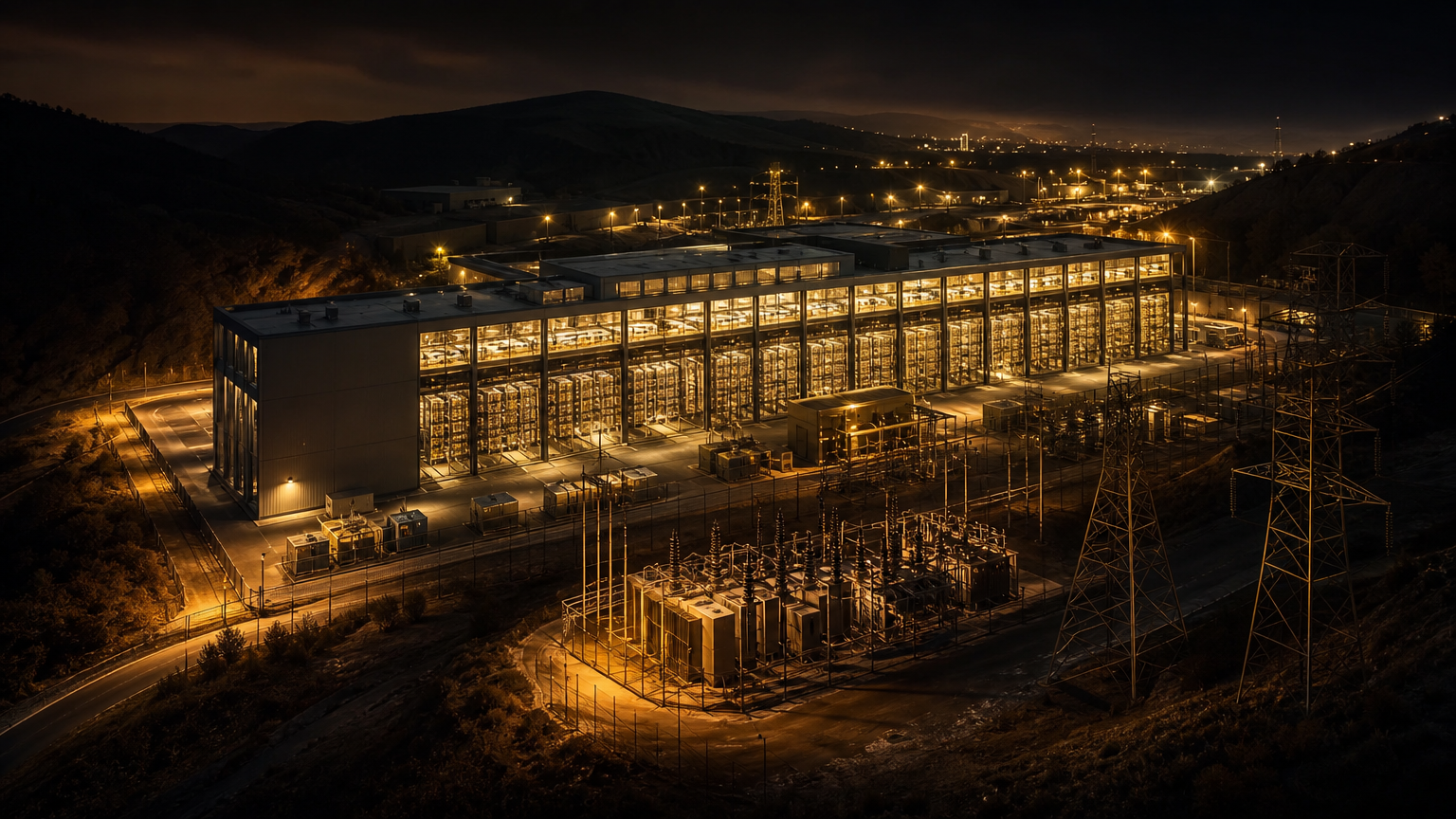
The deal: a data center becomes a power project
Black Hills Corp. says it has signed definitive agreements, effective September 30, 2026, to serve a planned Google data center in Cheyenne, Wyoming, with contract terms running through 2048 . The company disclosed the arrangement in an October 6 Form 8-K, making the announcement a formal securities filing as well as a corporate press release . The headline number is $1.8 billion: Black Hills plans to invest that amount from 2027 through 2029 in new company-owned generation to support the Google load .
The deeper story is that a cloud facility is being treated less like an ordinary large customer and more like an energy-infrastructure anchor tenant. Reuters framed the move as part of a race by technology companies to secure electricity for AI data centers, whose power demand is now a bottleneck in where and how quickly computing capacity can be deployed . In Cheyenne, that bottleneck is being addressed with generation, tariff design, microgrid management and customer-protection provisions stitched into one long-dated commercial package .
What Black Hills plans to build
Black Hills says the project will be served by a total resource mix of about 2.7 gigawatts, including reserve margins . Within that mix, the utility will provide up to 590 megawatts of grid-connected energy service using company-owned generation and market energy, while also managing about 2.1 gigawatts of Wyoming-based third-party contracted resources through a privately managed microgrid under its Large Power Contract Service tariff .
The company-owned build is specifically described as 564 megawatts of nameplate natural-gas generation at Black Hills’ existing Cheyenne Prairie Generating Station location . The remaining 26 megawatts of the 590-megawatt grid-connected service would come through a combination of market energy purchases and retail utility service under the applicable industrial tariff . In plain English, the Google site is not being supplied by a single plant; it is being wrapped in a portfolio that includes new gas generation, market purchases, contracted third-party output and active operational coordination.
The timing is equally important. Black Hills expects the data center to begin taking energy service in late 2027 and to ramp to peak load in 2030 . That schedule explains why the utility is already emphasizing procurement and construction: large turbines, interconnection equipment, substations and transmission upgrades do not arrive on software timelines.
The money: return, fees and cash flow
For Black Hills, the arrangement is designed to be a growth platform, not just a pass-through service contract. The company expects to begin earning a return on its generation investment when construction starts in 2027, while microgrid management fee revenue is expected to begin in late 2027 and rise according to the contract ramp schedule . By 2030, Black Hills expects the project to contribute about $150 million of net income .
The long-term financial claim is even larger: Black Hills says the project is expected to generate about $2.4 billion of unlevered free cash flow through 2048, net of the $1.8 billion capital expenditure . The company also says it expects to finance the generation investment through a mix of project-generated cash flow, debt and other financing alternatives, while evaluating options intended to preserve its investment-grade credit profile .
One notable detail is Google’s upfront role. Black Hills says Google has provided $399 million of refundable advances to procure long lead-time equipment under the parties’ generation reservation agreement, with Black Hills expecting to reimburse those advances by June 30, 2027 . That detail matters because it shows how hyperscale customers are increasingly pulling utility supply chains forward: the cloud buyer is not simply waiting at the meter.
The rate question: who pays?
The central political and regulatory issue in any data-center power deal is whether other customers end up subsidizing it. Black Hills is directly addressing that concern. The company says the agreements and supporting regulatory mechanisms are structured so that Google bears all costs associated with serving the planned data center over the life of the project . Reuters likewise reported that the agreement requires Google to cover the full cost of supplying electricity to the facility, preventing those expenses from being passed on to other utility customers .
Black Hills lists several customer protections: cost pass-through mechanisms, stranded-asset risk protection, early-termination protection, and collateral or financial assurance requirements tied to the data center’s commitments . These provisions are not cosmetic. If the project underperforms, is delayed, or terminates early, the question becomes who is left holding generation, interconnection and transmission costs that were built for one very large load. Black Hills is telling regulators, investors and customers that the contract is built to answer that question before it becomes a rate case fight.
Permits and transmission are still part of the story
The announcement is definitive, but not operational. Black Hills says the Robinson substation Certificate of Public Convenience and Necessity was approved in May 2026, that it filed an industrial siting permit for the Cheyenne Prairie expansion in July 2026, and that the air-quality permit for the Cheyenne Prairie expansion was approved in August 2026 . The company also says it anticipates additional transmission investment to serve the Google project and other regional large-load opportunities .
Transmission may prove to be the quieter constraint. Generation capacity can be contracted, financed and built, but moving power reliably around a regional grid requires substations, rights of way, regulatory approvals and interconnection sequencing. Black Hills says it filed a Large Customer Transmission Cost Adjustment Mechanism in June 2026, filed a South Cheyenne Transmission Expansion CPCN in September 2026, and expects to file a Wyoming transmission expansion CPCN in the fourth quarter of 2026 .
That means the Google load is already reshaping the utility’s planning map. The $1.8 billion generation build is the headline, but the grid work around it may determine how fast the project can actually scale.
Why this matters beyond Cheyenne
The Cheyenne plan captures the new physics of cloud growth: artificial-intelligence infrastructure is limited not only by chips, land and fiber, but by firm megawatts. Google’s planned data center needs a power architecture large enough to support round-the-clock computing, and Black Hills is offering a structure that combines dedicated generation with flexible management of third-party resources .
The model also shifts part of hyperscale computing’s capital burden into utility-style infrastructure. Black Hills receives the prospect of long-term earnings, fee income and cash flow; Google receives a clearer path to power availability; regulators receive a contract framework that claims to protect existing customers . The bargain is attractive because it turns a potential grid shock into a planned buildout. It is still a bargain that depends on execution.
The risks are visible. Gas generation raises fuel-price and emissions questions. Transmission projects can run into cost, timing and siting friction. A 2048 contract term assumes the data-center load remains valuable and durable for more than two decades. And even with customer protections, public scrutiny will follow any project large enough to add hundreds of megawatts of demand in one region.
The bottom line
Black Hills’ Google agreement is not just another utility sales announcement. It is a blueprint for how AI-era data centers may be powered: long contracts, customer-specific generation, microgrid management, regulatory mechanisms and explicit cost-allocation promises. The cloud has discovered that before models can run, megawatts have to arrive.
For Cheyenne, the next phase is practical rather than promotional: build 564 megawatts of new gas generation, coordinate a 2.7-gigawatt resource mix, complete the needed transmission work, and prove that Google’s costs stay with Google . If Black Hills delivers, the deal could become a reference case for how regional utilities turn data-center demand into infrastructure investment without turning ordinary customers into involuntary financiers.
Sources from the last 72 hours
- [1]Black Hills Corp. Executes Definitive Agreements to Serve Google’s Planned Data Center in Cheyenne, WyomingOct 6, 2026, 10:10 PM
- [2]8-KOct 6, 2026, 2:00 AM
- [3]Black Hills plans $1.8 billion investment to power Google's data centerOct 6, 2026, 11:09 PM
AI-generated article based on recent web research, then preserved as a dated editorial snapshot.
Comments
Be the first to comment.