
Daily Podcast full article
Pasqal starts €50M quantum line
Pasqal has moved Q-PLANET from concept to execution, putting a €50 million European pilot line to work on the hard manufacturing layer behind neutral-atom quantum technology. The program’s real test is not whether Europe can describe a quantum roadmap, but whether it can repeatedly build the chip-scale lasers, atom chips, vapor cells, process kits and supply-chain habits that turn laboratory physics into industrial infrastructure.
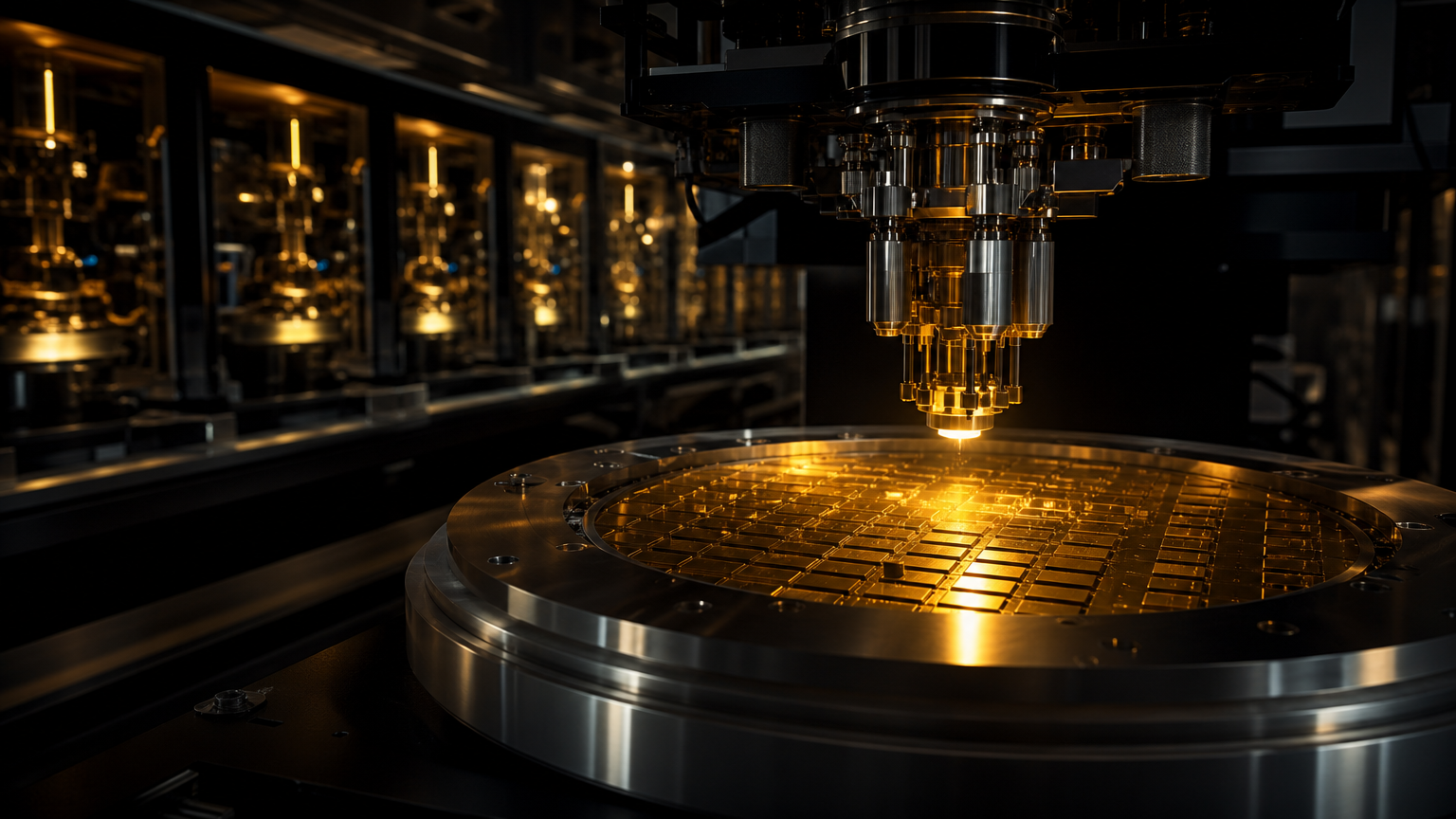
Europe presses run on quantum manufacturing
Pasqal’s Q-PLANET program has crossed the line from strategy into execution. Three months after its official kick-off in Brussels, the French neutral-atom quantum company says it is coordinating implementation of the European pilot line, backed by €50 million over three years and co-funded by the EU Chips Joint Undertaking together with national and regional authorities . The consortium brings together 28 partners from 11 European countries to develop industrial-grade chip components for neutral-atom quantum computing, sensing and communications .
That wording matters. Q-PLANET is not framed as another research grant for a single prototype. It is a manufacturing effort: a pilot line meant to make critical components repeatable, integrable and usable by European quantum builders. Quantum Computing Report described the development as the move of Q-PLANET into its operational execution phase, with Pasqal leading a 28-partner consortium across 11 countries to construct a domestic semiconductor and photonic supply chain for neutral-atom quantum technologies .
The short version is simple: Europe has pressed run on a quantum hardware line. The longer version is more consequential. Quantum roadmaps increasingly depend on fabrication capacity, standardization and component quality as much as they depend on algorithms or headline qubit counts. Pasqal’s execution phase puts that industrial constraint at the center of the project.
What Q-PLANET is actually building
Neutral-atom systems use carefully controlled atoms as the physical basis for quantum devices. To move such systems from lab benches into wider deployment, companies need precision photonics, reliable atom-control hardware, packaging approaches and repeatable production methods. Q-PLANET’s declared scope reflects that reality.
Over the next three years, the consortium plans to develop chip-based components including lasers at four key wavelengths — 461 nm, 698 nm, 795 nm and 1013 nm — alongside atom chips for quantum sensing and computing, and microfabricated vapor cells for atomic clocks and field sensors . Pasqal is specifically set to lead development activities for 1013 nm chip-based laser sources, one of the project’s core technology streams .
The pilot line also targets standardized Process Design Kits and Assembly Design Kits, known as PDKs and ADKs, to help move neutral-atom components from laboratory development toward industrial fabrication . That is a central detail. A PDK or ADK is not glamorous in the way a new quantum processor announcement can be, but design kits are part of the vocabulary of scalable chip production. They allow different actors in a supply chain to design, assemble, test and reproduce components with fewer bespoke steps.
Q-PLANET will also include energy-efficiency monitoring across the production cycle of quantum technologies . That places manufacturing discipline around a field often discussed in purely computational terms. If quantum machines are to become part of high-performance computing, sensing and communications infrastructure, the cost, power and reproducibility of their components will matter.
Pasqal’s role: coordinator, builder and end-user
Pasqal is not only coordinating Q-PLANET. It is also positioned as a technical participant and validator. The company will act as an end-user of the microfabricated vapor cells and laser sources, providing high-level specifications for development, testing and validation . In practice, that gives the project a feedback loop between component production and the needs of real neutral-atom systems.
That loop may be one of the most important parts of the announcement. Many quantum programs risk separating academic progress from manufacturable hardware. Q-PLANET’s structure is meant to connect research organizations, industrial partners and academic groups, with Pasqal serving as the anchor customer and integrator for pieces that can feed into neutral-atom platforms .
HPCwire’s publication of the release adds another useful context: Pasqal says its systems have already been delivered under the EuroHPC Joint Undertaking procurement process to high-performance computing centers in France, Germany and Italy — TGCC, Forschungszentrum Jülich and CINECA . That does not mean Q-PLANET components are already in those machines. It does show why Europe is trying to tie quantum hardware manufacturing to computing infrastructure rather than treating it as a detached science project.
Why this phase matters
The phrase “execution phase” can sound bureaucratic, but here it signals a shift in risk. The first risk in quantum computing was whether different physical approaches could demonstrate useful control at all. The next risk is whether those approaches can be engineered reliably, manufactured repeatedly and integrated into systems that users can access.
For neutral atoms, the industrial bottleneck includes optical control, lasers, vacuum-compatible packaging, atom chips, calibration and system integration. Q-PLANET’s component list points directly at those bottlenecks. The program is trying to make a European supply chain for the underlying parts, not merely assemble finished devices from uncertain external sources.
Pasqal’s chief technology officer, Loïc Henriet, summarized the transition by saying Q-PLANET has moved from ambition to execution and is building a European supply chain for neutral-atom technologies while bringing quantum industrialization closer to user needs . The article should not overstate that as proof of market readiness. A pilot line is still a pilot line. But it is a practical step toward the kind of repeatability quantum hardware will need if it is to leave the demonstration cycle.
Strategic autonomy, but with a technical test
The European framing is explicit. Pasqal describes Q-PLANET as aligned with the EU’s industrial quantum ambitions and the upcoming EU Quantum Act, while The Quantum Insider reports that the project is presented as one of the flagship initiatives of the European Quantum Strategy . The aim is to support large-scale industrialization of quantum technologies across the European Union and to strengthen strategic autonomy through a resilient quantum supply chain .
That sovereignty language is not just political. In advanced technology, dependence on fragile component supply chains can slow deployment, raise costs and limit who can build complete systems. For quantum hardware, where lasers, photonics, microfabrication and specialized packaging are tightly linked, domestic manufacturing capacity can be a competitive asset.
Still, strategic autonomy will be earned only if the pilot line can deliver usable components. The hard questions are operational: Can the consortium produce lasers and atom chips with the precision and stability neutral-atom systems require? Can standardized kits make collaboration faster rather than more complex? Can components move from research cleanrooms into commercial semiconductor fabrication workflows? Can Europe support enough demand from computing, sensing and communications users to sustain the line beyond the funded phase?
The bigger signal
Q-PLANET’s start of execution shows how the quantum race is changing. The discussion is no longer only about which qubit modality is most elegant. It is about industrial systems: supply chains, foundry practices, validation loops, standards and users. Pasqal’s neutral-atom line sits exactly at that junction.
The program also shows that European quantum policy is becoming more hardware-specific. Instead of merely funding broad research, the EU-backed effort is targeting a manufacturing layer for chip-scale components that could support computing, sensing and communications . If it works, Q-PLANET could give Europe a stronger domestic foothold in neutral-atom technology. If it struggles, it will still expose where the production bottlenecks are.
For now, the news is not that Pasqal has solved quantum computing. It has not. The news is that Pasqal and its European partners are moving from roadmaps into machinery, from laboratory promise into pilot-line discipline. In a field where scalable performance depends on repeatable device production, that is the step worth watching.
Sources from the last 72 hours
- [1]Pasqal Reaffirms its Commitment to the EU’s Quantum Ambitions as It Leads Q-PLANET for Neutral-Atom TechnologiesOct 6, 2026, 2:00 AM
- [2]Pasqal Transitions €50 Million Q-PLANET Pilot Line into Execution Phase for European Neutral-Atom ChipsOct 6, 2026, 2:00 AM
- [3]Pasqal Leads €50 Million Q-PLANET Project for Neutral-Atom Quantum TechnologyOct 6, 2026, 2:00 AM
- [4]Pasqal Coordinates Q-PLANET to Develop Chips for Neutral-Atom Quantum TechOct 6, 2026, 2:00 AM
AI-generated article based on recent web research, then preserved as a dated editorial snapshot.
Comments
Be the first to comment.