
Daily Podcast full article
SpaceX completed commercial Starship Flight 14
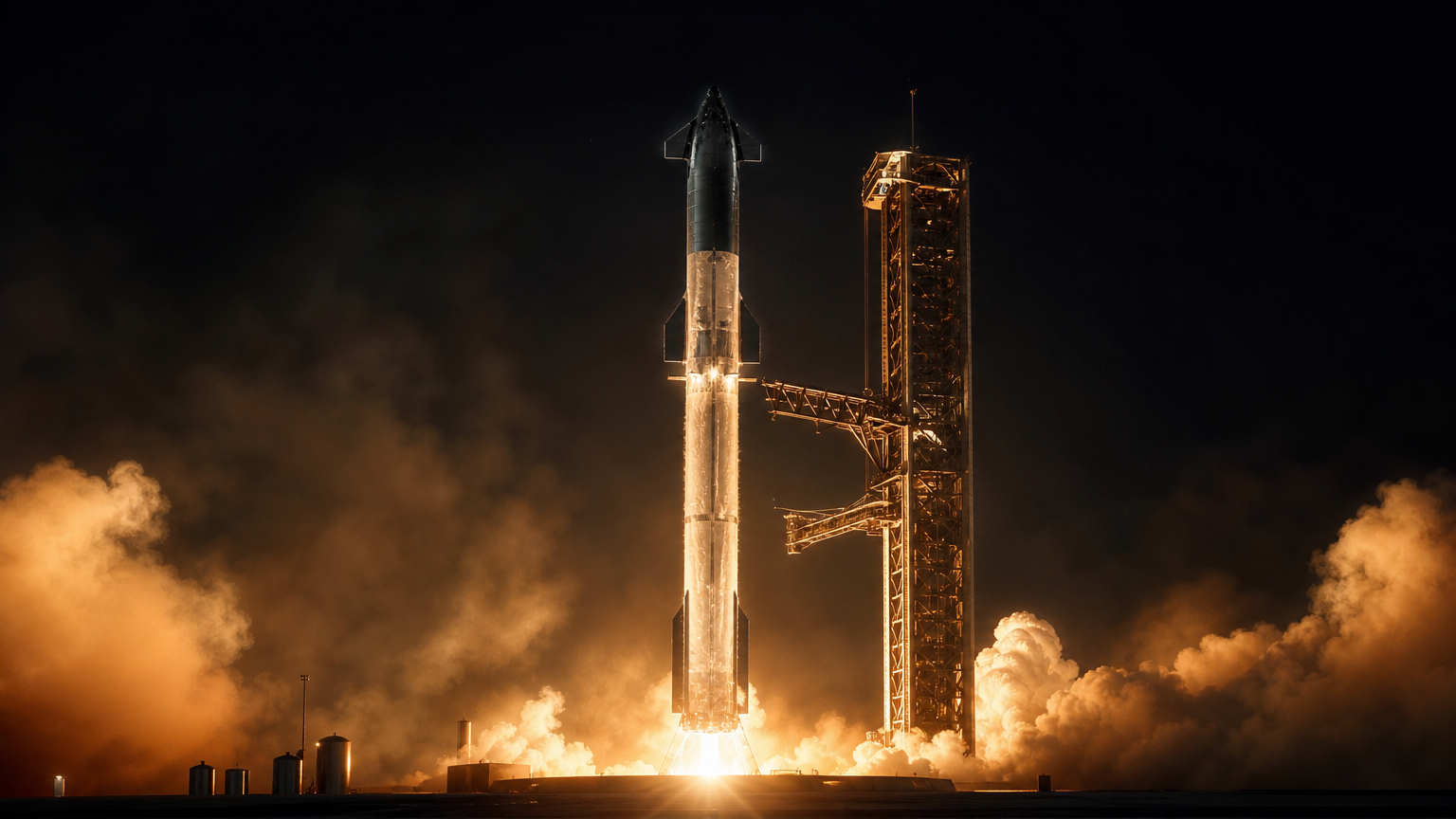
Starship Flight 14 was more than another spectacular launch from Texas: it was the moment SpaceX linked its reusable super-heavy rocket directly to a commercial payload story, while Elon Musk argued that government revenue will account for less than 5% of fourth-quarter income.
The headline check
The working headline is SpaceX completed commercial Starship Flight 14, and that is the story here: the completion of Starship’s fourteenth flight, its commercial meaning, and the financial claim that SpaceX is increasingly powered by non-government revenue. The mission is being framed not simply as another development test, but as the first clear bridge between Starship’s flight campaign and SpaceX’s broader commercial engine.
Flight 14 matters because it pulled two narratives into the same frame. On the engineering side, recent coverage and SpaceX-supplied footage describe Starship reaching orbit for the first time, deploying Starlink V3 satellites, and completing the mission profile with controlled end-of-flight operations . On the business side, Musk’s comment that government revenue should be less than 5% of fourth-quarter income gives the flight a sharper commercial context: Starship is not only a moon-and-Mars machine, but a capacity factory for SpaceX’s own communications business .
A test flight that behaved like a business case
The most important fact about Flight 14 is that it carried and released a real commercial payload, not just instrumentation or mass simulators. Yahoo’s October 6 video coverage says Flight 14 marked the first time Starship reached orbit and the first deployment of Starlink V3 satellites from the vehicle, with 26 satellites deployed during the mission . That turns the launch from a pure development milestone into an operational proof point: Starship can be used to place next-generation communications infrastructure in orbit.
That distinction is crucial. Previous Starship flights helped SpaceX learn about ascent, staging, thermal protection, engine behavior and recovery operations. Flight 14 still belongs to that rapid-test lineage, but the addition of V3 satellites means the rocket also demonstrated a route to revenue-generating deployment. TechQuire’s updated account describes the uncrewed vehicle as surviving an early engine shutdown, delivering its first operational payload, and splashing down in the Pacific . In other words, Flight 14 was not flawless, but it was useful in the way SpaceX values most: it produced data, accomplished the headline objective, and moved the system closer to repeatable service.
The deployment footage released after the flight also matters because it gives the public and investors a visual anchor for the commercial claim. The October 6 Yahoo video, credited to Space.com with SpaceX footage, shows the V3 satellites separating from Starship in orbit and states that 26 satellites were deployed during the historic mission . TeslaNorth also reported on October 6 that SpaceX had released new video of the Starlink V3 satellites deploying from Starship and tied the footage to official Starlink posts about autonomous operations and orbital safety .
Why V3 changes the economics
Starlink V3 is the connective tissue between Starship’s engineering case and SpaceX’s revenue case. If Starship can put larger, higher-capacity satellites into orbit at scale, then Starlink can expand without relying entirely on Falcon 9’s smaller payload envelope. TechQuire’s updated report says each V3 satellite adds about one terabit per second of capacity, meaning the 26-satellite Flight 14 batch represents roughly 26 terabits per second of nominal added capacity .
That number should not be read as an instant customer-speed guarantee. Capacity has to be commissioned, routed, balanced by geography and integrated into a live network. But as a deployment metric, it is significant. It suggests why SpaceX has been so determined to make Starship work: the rocket is not just a launch product for outside customers, it is a production tool for the company’s own broadband infrastructure. The more Starship can lift, the faster Starlink can add supply to meet demand.
This is where the phrase “commercial Starship Flight 14” becomes meaningful. The mission’s commercial nature does not depend on selling the launch to another satellite operator. It comes from Starship serving SpaceX’s own paying communications business. Starlink customers buy connectivity; Starship becomes the system that can expand the network behind that service. That is vertical integration with rocket exhaust.
Musk’s 5% claim raises the stakes
The financial backdrop makes the flight more than a technical success. Yahoo Finance reported on October 6 that Musk expects roughly 90% of SpaceX’s revenue this year to be commercial and government revenue to account for less than 5% in the fourth quarter . If that mix is realized, it challenges the familiar assumption that private space companies remain fundamentally dependent on public-sector contracts.
The same report adds nuance that should not be lost. SpaceX’s Enterprise & Government revenue increased 108% year over year to $1.806 billion while total company revenue reached $7.81 billion, meaning the combined category represented about 23% of quarterly revenue . But the category includes enterprise customers as well as government customers, so it cannot be read as a simple government-dependence figure . Musk’s claim is therefore both bold and, for now, a forecast rather than an audited fourth-quarter result.
Still, Flight 14 gives the claim a powerful narrative engine. Starship placing V3 satellites into orbit supports the argument that SpaceX’s most important growth drivers are commercial connectivity, launch demand, enterprise adoption and reusable infrastructure rather than direct government checks. Yahoo Finance also reported that SpaceX revenue rose from $10.4 billion in 2023 to $18.7 billion in 2025, while gross margin expanded from 41.2% to 49.4% . Those figures strengthen the picture of a company trying to scale like a communications-and-transport platform, not a traditional aerospace contractor.
Reusability is still the unresolved promise
Flight 14’s success does not mean Starship is finished. It means the campaign crossed a threshold. The reusable heavy-lift system still has to prove repeatability, rapid turnaround, higher cadence and eventually routine recovery. A single completed orbital deployment is not the same thing as airline-like operations.
That is why the next steps matter. A live Starship tracking page updated early on October 7 listed Flight 15 as a Q4 2026 target but said no firm date had been announced; it also noted that no FAA vehicle-operator-license modification had been reported for Flight 15 as of its latest check . That status keeps the program in the same place it has occupied for years: advancing quickly, but still constrained by vehicle readiness, regulatory reviews and the hard physics of reuse.
The safety conversation is also moving into the foreground. TeslaNorth reported that Starlink’s October 6 posts emphasized early contact with satellites, public ephemeris sharing, predicted trajectories and planned maneuvers as central to operating safely in low Earth orbit . That is not a side issue. If Starship enables larger and more frequent deployments, SpaceX must also show that scale can coexist with responsible traffic management in orbit.
The larger meaning of Flight 14
The significance of Flight 14 is that it joined three SpaceX ambitions in one mission: reusable heavy lift, Starlink expansion and commercial independence. The rocket demonstrated a more mature flight profile, the payload supported a revenue-generating network, and Musk’s revenue comments framed the company as a commercial infrastructure business first .
There is still plenty to prove. Starship must fly again, fly often, and eventually return hardware for reuse rather than simply complete splashdown profiles. Musk’s less-than-5% government-revenue claim must survive the actual fourth-quarter numbers. Starlink V3 satellites must move from deployed hardware to useful network capacity for customers.
But Flight 14 changed the tone of the campaign. The rocket tree has gained experience points, yes, but more importantly it has started to look like part of a business model. If SpaceX can repeat what Flight 14 demonstrated, Starship will no longer be only the company’s most ambitious vehicle. It will be the machine that feeds the commercial engine Musk says is already doing most of the work.
Sources from the last 72 hours
- [1]Musk Fires Back: SpaceX’s Government Revenue Will Be “Less Than 5%” in Q4Oct 6, 2026, 7:15 PM
- [2]SpaceX’s Starship Has Launched! Flight 14 Is A Historic Flight For SpaceXOct 6, 2026, 7:00 PM
- [3]Wow! SpaceX Starship deploys V3 Starlink satellites in epic new view from orbitOct 6, 2026, 8:09 PM
- [4]SpaceX Shows Off First Starlink V3 Satellites Deploying From StarshipOct 6, 2026, 7:00 PM
- [5]SpaceX Starship reaches orbit for first time on Flight 14, deploys 26 Starlink V3 satellites — TechQuire PostOct 6, 2026, 2:00 AM
- [6]When is the next Starship launch? (Live tracker) — Launch WindowOct 7, 2026, 5:42 AM
AI-generated article based on recent web research, then preserved as a dated editorial snapshot.
Comments
Be the first to comment.