
Daily Podcast full article
SpaceX launched fourth Tranche 1 military mission
SpaceX’s fourth Tranche 1 military data-transport mission has become the next key test in the Space Development Agency’s push to build a proliferated low-Earth-orbit network for secure communications and missile-warning support. After a final-minute scrub at Vandenberg, the Falcon 9 mission carrying 21 Northrop Grumman-built satellites was reset for an October 8 attempt, keeping attention on both the Pentagon’s constellation schedule and SpaceX’s national-security launch cadence.
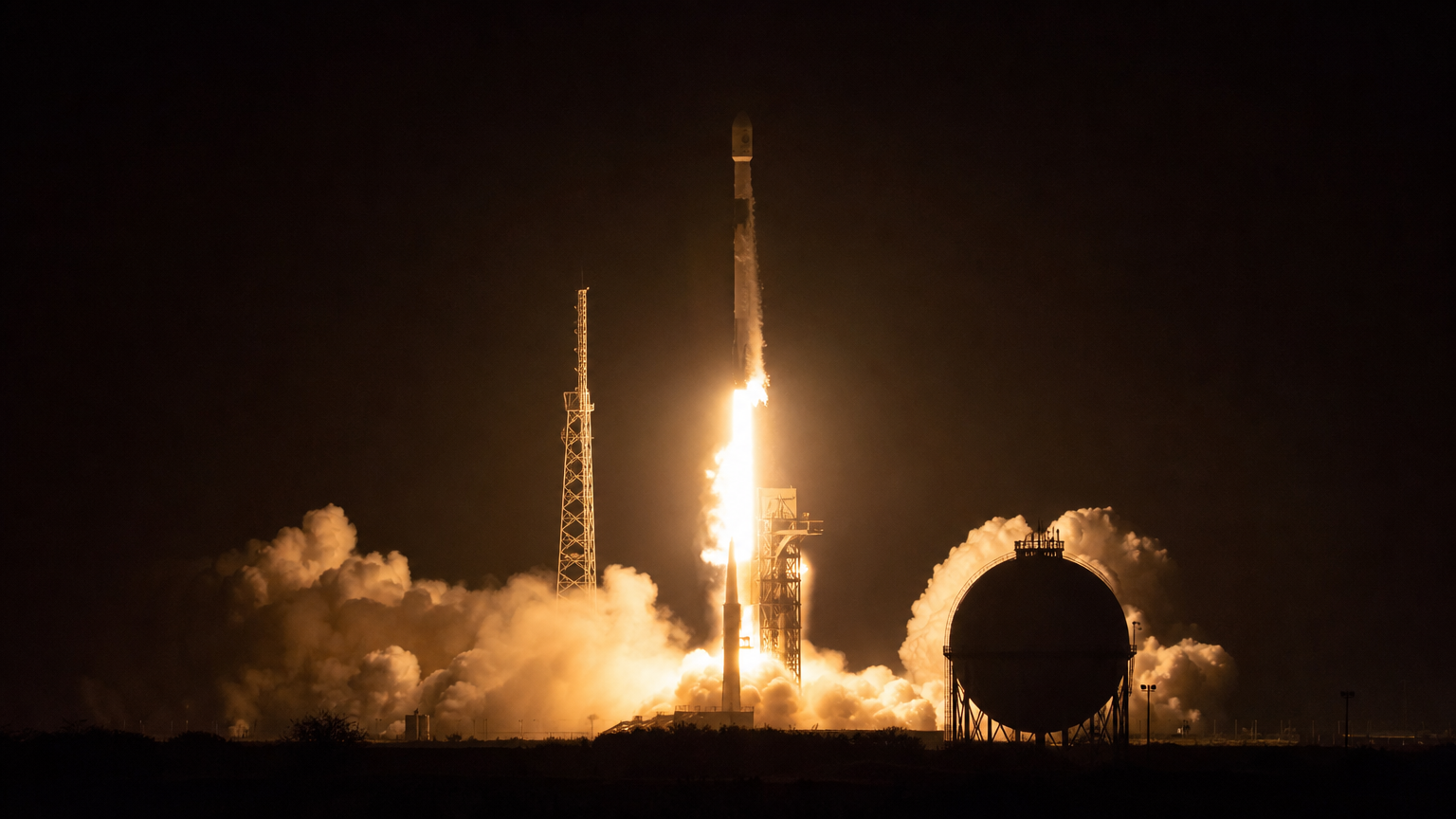
A fourth Tranche 1 flight, with the clock reset
SpaceX’s fourth Tranche 1 mission for the U.S. Space Development Agency is centered on a Falcon 9 flight from Space Launch Complex 4 East at Vandenberg Space Force Base in California, carrying 21 data-transport satellites for the agency’s Proliferated Warfighter Space Architecture, or PWSA . The mission is identified as Tranche 1 Transport Layer A, or T1TL-A, and is described in launch-tracking data as a government mission to polar orbit using Falcon 9 booster B1103 with a return-to-launch-site landing planned at Landing Zone 4 .
The mission did not leave Earth on its first try. SpaceX scrubbed the launch attempt in the final minute of the countdown on October 5, as the rocket was entering its automated startup sequence, and the company did not immediately give a reason for the abort . SpaceX then passed on the next opportunity and the launch was moved to no earlier than October 8, with a 07:54 UTC instantaneous launch window listed by SpaceLaunchNow and other launch trackers . That shift turns the mission from a routine addition to the SDA constellation into a small but visible schedule marker for a program that has already been watched closely for timing.
The payload is the first half of Northrop Grumman’s share of this portion of the Transport Layer, with 21 satellites assigned to this launch . These spacecraft are meant to expand the operational Tranche 1 architecture, following three earlier transport-layer missions: T1TL-B in September 2025, T1TL-C in October 2025 and T1TL-E in July 2026 . With those three launches completed, 63 satellites were already in orbit before T1TL-A, making the fourth flight another step toward filling out the initial military mesh network .
Why this mission matters
The SDA’s architecture is not a single exquisite satellite or a handful of large spacecraft. It is a proliferated constellation in low Earth orbit, designed to put many smaller satellites into service so the network can provide resilient coverage, lower latency and multiple pathways for military data . In practical terms, the Transport Layer is supposed to move information rapidly among U.S. and allied forces, while other parts of the architecture support missile warning, missile tracking and related defense functions .
The fourth mission matters because it adds another orbital plane to that structure. Launch listings describe T1TL-A as part of a Tranche 1 Transport Layer constellation intended to deliver assured, resilient and low-latency military data connectivity to a broad range of warfighter platforms from low Earth orbit . The satellites are expected to rely on optical inter-satellite links and Ka-band communications, giving the constellation a path toward faster routing and more fault-tolerant handoffs than older architectures built around fewer, larger nodes .
This is also a supplier-diversity milestone. The previous Tranche 1 missions used spacecraft from York Space Systems and Lockheed Martin, while T1TL-A carries Northrop Grumman-built satellites . The multi-vendor approach is important because SDA’s model depends not only on rapid launch but also on the ability to integrate satellites from different manufacturers into a functioning orbital network. The more mixed the architecture becomes, the more each launch tests the Pentagon’s bet that competition and parallel production can accelerate military space capability.
The Falcon 9 side of the story
For SpaceX, the mission reinforces the company’s role as a routine launch provider for national-security payloads. T1TL-A is one of 23 missions assigned to SpaceX under the National Security Space Launch Phase 2 framework managed by Space Systems Command . That means the flight is not an isolated commercial booking; it is part of a larger procurement lane through which the Space Force buys assured access to orbit for defense missions.
The booster, B1103, is scheduled for its sixth flight on this mission . Spaceflight Now reported that the same first stage previously supported SDA’s T1TL-E mission, NROL-179 and three Starlink batches . After stage separation, the booster is planned to return to Landing Zone 4 at Vandenberg, a profile that can produce sonic booms over parts of California’s Central Coast depending on atmospheric and local conditions .
That recovery profile is one reason the mission is locally noticeable even before payload deployment. A Vandenberg return-to-launch-site landing is operationally valuable because it avoids the need for a droneship recovery downrange, but it also makes the launch more audible for nearby communities. Launch trackers and SpaceX-derived mission notes warned that residents of Santa Barbara, San Luis Obispo and Ventura counties may hear one or more sonic booms if the booster returns to land as planned .
A scrub is not a failure, but the schedule matters
A final-minute scrub can sound dramatic, but in launch operations it is usually a sign that the countdown system is doing its job. Falcon 9’s automated sequence is designed to stop the clock if the vehicle, ground systems or flight rules do not meet required conditions. In this case, SpaceX did not immediately announce a specific cause, and available reporting did not point to a payload problem .
Still, schedule matters for SDA. The agency’s Tranche 1 system is expected to begin delivering operational capability to the Department of Defense in 2027, and the full Tranche 1 plan includes 126 Transport Layer satellites, 28 Tracking Layer satellites and four missile-defense demonstration spacecraft . Each launch therefore carries more significance than a simple batch number. Delays can be absorbed one by one, but the broader architecture depends on a steady tempo of production, launch, check-out and integration.
The October 5 scrub also came after the satellites had already been delivered to Vandenberg on September 28, according to Spaceflight Now . That suggests the immediate issue was tied to launch processing or countdown conditions rather than late payload availability. Leo.space reported that SpaceX initially reset for October 6 after the scrub, with the 21 Northrop Grumman-built satellites still assigned to the mission and booster B1103 still slated to fly . The subsequent move to October 8 shows the company and mission partners chose a longer reset rather than forcing the next window.
What comes next
If Falcon 9 lifts off successfully on the October 8 opportunity, T1TL-A will become the fourth operational Tranche 1 transport deployment and will raise the number of deployed Transport Layer satellites from 63 to 84. That would still leave significant work ahead, but it would put Northrop Grumman hardware into the operational sequence and continue the buildout of the orbital data backbone .
The mission also illustrates how SpaceX’s launch cadence now links two strategic arenas: commercial megaconstellations and military space infrastructure. The same Falcon 9 reusability model that supports high-frequency Starlink flights also underpins defense launches for the Space Force and SDA. In this case, the payload is not consumer broadband but a military mesh network meant to move targeting, warning and command data at speed.
For the Pentagon, the loading bar is not just a metaphor. Each Tranche 1 launch fills in another slice of a distributed constellation that is supposed to be harder to disable than traditional satellite systems. For SpaceX, the fourth Tranche 1 mission is another reminder that its most important customer may not always be the one buying the most satellites, but the one depending on the launch schedule to turn an architecture into an operational network.
Sources from the last 72 hours
- [1]SpaceX scrubs launch attempt for 21 data transport satellites for the Space Development AgencyOct 4, 2026, 10:33 PM
- [2]Falcon 9 Block 5 | SDA Tranche 1 Transport Layer AOct 6, 2026, 2:44 AM
- [3]SpaceX scrubs SDA T1TL-A launch in final minute, rescheduled for Oct. 6Oct 5, 2026, 3:30 PM
- [4]SDA Tranche 1 Transport Layer AOct 6, 2026, 2:00 AM
AI-generated article based on recent web research, then preserved as a dated editorial snapshot.
Comments
Be the first to comment.