
Daily Podcast full article
SpaceX Makes a Shocking Decision (No One Expected This)
SpaceX’s surprise move is not another rocket milestone but a financial and product pivot: the company is reportedly pursuing a $40 billion Nvidia-chip financing package while Grok Bot is being repositioned as a multi-model assistant that can call on rival AI systems when they are better suited to the task.
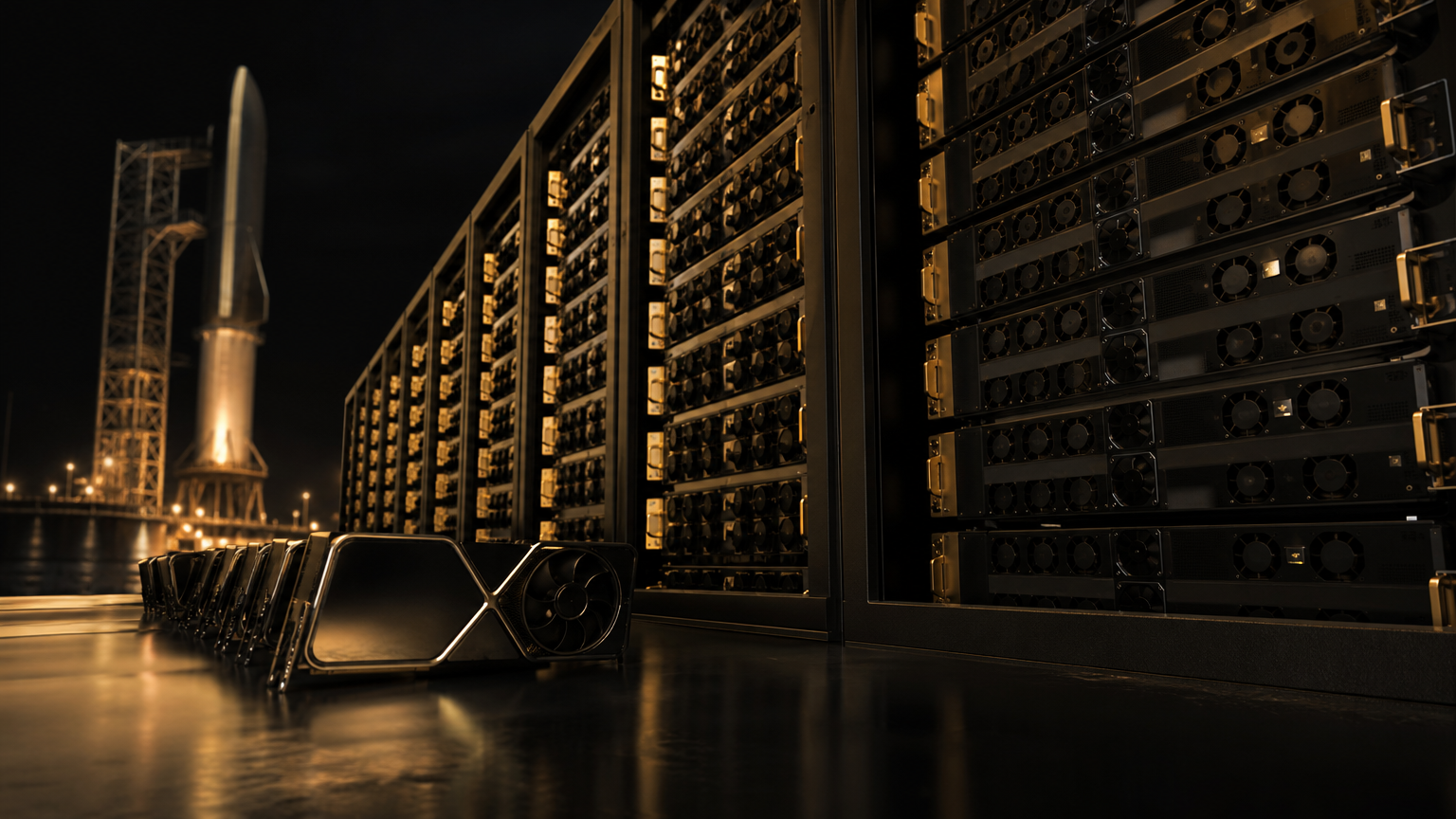
A rocket company is acting like an AI hyperscaler
SpaceX’s latest surprise is that its most aggressive near-term expansion may be happening on the ground, inside data centers, rather than on a launchpad. The company is reportedly pursuing $40 billion in financing to buy Nvidia chips, a package described as roughly $10 billion in bank loans and $30 billion in investment-grade debt . Apollo Global Management is expected to lead the financing effort, while Pimco has been named among the lenders that have discussed participating .
That is a shocking decision because it would push SpaceX deeper into the same capital-intensive race already reshaping cloud computing. SpaceX is no longer just selling launches, Starlink connectivity, and aerospace execution; it is increasingly presenting itself as a compute platform for frontier AI. The company has not confirmed the reported transaction, and the deal is not expected to close until 2027 if it proceeds . But the scale alone changes how investors, customers, and rivals must think about SpaceX.
The reported structure also matters. Investment-grade bonds are designed to reach large pools of conservative capital, including insurers and pension funds, and SpaceX’s BBB rating is described as the second-lowest investment-grade rung . In other words, the plan is not simply to borrow from a few private lenders; it is to make AI chips financeable at institutional scale.
Why Nvidia sits at the center
The financing is reportedly aimed at Nvidia hardware, and that is not accidental. Elon Musk has said SpaceX decided to build “exclusively” on Nvidia because he views the Vera Rubin architecture as the strongest AI-computing platform available . That statement helps explain why SpaceX would consider one of the largest chip-related debt financings of the AI buildout: the company appears to be standardizing its AI infrastructure around Nvidia’s roadmap.
SpaceX’s compute-leasing business already has large contracted demand, according to recent investor-focused reporting. Anthropic is described as paying $1.25 billion per month for access to roughly 325,000 Nvidia GPUs, while Google is contracted for $920 million per month for access to around 110,000 Nvidia GPUs . Reflection AI is also described as part of a $150 million-per-month agreement for GB300 chips inside SpaceX’s Colossus 2 data center .
Those numbers explain the logic behind the borrowing. If customers are willing to commit billions of dollars a month for compute access, SpaceX has an argument for expanding capacity quickly. But they also explain the risk. A company that builds infrastructure ahead of demand must keep utilization high, keep customers satisfied, and keep chip performance competitive long enough to justify the debt.
The debt signal investors cannot ignore
The market’s nervousness is visible in SpaceX’s existing debt. SpaceX bonds maturing in 2056 have been reported at about 85 cents on the dollar, with a yield roughly 2.27 percentage points above U.S. Treasurys . Axios cited the same spread as comparable to junk-bond levels, even though SpaceX retains an investment-grade rating .
That gap is the heart of the story. SpaceX may have investment-grade access, but investors are asking a tougher question: how much debt can AI infrastructure absorb before the economics become fragile? Recent market coverage placed SpaceX alongside Broadcom and Oracle as part of a broader wave of enormous AI-chip debt deals . Newsquawk described the shift as a move from AI buildouts funded largely by operating cash flow toward large-scale external borrowing .
That does not mean SpaceX is in trouble. It means the AI race has entered a new financial phase. The first phase was about who could train the strongest models. The second was about who could secure the most GPUs. The current phase is about who can finance, deploy, and monetize enough compute without overloading the balance sheet.
Grok Bot’s other surprise: use the best model, even if it is a rival
The financing news is only half of the decision. The product strategy around Grok Bot is also changing. Musk said on October 7 that SpaceX will let Grok Bot use outside AI services, including Claude Opus 5.5, Midjourney, and Suno, selecting what he called the best back-end model for a given task .
That is striking because it softens the idea that Grok must always be the sole intelligence inside SpaceXAI products. Instead, Grok Bot appears to be moving toward an orchestration layer: the user interacts with one assistant, while the assistant can route work to specialized systems for text, image, music, or other outputs . If implemented well, this could make Grok Bot more useful than a single-model chatbot.
But the announcement leaves key details unresolved. The report notes that Musk did not explain which tasks would go to which provider, whether users can see which model handled a request, whether customers can opt out, or how data will be filtered before being passed to outside systems . Those questions matter because Grok Bot is not just a casual chat tool. Its documentation and terms describe persistent cloud computers that can browse websites, execute code, modify files, and communicate on a user’s behalf .
The strategic contradiction may be the strategy
At first glance, SpaceX’s two moves pull in opposite directions. On one side, the company is reportedly borrowing tens of billions to buy its own Nvidia-based compute. On the other, Grok Bot may route some user tasks to outside AI providers. But the contradiction may be deliberate.
If SpaceX becomes a compute landlord for Anthropic, Google, and other AI companies, it benefits from the entire AI ecosystem, not just from Grok’s market share. If Grok Bot becomes a front-end agent that can choose the best back end, it can compete on workflow, integration, and execution rather than pretending one internal model is best at everything.
That also helps explain why the decision feels unexpected. Traditional platform strategy says a company should lock users into its own stack. SpaceX’s emerging strategy appears more pragmatic: own the infrastructure where possible, rent capacity to rivals when profitable, and let the assistant call rival models when that produces a better result.
What to watch next
The next test is whether the financing actually closes. The reported package remains unconfirmed, and early-stage terms can change . If Apollo and other lenders succeed in placing the debt, it will validate investor appetite for AI infrastructure backed by SpaceX’s credit. If the deal stalls or becomes more expensive, it will signal that the market is drawing a line around chip-backed borrowing.
The second test is transparency. Grok Bot’s multi-model routing could be powerful, but customers will need clear controls over data, permissions, model selection, and audit trails . That is especially true for enterprise users who may connect the bot to files, credentials, code repositories, or customer records.
The shocking decision, then, is not one decision but two connected bets. SpaceX is betting that AI compute demand will be large enough to justify tens of billions in new Nvidia-backed infrastructure. It is also betting that the winning assistant may not be the one that uses only its own model, but the one that knows when to call the best model available.
Sources from the last 72 hours
- [1]SpaceX seeks $40bn in financing for Nvidia chip purchaseOct 7, 2026, 11:42 AM
- [2]SpaceX Reportedly Wants $40 Billion to Buy Artificial Intelligence (AI) Chips. Here's Why That's Huge News for Nvidia Investors.Oct 7, 2026, 8:00 PM
- [3]SpaceX says Grok Bot will use rival AI models for different tasksOct 7, 2026, 10:22 AM
- [4]Oracle (ORCL), Broadcom (AVGO) and SpaceX (SPCX) seek blockbuster debt deals to pay for AI chips, in which Broadcom has been working in recent weeks to arrange more than USD 50bln in financing for OpenAI custom artificial intelligence chips, according toOct 7, 2026, 11:26 PM
- [5]SpaceX stock slips on report of its $40 billion in new debt for Nvidia chipsOct 7, 2026, 10:33 PM
AI-generated article based on recent web research, then preserved as a dated editorial snapshot.
Comments
Be the first to comment.