
Daily Podcast full article
Starlink opens two regulatory fronts
Starlink’s week has split into two battles: in the United States, SpaceX won a regulatory path to build a 15,000-satellite direct-to-device network that could eventually loosen AT&T and Verizon’s grip on mobile coverage; in India, Elon Musk turned a stalled licensing process into a public fight over competition, security and rural connectivity.
A new orbit for the mobile business
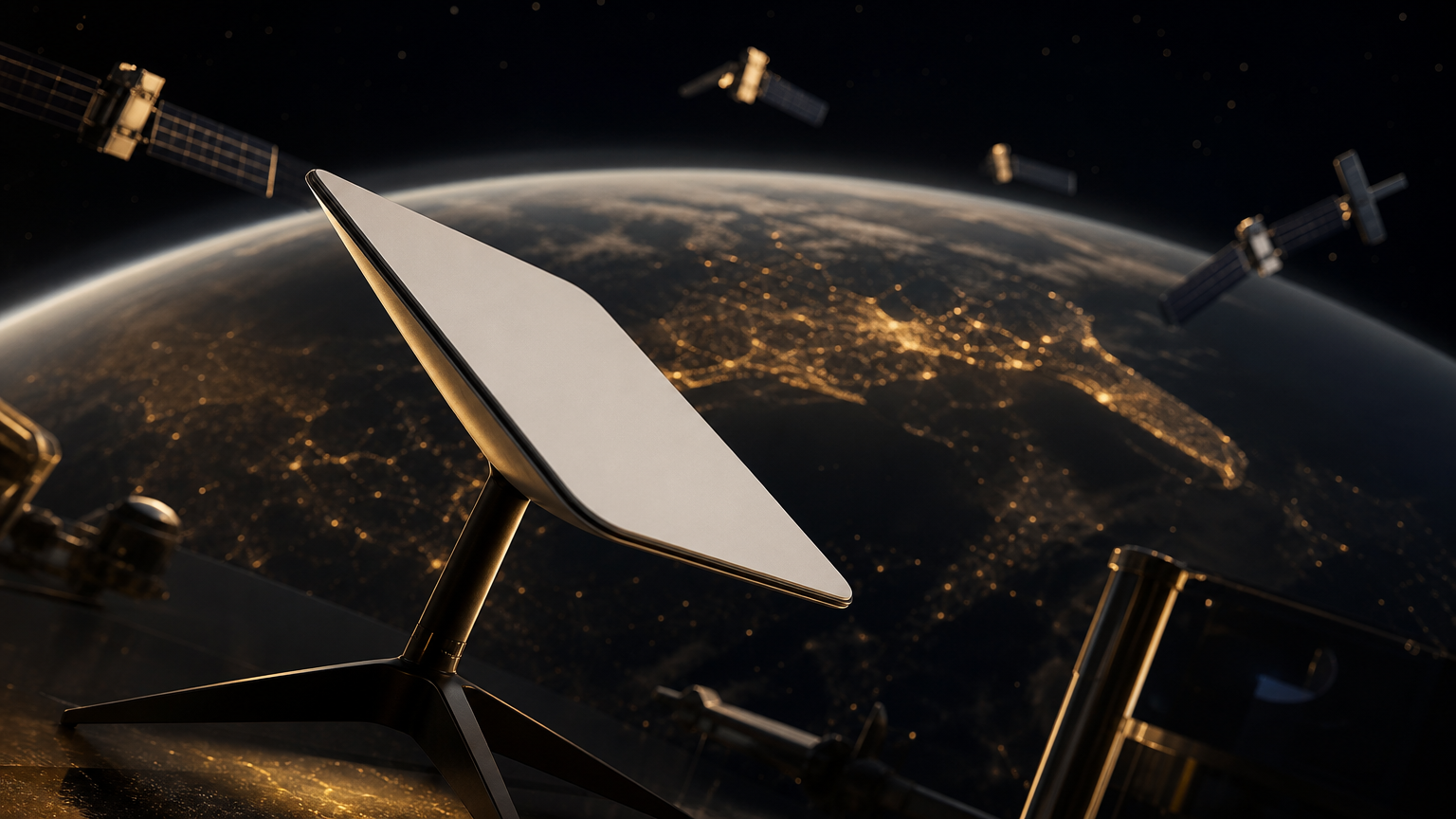
Starlink’s latest regulatory breakthrough is not just another satellite approval. It points to a broader ambition: turning SpaceX from a broadband disruptor into a potential mobile-network competitor. The Federal Communications Commission’s Space Bureau and Wireless Telecommunications Bureau granted Space Exploration Holdings authority, in part, to launch and operate a new non-geostationary mobile satellite system for direct-to-device services . According to the FCC summary, the system is authorized for Mobile Satellite Service and Supplemental Coverage from Space operations in the United States, MSS and direct-to-cell service outside the United States, and related fixed-satellite operations .
The scale is what changes the competitive frame. The approved constellation is described as a new 15,000-satellite network aimed at direct-to-device connectivity, meaning links to ordinary phones rather than only to dedicated Starlink terminals . That makes the decision a mobile-market event, not only a space-sector event. If SpaceX can execute, the company would be positioning satellites as a layer of consumer wireless infrastructure, especially for places where conventional towers are absent, sparse or uneconomic.
The immediate impact should not be overstated. The U.S. authorization is a permission slip, not a live service. A report on the order noted that SpaceX does not yet have this new constellation in orbit, that launches are expected to begin in late 2027, and that the acquired bands cannot be used commercially until a later stage of the EchoStar transaction closes, expected by November 30, 2027 . The same account says deployment milestones extend far beyond the next product cycle: half the constellation must be in orbit by October 7, 2032, and the full constellation by October 7, 2035 .
Still, regulatory architecture matters. The most strategically important piece is that SpaceX can move toward using spectrum it owns, rather than relying only on a terrestrial carrier as gatekeeper. The FCC-related reporting says the agency waived a leasing requirement because requiring SpaceX to lease from itself would add unnecessary regulatory burden . In practical terms, that is why this decision sharpens the challenge to AT&T and Verizon. It suggests a future in which SpaceX does not merely complement a carrier’s network, but can sell a space-based connectivity layer with more independence.
AT&T and Verizon face a different kind of infrastructure rival
The competitive pressure is not that Starlink will replace dense urban mobile networks next year. It is that SpaceX is pushing the boundary of what counts as wireless infrastructure. AT&T and Verizon built their power through spectrum, towers, fiber backhaul, billing relationships and nationwide brand trust. Starlink’s proposition is different: use low Earth orbit capacity to cover gaps where terrestrial economics are weak, then expand the service envelope as satellite hardware and spectrum rights improve.
That is why the phrase “from orbit” is more than a headline. Coverage gaps have traditionally been explained by the cost of land, towers, permits, power and backhaul. A satellite layer changes the equation by spreading infrastructure over geography from above. It does not erase physics, congestion or device constraints. But it does give SpaceX a way to attack the most emotionally powerful weakness of mobile incumbents: the dead zone.
The carrier response is already taking shape. Reporting on the FCC decision says AT&T, Verizon and T-Mobile established a satellite-to-phone joint venture on October 2, 2026, though that venture still needs satellite capacity from another provider . That matters because it shows the incumbents are not treating satellite-to-phone as a gimmick. They are trying to organize a counterweight before SpaceX’s next-generation network exists in orbit.
For consumers, the unresolved questions are basic: when will the service be usable, how much will it cost, which phones will work, what speeds will appear under real load, and will it be sold as an add-on, a standalone plan or a wholesale layer? The fresh reporting does not provide firm consumer prices, a rollout map or a commercial launch date for the full service . Until those details arrive, the U.S. front is best understood as a regulatory opening with a long execution runway.
India: a licence fight becomes a political fight
The second front is India, where Starlink’s problem is almost the opposite. In the United States, SpaceX has a regulatory pathway but years of deployment ahead. In India, the company says it is ready to serve, but the authorization process remains unfinished.
At the India Mobile Congress, SpaceX executive Lauren Dreyer said Starlink had completed much of its India build-out and was waiting for remaining government clearances . Business Today reported that Starlink had received permissions from IN-SPACe and a Global Mobile Personal Communication by Satellite licence, but still needed security clearance and foreign direct investment approval . ThePrint added that Starlink cannot sell services in India until it receives spectrum and the second stage of security clearance, and that as a wholly foreign-owned company it also requires FDI approval .
Musk then escalated the dispute. On October 7, he accused unnamed “oligarchs” of blocking Starlink in India to maintain a “monopolistic chokehold” on consumers, and called the situation a “crime against the people of India” . He did not name the individuals or companies he was accusing . That omission is important: the claim is politically explosive, but the public record in the cited reports does not establish proof of the alleged obstruction.
India’s government answered quickly. The Ministry of Communications said on October 8 that India has a fair and non-discriminatory authorization framework for all telecom services, including satellite communications . It said licences had been granted to three Global Mobile Personal Communication by Satellite services based on non-geostationary orbit systems, and that each licensee must demonstrate compliance with security conditions . The ministry also said security assessments were under way for all three licensees and that all three were “at broadly the same regulatory stage” before moving to spectrum assignment . It called suggestions of unfair or discriminatory application “baseless and misconceived” .
Competition, security and the rural promise
The India fight is not only about one company’s licence. It is about who controls connectivity in a market with vast rural demand, powerful incumbent telecom groups and a government that treats communications infrastructure as a security-sensitive sector. ThePrint reported that Starlink had built 20 gateway sites with hundreds of antennas in India and would keep Indian user data within the country . That is a direct response to the sovereignty and security concerns that often shape satellite-internet approvals.
The connectivity argument is also powerful. Musk’s intervention came in a discussion that cited villages without 4G coverage and low wired-broadband penetration . Satellite broadband is not a magic substitute for fiber or mobile towers, but it can serve remote users faster than trenching fiber or building towers in difficult terrain. For SpaceX, India is therefore not just another country on a coverage map; it is one of the largest possible tests of whether satellite broadband can become a mass-market complement to terrestrial networks.
Yet India’s caution is not surprising. A satellite network can cross borders, route traffic through complex infrastructure and remain technically controlled by a foreign private company. The government’s insistence on security assessments, user-data safeguards and spectrum assignment before commercial launch reflects that reality . The dispute is sharper because Musk framed the delay as anti-competitive obstruction, while the government framed it as equal treatment under security rules.
The common thread: regulators now shape Starlink’s next market
The two fronts look different, but they share one lesson. Starlink’s next phase depends as much on regulators as on rockets. In the United States, permission has opened a route toward direct competition with terrestrial mobile giants, but the business will take years to prove. In India, the demand case may be obvious, but the regulatory firewall remains decisive.
For AT&T, Verizon, Jio, Airtel and every other incumbent watching from the ground, the message is uncomfortable. The cell tower has not disappeared. But it now has a rival in low Earth orbit, and that rival is learning to fight in licensing rooms as aggressively as it launches satellites.
Sources from the last 72 hours
- [1]FCC - Federal Communications Commission (via Public) / SpaceX approved for NGSO MSS system for direct-to-device servicesOct 6, 2026, 8:29 PM
- [2]FCC Grants SpaceX Approval for 15,000 Direct-to-Device Satellites in MSS SpectrumOct 7, 2026, 2:00 AM
- [3]SpaceX Just Got Permission to Compete With AT&T and Verizon From OrbitOct 8, 2026, 1:15 PM
- [4]India’s regulatory framework for satellite communication services is fair and non-discriminatoryOct 8, 2026, 5:49 AM
- [5]Musk claims ‘certain oligarchs’ blocking Starlink in India, Centre calls authorisation process ‘fair’Oct 8, 2026, 6:42 AM
- [6]Elon Musk says Starlink blocked by 'oligarchs' in India: 'You can guess who they are'Oct 7, 2026, 6:53 PM
AI-generated article based on recent web research, then preserved as a dated editorial snapshot.
Comments
Be the first to comment.