
Daily Podcast full article
Starship readies first Florida launch
SpaceX says Launch Complex 39A is moving from construction into acceptance and activation testing for Starship, while a proposed 32.4-mile Brevard County gas pipeline shows how fast reusable launch ambitions are turning into an industrial logistics problem.
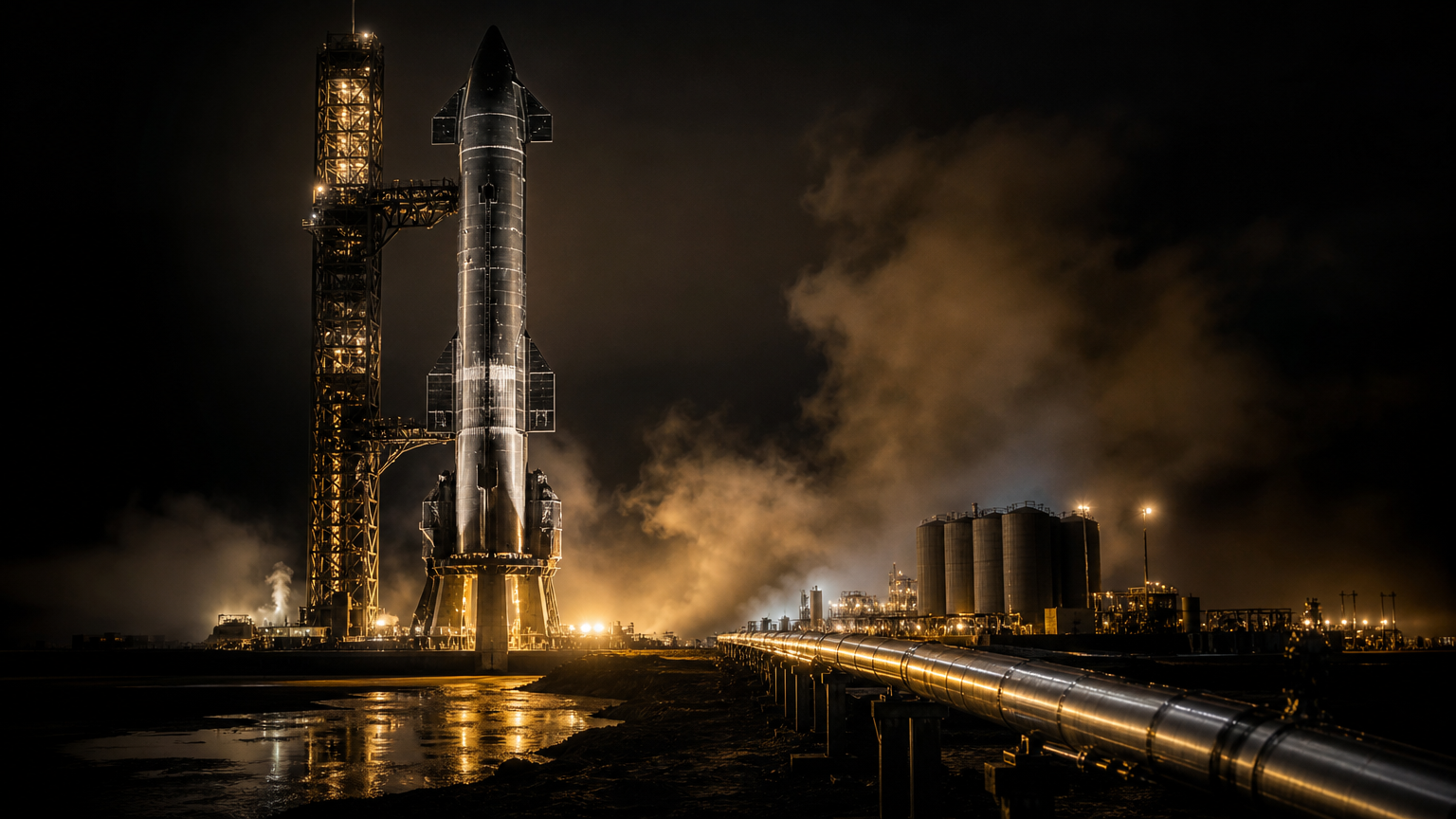
A Florida Starship moment is getting closer
SpaceX’s first Starship launch from Florida is no longer a distant pad-construction story; it is becoming an activation story. The company says the Starship work at Kennedy Space Center’s historic Launch Complex 39A is “going super well,” with the new launch tower nearly complete and much of the essential construction finished . The next phase, according to the SpaceX account reported this week, is acceptance testing, proofing and operational testing before the pad can be activated for Starship operations .
That distinction matters. Construction means steel, concrete, tanks and cranes; activation means SpaceX has to prove that the pad, ground systems, propellant handling, controls and procedures can operate as a launch site for the largest rocket system the company has ever attempted to fly from the Space Coast. Aviation Week also reported this week that SpaceX plans at least one more Starship-Super Heavy test flight from Starbase, Texas, before the vehicle lifts off from Kennedy Space Center’s 39A . In other words, Florida is close enough to be in the sequence, but not yet past the remaining validation work.
So far, all 14 integrated Starship test flights have launched from SpaceX’s Starbase site in South Texas, including the Sept. 28 flight that Space.com described as Starship’s first successful trip to orbit . A Florida debut would therefore be more than a change of scenery. It would show that Starship is beginning to break out of a single-site test campaign and into the multi-pad infrastructure SpaceX says it needs for higher flight rates.
Why 39A is not just another launch pad
Launch Complex 39A carries symbolic and operational weight. SpaceX already flies Falcon 9 and Falcon Heavy missions from the pad under its NASA lease, but Starship is a different class of machine. Space.com notes that Starship stands about 408 feet tall, compared with about 230 feet for Falcon 9 and Falcon Heavy . The difference is not only height. Starship is designed around the return of both the Super Heavy booster and the Ship upper stage to the launch site, where tower arms are intended to catch returning hardware rather than relying only on downrange droneships or conventional landing pads .
That makes the tower, the mount and the nearby ground systems part of the vehicle’s reusability architecture. For Falcon 9, rapid reuse is already an operations discipline; for Starship, the launch pad is also expected to become a recovery machine. The Florida pad therefore has to support launch, catch, servicing and refly concepts at a scale the Space Coast has not yet seen.
The propellant change is equally important. Falcon 9 and Falcon Heavy use Merlin engines burning rocket-grade kerosene and liquid oxygen; Starship’s Raptor engines burn liquid methane and liquid oxygen . That means a Starship-capable 39A needs new propellant infrastructure, including tankage and delivery systems suited to methane operations . A rocket can look ready from the beach, but the decisive question is often whether its plumbing, software, valves, power, safety systems and procedures are ready to run repeatedly under flight conditions.
The pipeline tells the same story from the ground
The launch-pad update arrived alongside a second, less glamorous but equally revealing development: SpaceX’s push for dedicated natural-gas infrastructure in Florida. Bloomberg Law reported on Oct. 5 that SpaceX is proposing a natural gas pipeline in Florida to deliver fuel for Starship rockets launched from Cape Canaveral . The report, citing a Florida Public Service Commission filing, said SpaceX subsidiary Coastal Connect Services requested a 32.4-mile, 16-inch pipeline in Brevard County that would connect with Florida Gas Transmission .
Benzinga reported on Oct. 6 that Coastal Connect Services is seeking Florida regulatory approval for the 32.4-mile pipeline because truck deliveries and existing local pipelines can no longer meet SpaceX’s growing fuel requirements for Starship operations at Cape Canaveral . Pipeline & Gas Journal likewise reported on Oct. 7 that the proposed infrastructure would bring gas from the existing Florida Gas Transmission interstate pipeline directly to customers and that the petition describes the project as necessary for safe, timely and efficient delivery .
This is the terrestrial side of a reusable super-heavy rocket. Starship’s pitch is cadence: frequent flights, large payloads and eventual refueling operations that require many launches in support of one mission architecture. But cadence is not created only by engines and heat shields. It depends on industrial inputs arriving on time, in the right quantity and with enough reliability that the launch site is not throttled by tanker-truck schedules.
From test flights to industrial cadence
The proposed pipeline does not mean a Florida Starship launch is imminent tomorrow. It does mean SpaceX is planning as if Florida Starship operations will become large enough to justify fixed energy infrastructure. Bloomberg Law’s report frames the pipeline as serving SpaceX facilities and the company’s growing need for gas that it liquefies for rocket fuel . Benzinga adds that the gas would ultimately supply methane for Starship, whose Raptor engines use liquid methane and liquid oxygen .
That is a useful reality check on the scale of SpaceX’s ambitions. A single demonstration launch can be supplied with extraordinary effort. A routine launch campaign cannot. If Starship is to fly often from Florida, SpaceX needs a ground network that looks less like a special event and more like an industrial process: bulk propellant, predictable delivery, permitting, tariff approval, environmental coordination, emergency planning, road access, utilities and pad scheduling.
The timing also creates an important narrative contrast. In the same week that reporting described 39A as nearing activation testing, energy trade coverage described a pipeline application meant to remove fuel-supply constraints . One update is about a tower at one of the world’s most famous launch pads; the other is about a 16-inch steel line under Brevard County. Together, they describe the same transition: Starship is moving from experimental flights at one bespoke site toward a launch network that must be supported by ordinary, heavily regulated infrastructure.
Florida as the expansion test
Florida readiness matters because the Space Coast is already a dense operational environment. SpaceX, NASA, the Space Force, commercial satellite operators and national-security missions all share range resources, roads, pads, airspace and recovery zones. Space.com reported that SpaceX is preparing three pads on Florida’s Space Coast for Starship, with 39A nearest to activation and work also visible at Launch Complex 37 . That suggests Florida is not being treated as a symbolic backup to Texas; it is being built into a major Starship operations hub.
But the more Florida matters, the more coordination matters. A Starship flight campaign would have to fit into existing Falcon, Dragon, national-security and commercial launch activity. It would also bring larger exclusion zones, more propellant movements, different pad hazards and new recovery procedures. The proposed pipeline is therefore not a side plot. It is part of the same capacity equation as the tower and tank farm.
What to watch next
The most immediate milestone is whether 39A completes acceptance and operational testing without major redesign work. SpaceX has not announced a firm target date for the first Florida Starship launch, and Space.com notes that the company plans at least one more Starship test flight from Starbase before moving the vehicle to Kennedy Space Center, making Florida possible as soon as Flight 16 rather than the next flight .
The second milestone is regulatory progress for Coastal Connect Services’ pipeline proposal. Current reporting describes the request as a tariff and firm transportation arrangement tied to a new 32.4-mile, 16-inch line in Brevard County . If approved and built, that line would not launch a rocket by itself, but it could remove one of the bottlenecks that would otherwise limit Starship’s launch tempo.
The larger takeaway is simple: Starship’s Florida debut is becoming a systems-integration story. The rocket needs a tower; the tower needs propellant; the propellant needs delivery infrastructure; and the whole system needs permits, tests and range coordination. SpaceX may be aiming at orbital ambition, but the next proof point is very much on the ground.
Sources from the last 72 hours
- [1]'Things are going super well at 39A': SpaceX gearing up to launch Starship from Florida for 1st timeOct 7, 2026, 2:00 AM
- [2]SpaceX Looks Toward Starship Flights From Kennedy Space CenterOct 7, 2026, 2:00 AM
- [3]SpaceX Proposes Gas Pipeline to Supply Cape Canaveral RocketsOct 5, 2026, 8:18 PM
- [4]Elon Musk Wants to Build a 32-Mile Natural Gas Pipeline for SpaceX in Florida — Truck Deliveries Can’t Keep Up With Starship’s Growing Fuel Demands: ReportOct 6, 2026, 10:51 AM
- [5]SpaceX seeks approval for Florida gas pipeline to support Cape Canaveral launchesOct 7, 2026, 2:00 AM
AI-generated article based on recent web research, then preserved as a dated editorial snapshot.
Comments
Be the first to comment.