
Daily Podcast full article
SpaceX reaches $2.8T valuation
SpaceX’s valuation story has moved into a different orbit: the company is being priced far above Tesla despite producing a fraction of Tesla’s sales, with investors rewarding Starlink’s operating strength, launch dominance and future AI optionality more than today’s consolidated revenue.
A valuation gap that no longer looks like a typo
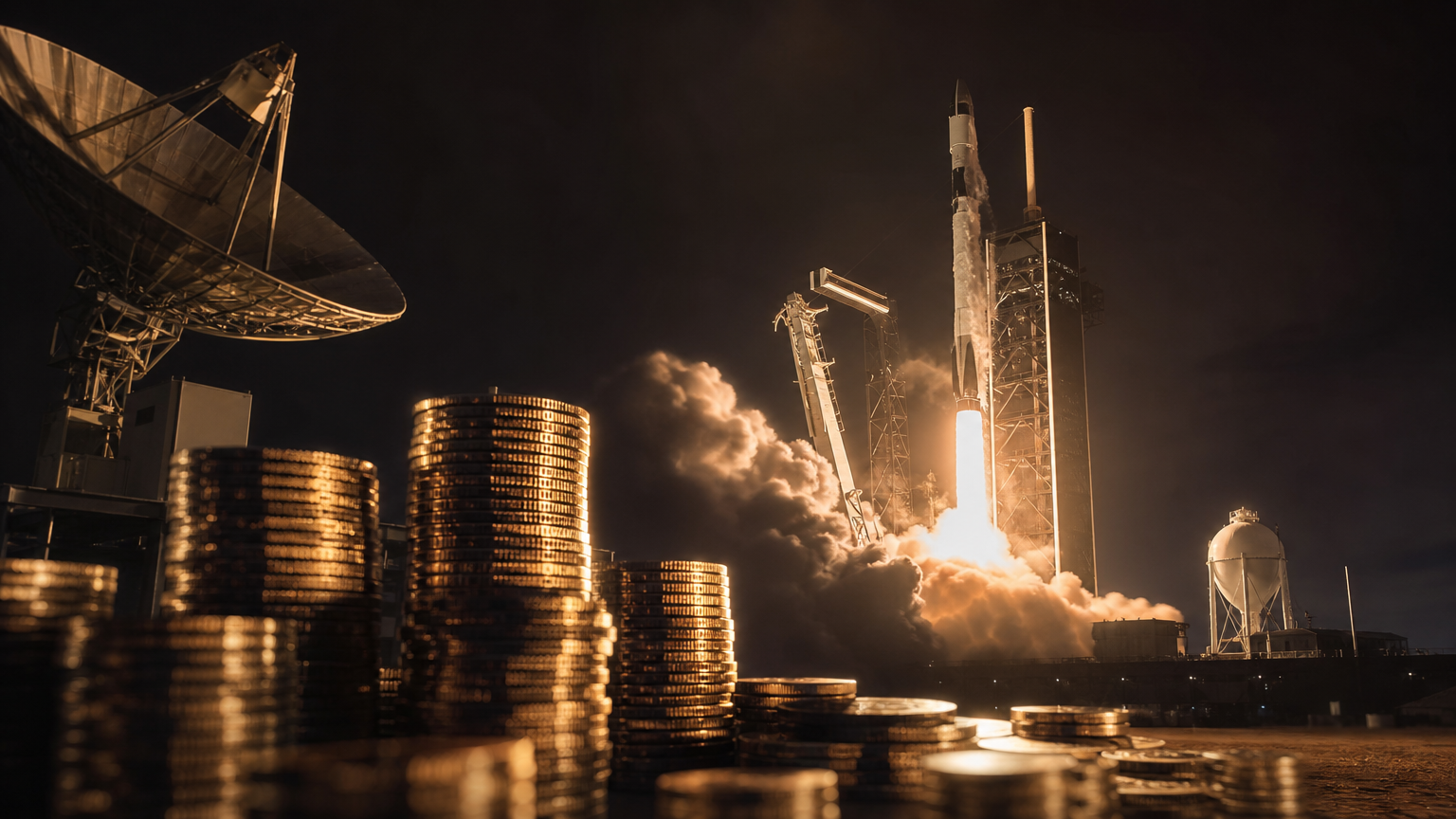
SpaceX has become the most striking valuation story in Elon Musk’s business empire: investors are assigning the rocket, satellite and connectivity company a value roughly $800 billion above Tesla, even though SpaceX’s current sales base is much smaller. In the freshest market snapshot behind the comparison, SpaceX was valued at about $2.27 trillion at Wednesday’s close, while Tesla stood near $1.49 trillion, leaving SpaceX almost $800 billion ahead . The subject has been widely framed around SpaceX entering the $2.8 trillion valuation orbit, but the current 72-hour reporting shows a live public-market comparison closer to $2.3 trillion; the key point is unchanged: investors are putting a far richer multiple on SpaceX than on Tesla.
The contrast is stark because it is not driven by revenue scale. SpaceX generated about $23 billion over its past four reported quarters, compared with about $104 billion for Tesla, meaning SpaceX produced less than one-quarter of Tesla’s sales in the period used for the comparison . Yet the market valued each dollar of SpaceX sales at almost seven times the value assigned to each dollar of Tesla sales, with SpaceX trading near 99 times trailing sales and Tesla around 14 times . That is the number at the center of the story: not simply that SpaceX is large, but that investors are treating its revenue as structurally more valuable.
Why the market is paying for orbit, not just sales
A conventional reading would say the numbers are absurd. Tesla sells vehicles, batteries and energy products at global scale. SpaceX sells launch services, satellite connectivity and newer AI-linked services from a much smaller revenue base. But the market is not paying SpaceX for being a smaller Tesla. It is paying for the possibility that SpaceX owns the infrastructure layer of the next communications, defense and orbital economy.
Starlink is the clearest reason. SpaceX’s connectivity segment, mainly Starlink, generated roughly $5.3 billion in operating income over the last four quarters, more than Tesla’s roughly $4.4 billion in operating income over the same stretch . That fact changes the comparison. SpaceX may have less total revenue, but one of its core segments is already producing operating profit at a scale that rivals, and in this snapshot exceeds, all of Tesla.
The margin story also matters. Starlink’s operating margin was reported at roughly 36% a year earlier and in the first quarter of 2026, then rose to about 39% in the second quarter . During the same general period, Tesla’s profitability looked more compressed: its operating margin fell from around 6% in late 2025 to 4.2% in the first quarter of 2026 and 1.4% in the second quarter . Investors are therefore not merely comparing rockets with cars. They are comparing a satellite-network business with widening margins against an automaker whose current margins remain under pressure.
Tesla is being valued on promises too
The valuation gap should not be read as a simple verdict that SpaceX is “better” and Tesla is “worse.” Both companies are being priced partly on things that have not yet fully arrived. Tesla’s valuation still contains large expectations for autonomy, robotaxis and the Optimus humanoid robot program . Those businesses may eventually become material, but they are not yet the source of Tesla’s present revenue scale.
That makes the SpaceX premium more interesting. Investors appear to be rewarding SpaceX for growth that is visible in current segment results, especially Starlink, while discounting Tesla’s still-developing autonomy and robotics narrative. In other words, both companies are future stories, but SpaceX’s future has a present-day profit anchor that investors can point to.
Even so, SpaceX is not a clean profit machine. The company lost more than $8 billion over the same four-quarter stretch in which it generated about $23 billion in revenue . Its artificial-intelligence segment, which includes Grok, X and computing capacity rented to other companies, lost $3.7 billion from operations in the first half of 2026 . The AI segment’s loss narrowed from $2.5 billion in the first quarter to $1.3 billion in the second, but a smaller loss is not yet a durable profit engine .
The AI debt question enters the valuation debate
The valuation story became even more complicated this week as SpaceX was reported to be seeking about $40 billion in debt financing to buy Nvidia chips, with Apollo Global Management leading the process . The proposed package would reportedly include around $30 billion in investment-grade debt and another $10 billion in bank loans . For a company already being valued on ambitious expectations, that kind of financing tells investors two things at once.
First, SpaceX is trying to scale AI infrastructure aggressively. That supports the bullish view that the company is no longer only a launch-and-connectivity platform. Second, it highlights the cash demands behind that ambition. A premium valuation can be easier to defend when growth is funded cleanly by internally generated cash; it is more controversial when investors must also underwrite large borrowing, heavy capital spending and an AI segment still reporting operating losses.
That does not mean the valuation is wrong. It means the valuation depends on execution across multiple difficult businesses at once: launch cadence, Starlink subscriber growth, enterprise and government connectivity, AI infrastructure utilization, and the ability to turn large capital spending into durable margins.
Insider unlocks add pressure to the public-market story
SpaceX’s path as a public stock also remains unusual. On October 9, a new insider-share unlock made roughly 319 million early-release-eligible shares available for sale, representing nearly $51 billion in market value at the cited prices . The report emphasized that eligibility does not guarantee immediate selling, but the unlock still matters because it can expand the float and put pressure on a stock whose valuation already depends on exceptional confidence .
That detail is important for readers who focus only on market capitalization. A trillion-dollar valuation can look stable from a distance, but the actual trading structure matters. If more insider shares become available while the stock is priced at extreme sales multiples, the market has to absorb more supply at a time when investors are already debating whether SpaceX’s AI losses and capital needs justify the premium.
What the $800 billion gap really says
The most useful way to read the SpaceX-Tesla gap is not as a ranking of Musk companies. It is a referendum on what public markets now value most. Tesla has the larger sales base, the established consumer brand and the long record as a public company. SpaceX has a smaller revenue base but a rare combination of launch dominance, satellite distribution, government relevance, profitable connectivity and AI optionality.
At roughly 99 times trailing sales in the cited comparison, SpaceX is priced for extraordinary growth . For that valuation to work, Starlink likely has to keep expanding, the AI segment has to move from heavy losses toward meaningful profit, and the launch business has to maintain a strategic position that competitors cannot easily erode. If those things happen, conventional sales multiples may prove too earthbound. If they do not, valuation gravity will eventually reassert itself.
For now, the market’s message is clear: SpaceX is being valued less like an aerospace contractor and more like a platform company whose network could span launch, broadband, defense and compute. That is why a company with less than one-quarter of Tesla’s sales can trade hundreds of billions of dollars above it. The number may move by the hour, but the signal is unmistakable: investors are no longer valuing space as a side quest. They are valuing it as infrastructure.
Sources from the last 72 hours
- [1]SpaceX Is Worth About $800 Billion More Than Tesla on Less Than a Quarter of Its SalesOct 9, 2026, 6:57 AM
- [2]SpaceX Is Worth About $800 Billion More Than Tesla on Less Than a Quarter of Its SalesOct 9, 2026, 7:37 AM
- [3]SpaceX is going on a bond bingeOct 7, 2026, 4:59 PM
- [4]SpaceX's Fleecing of Retail Investors Continues: Up to $51 Billion in Insider Shares Unlock Today, Oct. 9Oct 9, 2026, 12:06 PM
AI-generated article based on recent web research, then preserved as a dated editorial snapshot.
Comments
Be the first to comment.