
Daily Podcast full article
IonQ and IBM advance quantum scale
IonQ’s memory-enhanced quantum interconnect and IBM’s 100-qubit feedback-control experiment attack the same scaling problem from different sides: one links quantum modules, the other keeps larger circuits stable long enough to matter.
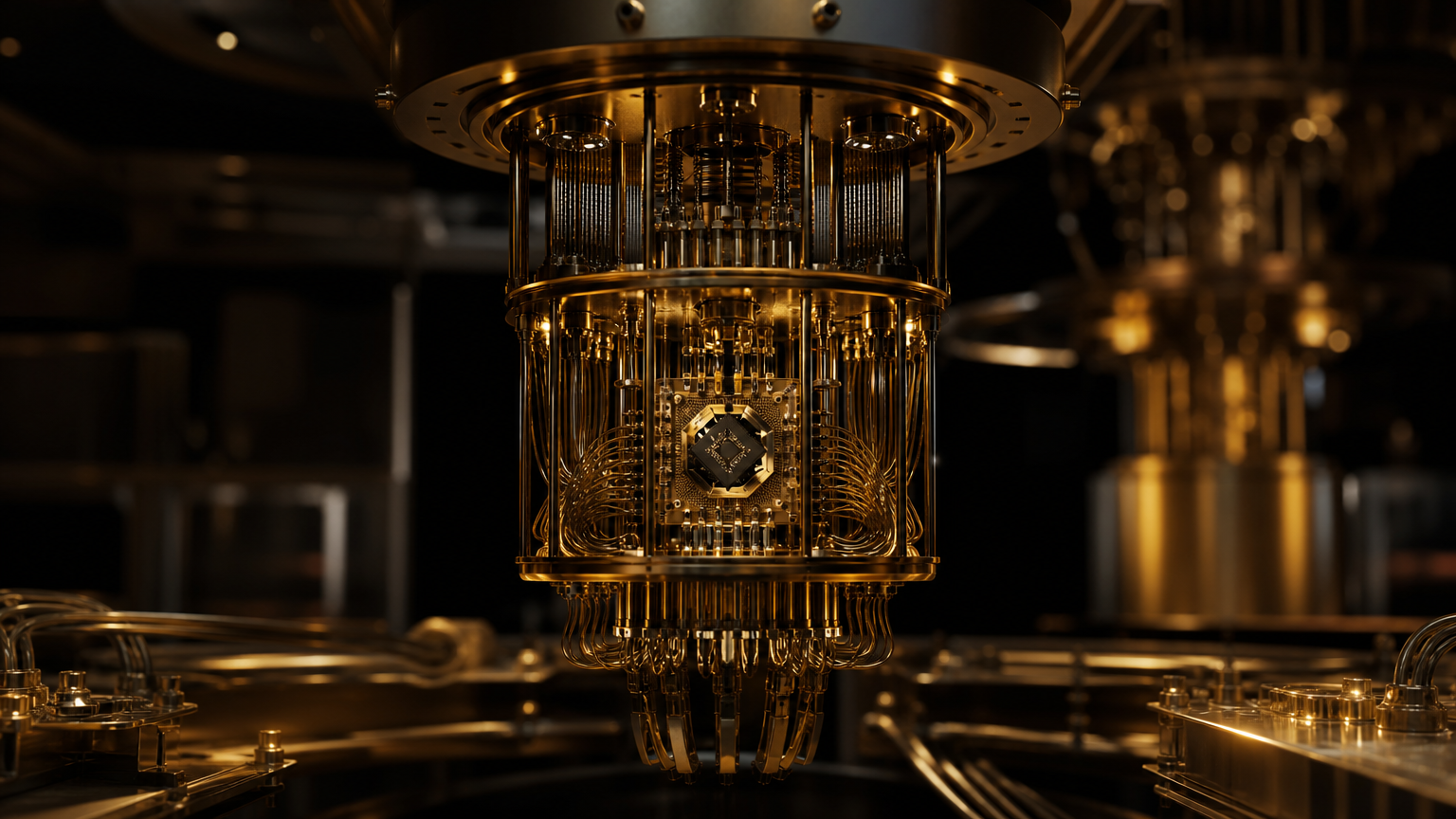
IonQ and IBM advance quantum scale
Two fresh quantum announcements point to the same uncomfortable truth: scaling quantum computing is no longer just about adding more qubits. It is about moving quantum information between systems without destroying it, and about correcting fragile states while a calculation is still running. IonQ and IBM addressed those two fronts this week, with IonQ reporting a memory-enhanced quantum interconnect and IBM-linked researchers demonstrating large-scale adaptive feedback on up to 100 qubits .
IonQ said it achieved entanglement rates above 1,000 per second, or 1 kHz, between a trapped-ion qubit and a solid-state quantum memory through a photonic interconnect . IBM’s milestone, described in a Nature Physics paper and covered in current reporting as a 100-qubit advance, used an IBM Quantum Heron processor to apply nearly 5,000 entangling gates and about 5,000 mid-circuit measurement-and-reset operations on systems of up to 100 qubits .
The two efforts are not the same kind of result. IonQ is emphasizing a route to modular, distributed quantum machines, while the IBM work is focused on controlling quantum chaos and testing feedback methods that future error-corrected systems will need . Taken together, however, they show why the next phase of quantum competition is shifting from headline qubit counts toward interconnects, memory, feedback, and error control.
IonQ’s bet: network the machine
IonQ’s demonstration links two very different quantum components: a trapped barium ion qubit and a silicon-vacancy quantum memory embedded in diamond nanophotonics . According to IonQ, the photonic link generated more than 1,000 quantum connections per second between the trapped ion and the memory, a rate the company says is fast enough to support distributed quantum computing use cases .
That matters because distributed quantum computing depends on entanglement between nodes. If a future useful system is built from many modules rather than one monolithic processor, those modules must share quantum states through photons, memories, and interfaces that do not become the bottleneck. IonQ’s release frames entanglement as the essential quantum connection that lets separate systems operate together .
The technical significance is not just the 1 kHz headline number. Quantum Computing Report said the link operated at an average entanglement rate of 1.032 kHz, or 1,032 Bell pairs per second, with 87.9% state fidelity . That same report described the result as a heralded photonic interconnect between a trapped ion and a diamond silicon-vacancy memory, using a single reflected photon to signal successful entanglement .
The architectural point is important. Conventional two-photon heralding can suffer badly from photon loss because success depends on two photons arriving together; the IonQ approach, as described by Quantum Computing Report, replaces that with a single-photon reflection protocol whose success scales more favorably with photon collection efficiency . In plain English, IonQ is trying to make the quantum network less allergic to lost photons.
IonQ also says the demonstration is more than four times faster than the previous trapped-ion record associated with Duke University work involving IonQ co-founder Chris Monroe . The company is positioning the result as part of a broader interconnect roadmap, including work tied to DARPA’s High-Speed Quantum Interconnects program, which seeks links that can work across multiple qubit technologies .
That cross-platform ambition is crucial. If trapped ions, neutral atoms, superconducting circuits, memories, and photonic systems all keep improving, the winning architecture may not be a single uniform device. It may be a quantum data center assembled from specialized components. IonQ’s CEO Niccolo de Masi explicitly compared the direction to classical data centers, where processors, memory, and networking scale together rather than as one giant chip .
IBM’s bet: keep order while computing
The IBM-linked result attacks the other side of scaling: what happens after a processor is large enough that errors and chaos spread through it. The Nature Physics paper reports adaptive monitored quantum circuits that used local mid-circuit measurements and resets to control quantum chaotic dynamics on an IBM superconducting processor with up to 100 qubits .
The experiment implemented a quantum version of the classically chaotic Bernoulli map, where one process scrambles information across the system and another process uses measurement and feedback to steer it toward a fixed point . The researchers observed a dynamical phase transition between chaotic quantum behavior and a more controlled regime, and they compared the result with theoretical descriptions using simulations, matrix product states, and statistical-mechanics mappings .
Current Rutgers-sourced reporting said the team used a 156-qubit IBM Quantum Heron processor and selected a connected chain of as many as 100 qubits . The experiment involved nearly 5,000 operations linking pairs of qubits, along with nearly 5,000 checks and resets . Interesting Engineering likewise reported that the work used a 156-qubit Heron processor, selected up to 100 connected qubits, and alternated between scrambling and measurement-reset processes .
That is why the result is being described as relevant to self-correcting or fault-tolerant quantum computing. A useful quantum computer cannot simply run a long calculation and hope its qubits remain pristine. It must repeatedly detect, manage, and correct errors while computation continues, without copying quantum information in the classical sense and without destroying the state it is trying to protect .
The Rutgers release was careful on the central limitation: no one has yet built a fault-tolerant quantum computer . But it also described the experiment as a landmark on that road because the machine repeatedly checked and reset parts of itself while running . IBM researcher Maika Takita said the challenge was not merely measuring a qubit, but doing so repeatedly while the rest of the processor continued to operate .
Why these advances belong in the same story
IonQ’s interconnect and IBM’s feedback-control experiment are separate technical achievements, but they converge on one strategic problem: quantum scale is not a single dimension. More qubits help only if they can be connected, synchronized, protected, and corrected. A huge device with weak links is not scalable, and a well-connected system that cannot control errors is not useful.
IonQ’s path suggests that future quantum computers may look more like networks than single processors. IBM’s result suggests those processors, once large and connected, must run adaptive checks and resets thousands of times without collapsing into unusable noise. One result is about moving quantum states between modules; the other is about keeping those states orderly inside a module.
The near-term caution is equally important. IonQ’s reported 87.9% Bell-state fidelity is a real engineering data point, not a finished distributed fault-tolerant computer . IBM’s 100-qubit adaptive-circuit experiment shows control of quantum chaos and feedback at scale, not a commercial machine running corrected business workloads . Both are steps, not finish lines.
Still, the direction is clear. Quantum computing is moving from isolated processor demonstrations toward systems engineering: interconnects, memories, feedback loops, resets, decoders, and modular layouts. If those pieces mature together, the industry gains more than bigger chips. It gains a plausible path to machines that can scale without drowning in their own fragility.
That is the real significance of this week’s IonQ and IBM news. IonQ is trying to make quantum packets travel between systems without losing their identity, while IBM-linked researchers are trying to keep many qubits from spiraling into chaos during active computation. Quantum packets still hate being observed, and decoherence remains the boss battle, but both announcements show the field learning to fight on the right fronts .
Sources from the last 72 hours
- [1]IonQ Demonstrates World-First Quantum Memory-Enhanced Interconnect for Distributed Quantum ApplicationsOct 9, 2026, 3:00 PM
- [2]IonQ Demonstrates 1 kHz Memory-Enhanced Quantum Interconnect Connecting Trapped Ions and Diamond Color CentersOct 9, 2026, 2:00 AM
- [3]Order from chaos with adaptive circuits on quantum hardwareOct 9, 2026, 2:00 AM
- [4]Scientists Advance Self-Correcting Quantum ComputersOct 9, 2026, 8:38 PM
- [5]IBM’s 100-qubit chip advances self-correcting quantum computers with 5,000 operationsOct 10, 2026, 1:18 AM
AI-generated article based on recent web research, then preserved as a dated editorial snapshot.
Comments
Be the first to comment.