
Daily Podcast full article
Pentagon commits $350M to quantum
The Pentagon’s roughly $350 million quantum-computing package combines DARPA validation money, a PsiQuantum manufacturing loan commitment and new application workshops, making clear that Washington is still treating fault-tolerant quantum computing as a strategic defense bet despite uncertain timelines.
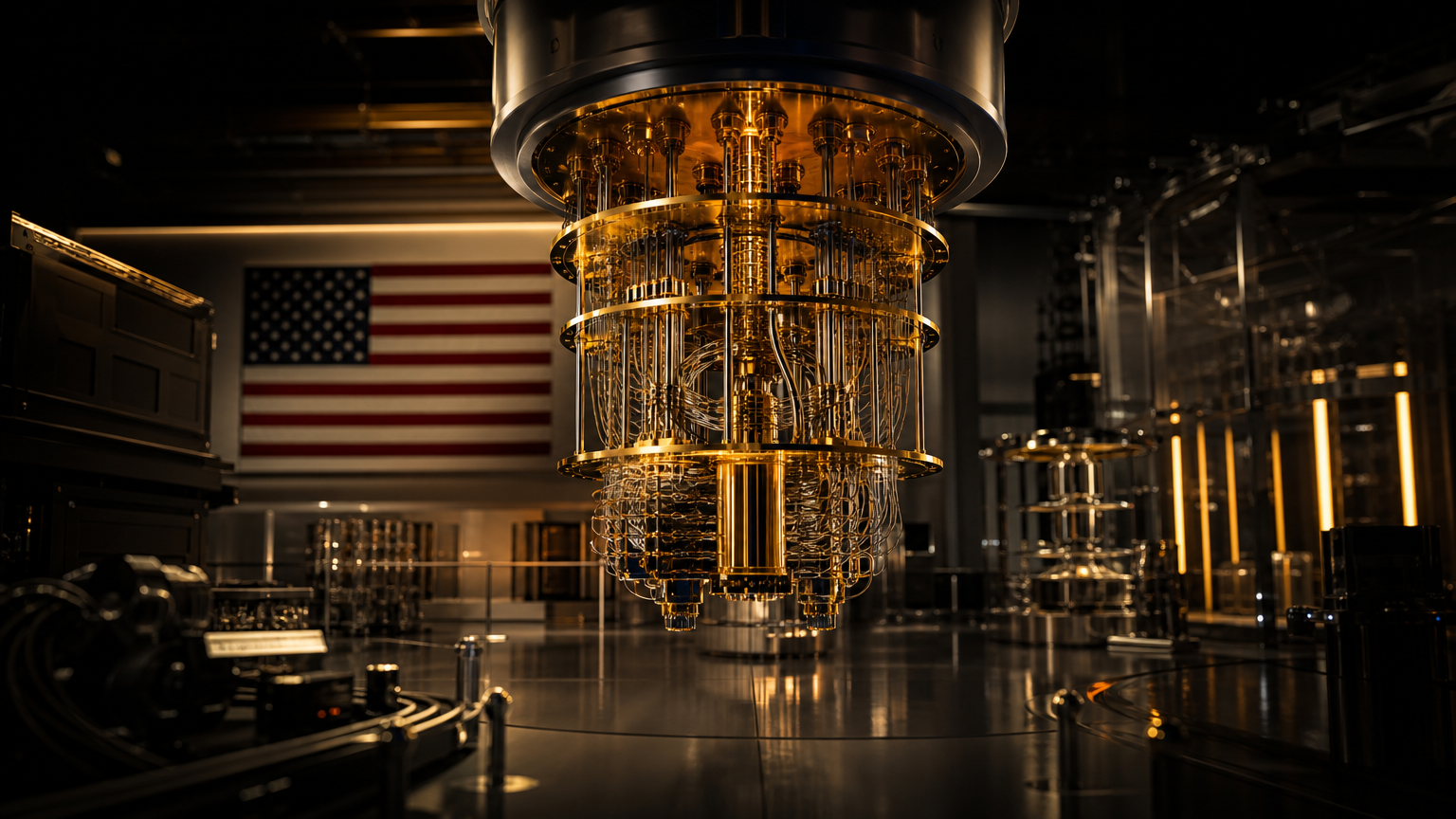
A defense bet on post-classical computing
The Pentagon has committed roughly $350 million to quantum-computing initiatives designed to strengthen U.S. national-security capabilities, move promising hardware approaches through tougher validation and connect future machines to defense-relevant applications . The package is not a single conventional procurement award. It is a bundle: about $200 million in new funding tied to DARPA’s Quantum Benchmarking Initiative, plus an approximately $150 million conditional loan commitment to PsiQuantum through the Office of Strategic Capital .
That structure matters. Quantum computing remains a field where timelines are contested, hardware architectures compete and commercial claims can run ahead of engineering proof. The Pentagon’s approach appears to be less “buy a quantum computer today” than “pay to find out which paths could become militarily useful, and make sure the industrial base can build them in the United States.” The official framing says the effort is intended to identify, develop and prepare for quantum-computing capabilities that could underpin future national-security missions .
The investment also signals that the U.S. defense establishment is willing to support long-cycle technologies before a clear market exists. That is familiar territory for defense innovation: early demand, technical validation and manufacturing support can shape entire industries before products are fully mature. In quantum, the difference is that the “product” is still a fault-tolerant machine powerful enough to deliver value exceeding its cost.
The $200 million validation track
The largest technical piece is DARPA’s Quantum Benchmarking Initiative, or QBI. According to the announcement, DARPA is advancing four additional quantum-computing providers to Stage C, the program’s final evaluation phase, with approximately $200 million in new funding that builds on more than $650 million in prior DARPA investments in prospective quantum-computing providers .
The four newly advanced companies are Atom Computing, Diraq, IBM and IonQ, each representing a different hardware route: neutral atoms, silicon CMOS spin qubits, modular superconducting processors and trapped ions, respectively . They join Microsoft and PsiQuantum, which had already reached Stage C through the earlier Underexplored Systems for Utility-Scale Quantum Computing pilot program .
Stage C is the crux. Earlier stages examined technical concepts, roadmaps and risk mitigation. Stage C moves the process toward government verification and validation of whether proposed utility-scale systems can actually be constructed as designed and operated as intended . DARPA defines “utility scale” as the point where a system’s computational value exceeds its cost, and the initiative is assessing whether any approach can plausibly reach that level by 2033 .
That phrasing is important because it keeps the program grounded in economics as well as physics. A quantum computer that is scientifically impressive but too expensive, unstable or narrow in use would not meet the standard. DARPA is therefore testing architectures, manufacturability, systems engineering and practical performance rather than simply counting qubits or accepting vendor roadmaps.
Diraq’s separate announcement illustrates the scale of what Stage C can mean for a participant. The company said its Stage C path carries funding of up to $300 million, with an initial $51 million tranche supporting the next year of work on a silicon-based route to utility-scale, fault-tolerant quantum computing . That does not mean every company receives the same amount or that all potential funding is guaranteed. But it shows that the Pentagon’s validation campaign is large enough to shape private-sector priorities.
The PsiQuantum manufacturing lane
The second major component is the approximately $150 million conditional loan commitment to PsiQuantum, a Palo Alto company pursuing a photonic architecture for fault-tolerant quantum computing . PsiQuantum said the potential financing from the Office of Strategic Capital would expand its U.S. advanced manufacturing and prototyping capabilities, especially at its 140,000-square-foot hub in Milpitas, California .
The money would support equipment and infrastructure for fabricating and validating components, integrating and testing systems, and deploying advanced cryogenic systems for prototype machines . In practical terms, that means the Pentagon is not only funding theory, algorithms or evaluation. It is also trying to underwrite the physical manufacturing base needed to turn a quantum-computing architecture into hardware at scale.
The commitment remains conditional. PsiQuantum said a final loan would require satisfaction of financial, legal, technical and regulatory conditions . The Defense Department’s press-list version of the announcement similarly described the commitment as conditional and tied to due diligence and other steps before financial close . That caveat is essential: this is a signal of intent and a financing pathway, not a blank check already spent.
Still, the loan fits a broader pattern. The Office of Strategic Capital has become one of the Pentagon’s mechanisms for using debt finance to reinforce technologies considered vital to national security. For quantum vendors, that can be as important as research grants: fabrication facilities, test infrastructure and cryogenic systems are expensive, and venture capital alone may not want to absorb the slow, uncertain path toward fault-tolerant machines.
From hardware races to mission use cases
The Pentagon is also trying to connect future machines to mission problems. The announcement says DARPA, working with the Department of Energy’s Office of Science, the National Nuclear Security Administration and the Laboratory for Physical Sciences, will host application workshops beginning before January 2027 . The workshops are meant to bring end users and quantum-algorithm experts together to identify high-value use cases in areas such as chemistry, materials science and physics .
That is a subtle but consequential move. Much of the public quantum debate focuses on cryptography or on abstract computational speedups. Defense users, however, are likely to care about narrower but high-impact applications: materials for next-generation platforms, chemical modeling, physics simulations, optimization and design problems that classical systems struggle to solve efficiently. If the workshops can define credible use cases, they may also define future procurement requirements.
This is where the $350 million package becomes more than a funding headline. The Pentagon is linking three layers: validation of hardware claims, exploration of military applications and support for domestic manufacturing capacity. Those layers reinforce one another. Hardware programs need real applications to justify costs; application developers need credible machines to target; manufacturers need predictable demand to invest in facilities.
Why it matters now
The timing is notable because quantum computing is simultaneously hyped and hard. Fault-tolerant machines could eventually transform simulation, optimization and certain security-relevant computations, but the engineering challenge remains formidable. Error correction, control electronics, cryogenics, interconnects, software stacks and manufacturing yield all have to improve together.
By putting money into multiple architectures, the Pentagon is hedging. It is not declaring that neutral atoms, trapped ions, superconducting systems, silicon spin qubits or photonics have already won. It is paying for a structured process to find out which approaches can survive independent scrutiny. That is a rational stance in a field where the wrong early standard could waste years and billions.
For vendors and laboratories, the package can bridge long development cycles and create a clearer route from research prototypes to defense-relevant systems. For U.S. rivals, the message is equally clear: quantum computing is moving deeper into national industrial policy. The Pentagon is not waiting for fully fault-tolerant machines to appear before it starts shaping the market around them.
The punchline is that this is not a quantum moonshot with a single rocket. It is a portfolio: DARPA tests the physics and systems engineering, the Office of Strategic Capital backs manufacturing capacity, and defense agencies start defining the problems they want solved. Schrödinger’s budget is no longer in superposition; at roughly $350 million, it has been observed, allocated and aimed at national security.
Sources from the last 72 hours
- [1]War Department Announces $350 Million Quantum Computing InitiativesOct 8, 2026, 5:44 PM
- [2]DoD announces $350 million in quantum computing initiativesOct 9, 2026, 2:00 AM
- [3]Diraq Advances to Final Stage of DARPA’s Quantum Benchmarking InitiativeOct 7, 2026, 11:35 PM
- [4]PsiQuantum Receives Conditional $150 Million Loan Commitment from the U.S. Department of War to Advance Domestic Quantum ComputingOct 8, 2026, 2:00 AM
- [5]Department of War's Office of Strategic Capital Signs $150 Million Conditional Loan Commitment With PsiQuantumOct 8, 2026, 5:06 PM
AI-generated article based on recent web research, then preserved as a dated editorial snapshot.
Comments
Be the first to comment.