
Daily Podcast full article
Photons preserve 13-qubit entanglement
Researchers have demonstrated genuine multipartite entanglement across 13 photonic qubits while using a nondestructive measurement strategy that keeps the photons available rather than consuming them during verification. The result, built around deterministic and programmable fusion of smaller microwave-photon graph states, is a meaningful step for photonic quantum architectures, though still far from a fault-tolerant quantum network or computer.
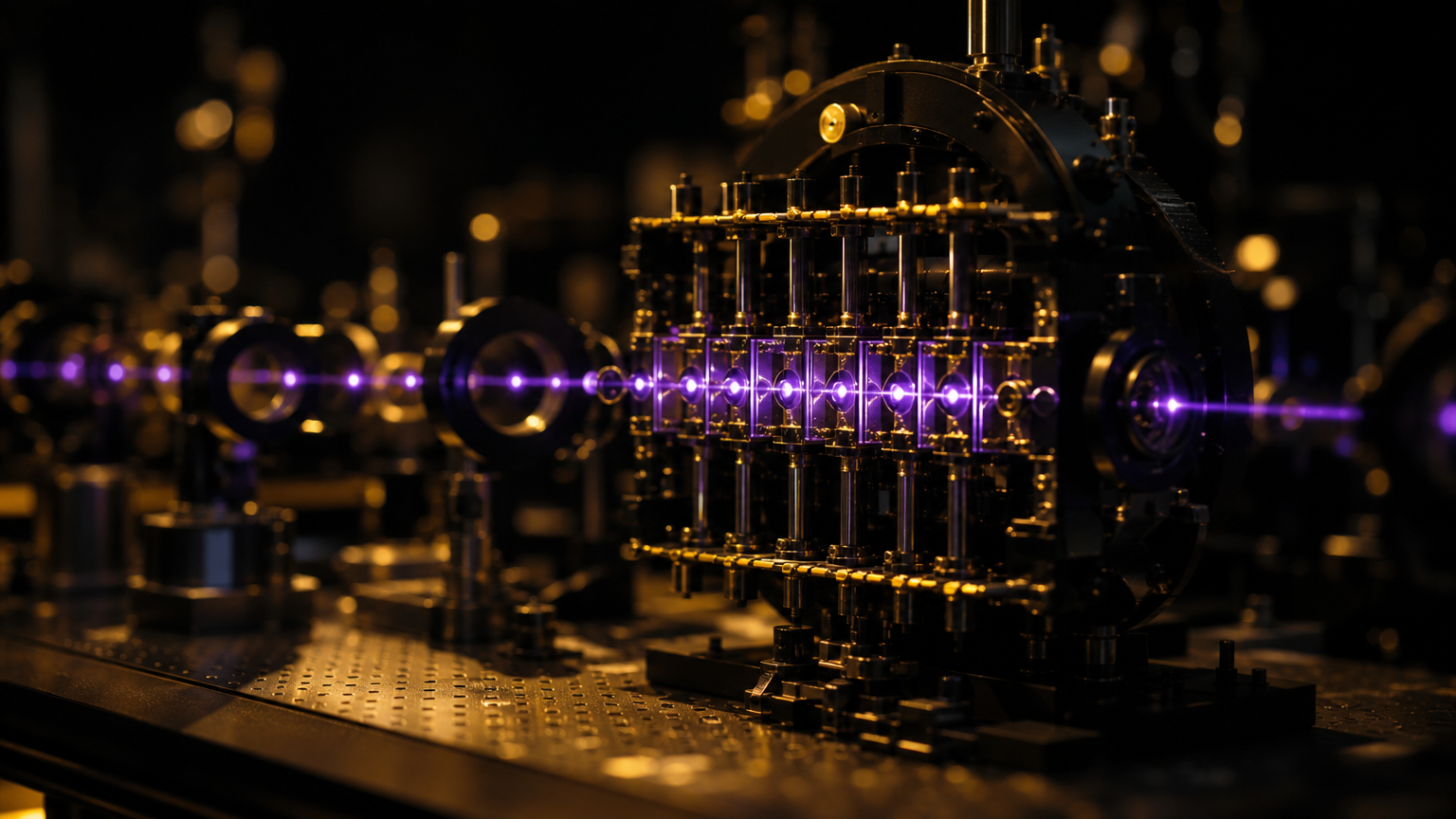
A 13-qubit result with a crucial qualifier: the photons survive
A team associated with Tsinghua University and Hefei National Laboratory has reported a photonic quantum experiment in which smaller entangled groups of microwave photons are fused into a larger graph state, reaching genuine multipartite entanglement across 13 photonic qubits . The phrase “13 qubits” can easily invite overstatement, so the important point is narrower and more interesting: this is not a 13-qubit general-purpose quantum computer, but a laboratory demonstration of how larger photonic entangled states might be assembled more flexibly .
The key advance is that the verification-and-fusion step is described as nondestructive. In many photonic schemes, learning enough about a photon’s state can mean absorbing or otherwise destroying it. Here, the reported method uses a quantum non-demolition detector to perform parity measurements on selected photon pairs, entangling them without destroying them and thereby connecting smaller graph states into a larger one . Put simply, the photons are not merely evidence left behind by the experiment; they remain part of the quantum resource the experiment is trying to build.
That distinction matters for quantum communication and distributed quantum processing. If a quantum state is consumed every time engineers confirm or connect it, scaling becomes punishing. If selected measurements can establish links while preserving the photonic qubits, the architecture becomes more compatible with repeaters, networks and later computational steps. The recent reports frame the result as a route toward larger, reconfigurable photonic graph states, not as a finished machine .
Why graph states are the right language
In this work, the entanglement is organized as a graph state: qubits are represented as nodes, and entangling relations are represented as links. Such states are widely discussed as resources for measurement-based quantum computing, quantum communication and quantum networking . In measurement-based computing, the entangled state is prepared first, and computation proceeds through carefully chosen measurements. In network settings, graph-like entanglement can describe how remote or modular quantum nodes are connected.
The new demonstration follows a divide-and-conquer logic. Rather than preparing one large state in a single uninterrupted operation, the researchers first generate smaller entangled states of microwave photons and then fuse those building blocks . This is conceptually attractive because large multipartite entanglement is fragile: every extra qubit, optical path, microwave component or detector can add loss, noise or timing errors. Building from smaller units could make the system more modular.
The reports also emphasize programmability. Frequency tuning lets the experimenters choose which photons undergo the parity measurement, giving them control over which smaller graph states are connected . That is significant because practical quantum processors and quantum networks will not need just “more entanglement”; they will need the right connectivity for a given task. A rigid entanglement pattern is less useful than one that can be selected or reconfigured.
Deterministic fusion, not magic scaling
The word “deterministic” also requires care. In the reported context, it contrasts with conventional fusion methods in linear-optical systems, where attempts can be probabilistic and failures may require repeated trials, extra hardware or feed-forward resources . The new approach asks whether fusion can be made deterministic by using quantum non-demolition measurement, with the stated goal of demonstrating a deterministic, programmable operation for assembling larger reconfigurable photonic graph states .
That does not mean every part of a future large-scale machine will work perfectly. It does not erase photon loss, detector imperfections, calibration overhead or decoherence. One account explicitly cautions that the result is a laboratory state-generation demonstration, not a working quantum-network service or a 13-qubit general-purpose processor . The most accurate reading is that the fusion operation has been made more controlled and less wasteful in this experimental setting.
The mechanism is elegant. Superconducting circuits generate microwave photons in small entangled states . The photons are time-bin encoded, meaning their quantum information is carried in distinct time slots rather than, for example, only in polarization . A quantum non-demolition detector then performs a parity measurement on selected photon pairs, projecting them into an entangled relation without absorbing them . Frequency tuning selects which photons are fused, making the connectivity programmable .
The researchers also used active resetting and reuse of superconducting qubits, along with built-in error mitigation, to reduce the impact of decoherence . That detail is important because decoherence is one of the central enemies of multipartite entanglement. It is one thing to entangle two or three systems briefly; it is much harder to maintain a useful shared quantum state across a larger group while the apparatus itself continues operating.
What “genuine multipartite entanglement” means here
The reported achievement is not just that 13 photons are somewhere in the same apparatus. The claim is genuine multipartite entanglement across 13 photonic qubits, meaning the entanglement spans the whole group rather than being explainable as several smaller, disconnected entangled clusters . That is the scientific weight of the number 13.
In practical terms, genuine multipartite entanglement is the difference between a collection of small teams and one coordinated system. A device might create several separate entangled pairs or triplets, but that would not provide the same resource as a single state whose correlations involve all 13 qubits. For graph-state quantum technologies, the connectedness of the state is as important as the raw qubit count.
The work is therefore best viewed as an architectural demonstration. It shows a way to connect on-demand resource states into larger structures, and it suggests that nondestructive, programmable fusion could help scale photonic graph-state synthesis . The reporting also points to possible relevance for quantum error-correction schemes, where both the size and the connectivity of graph states can matter .
Why photons are attractive, and why they are difficult
Photons are appealing carriers of quantum information because they move naturally, interact weakly with the environment compared with many matter-based systems, and are central to quantum communication. Those same qualities create engineering challenges. Because photons do not readily interact with one another, making reliable entangling operations between them is difficult. Conventional photonic schemes often rely on measurement-induced interactions, and those measurements can be probabilistic or destructive.
The new experiment uses microwave photons and superconducting circuitry, which places it in a hybrid territory between photonic quantum information and circuit quantum electrodynamics. Superconducting circuits can provide strong controllability, while photons can serve as flying quantum carriers. The nondestructive parity measurement is the bridge: it extracts the information needed to connect states without consuming the photons .
This is why the “kept both the result and their day jobs” joke lands. In many quantum experiments, a photon’s final act is to reveal information by being detected. Here, the point is that selected photons can participate in a verification or fusion operation and remain part of the quantum state being built.
The road from 13 qubits to useful infrastructure
The limitations are as important as the milestone. The reports identify device fidelity, photon-generation efficiency and detector performance as areas needing improvement . The team also plans to develop multi-detector architectures capable of performing more fusion operations and generating larger, higher-dimensional graph states . These are not minor details; they are the difference between a compelling physics result and a scalable platform.
A fault-tolerant quantum network or distributed processor would require many more qubits, lower error rates, reliable interfaces, repeatable state generation and integration with error correction. Thirteen photonic qubits is a notable multipartite-entanglement benchmark, but it remains far from the scale required for robust infrastructure. The achievement is better described as a proof of a promising assembly method than as a finished computing advance.
Still, the direction is important. Quantum technologies will likely need modular approaches: small reliable units connected into larger systems. If nondestructive, programmable fusion can be improved, parallelized and integrated with better photon sources and detectors, it could become one of the techniques that make photonic graph states more practical. For now, the result shows that 13 entangled photonic qubits can be linked without making the photons pay the usual price of confirmation.
Bottom line
The story is not that a new quantum computer has arrived. It is that researchers have shown a cleaner way to assemble a larger photonic entangled state: generate smaller microwave-photon graph states, choose which photons to connect, use a nondestructive parity measurement to fuse them, and preserve the photons while demonstrating genuine 13-qubit entanglement . That combination of scale, programmability and preservation is why this modest-looking number matters.
Sources from the last 72 hours
- [1]Superconducting circuit links smaller photon groups into larger entangled statesOct 9, 2026, 2:00 AM
- [2]Scientists achieve 13-qubit genuine entanglement without destroying their photonsOct 10, 2026, 3:27 PM
- [3]Researchers develop deterministic fusion method for larger photonic graph statesOct 9, 2026, 2:00 PM
AI-generated article based on recent web research, then preserved as a dated editorial snapshot.
Comments
Be the first to comment.