
Daily Podcast full article
SpaceX deploys 21 military satellites for U.S. data network
SpaceX launched and deployed 21 Northrop Grumman-built satellites for the U.S. Space Development Agency on October 10, adding a fourth orbital plane to the Pentagon’s proliferated low-Earth-orbit communications architecture after a five-day delay.
A delayed launch becomes a strategic deployment
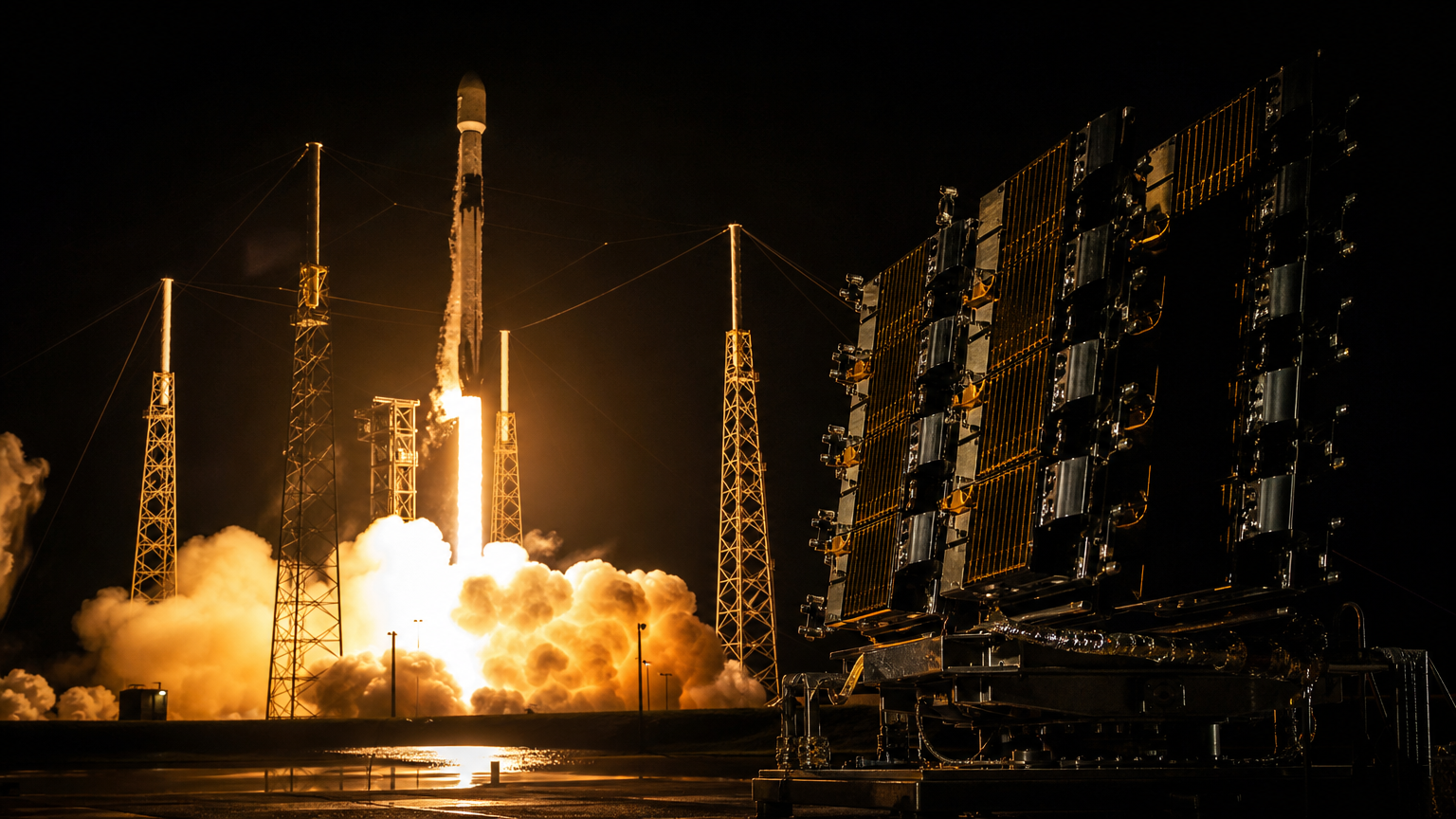
SpaceX has completed the launch of 21 military data-transport satellites for the U.S. Space Development Agency, turning a scrubbed countdown earlier in the week into a successful October 10 deployment from Vandenberg Space Force Base in California . The Falcon 9 mission delivered Northrop Grumman-built Tranche 1 Transport Layer space vehicles into low Earth orbit, bringing the number of on-orbit Tranche 1 transport satellites to 84, according to the agency .
The flight lifted off from Space Launch Complex 4 East at 12:39 a.m. Pacific time, or 07:39 UTC, after a five-day delay from an October 5 attempt . That earlier attempt was stopped in the final minute of the countdown when Falcon 9’s automated systems halted the launch sequence just before liftoff, the SDA said . Spaceflight Now reported that SpaceX later attributed the hold to off-nominal data on the second stage and used the extra days for vehicle checks and range coordination .
For the Pentagon, the important word is not just “launched,” but “deployed.” Northrop Grumman said all 21 satellites it built were successfully launched and deployed for the SDA’s Tranche 1 Transport Layer satellite communications network . That makes this mission more than another Falcon 9 statistic: it is a new operational building block in the U.S. military’s effort to move critical data through a larger, more distributed orbital network.
What went to orbit
The payload was part of the SDA’s Proliferated Warfighter Space Architecture, a low-Earth-orbit constellation intended to provide secure, low-latency, beyond-line-of-sight data transport for military users . In practical terms, the Transport Layer is meant to move tactical communications, missile-warning information and targeting data faster and more resiliently than architectures that depend on a small number of large, expensive spacecraft.
The SDA said the 21 new satellites form the fourth orbital plane of Tranche 1 Transport and add capacity to a “resilient, proliferated” low-Earth-orbit architecture . The agency said these satellites will support data transport tied to tracking advanced missile threats, including secure communications links and user connectivity through tactical optical and Ka-band links .
Northrop framed the spacecraft as part of a broader data-relay mesh designed to detect and track missiles and pass information around the world with almost no lag time . The company said its satellites help extend Link 16 — a secure, high-speed and jam-resistant military data network — into space, allowing tactical data to be delivered to warfighters when seconds matter .
This is the core logic of proliferated military space: instead of relying on a few exquisite satellites that are difficult to replace and attractive to adversaries, the network spreads capability across many smaller spacecraft. If a single node fails, is jammed or is threatened, the architecture is designed to route around the problem. The mission therefore strengthens not only coverage, but also the survivability of the data layer.
Falcon 9’s role in the SDA buildout
The October 10 mission was the fourth of nine SpaceX launches planned to assemble Tranche 1, which the SDA describes as its initial warfighting capability tranche . Space.com reported that 84 of the planned 126 Tranche 1 data-transport satellites have now launched, all on Falcon 9 missions from Vandenberg in September 2025, October 2025, July 2026 and this latest flight .
That repetition matters. The SDA’s model depends on launching many spacecraft at a cadence closer to commercial constellation deployment than traditional defense satellite acquisition. Falcon 9’s role is to make that cadence possible with a reusable vehicle and a West Coast launch site suited to the mission’s orbital needs.
The booster used on this mission, identified as B1103, was flying for the sixth time, Space.com reported . Its previous missions included another SDA Tranche 1 flight, the NROL-179 national-security mission and three Starlink launches . After sending the upper stage and satellites on their way, the first stage returned to Landing Zone 4 at Vandenberg a little more than seven minutes after liftoff .
Spaceflight Now reported that the landing was the 37th at Landing Zone 4 and the 668th Falcon booster landing overall . For SpaceX, that number reinforces its case as the dominant U.S. launch provider for repeat national-security missions. For the government, it underlines a more practical point: reusable launch operations are now embedded in the architecture of American military space deployment.
Northrop’s constellation-scale moment
The mission also gives Northrop Grumman important flight heritage in a constellation program that demands scale, speed and manufacturing discipline. The company said this was its first plane of 21 Tranche 1 Transport Layer satellites and the first in a series of Northrop Grumman Tranche 1 launches . It also said a second plane of 21 satellites is planned to follow, with several dozen additional satellites for the Proliferated Warfighter Space Architecture expected to launch into low Earth orbit over the next six months .
Northrop said it is building approximately 150 space vehicles across Tranches 1, 2 and 3, including transport satellites and missile-warning and tracking spacecraft . That scale is central to the SDA model. The agency is not simply buying a few custom satellites; it is trying to build an evolving network refreshed by regular tranches and multiple suppliers.
SDA Director GP Sandhoo said the October 10 launch delivered satellites built by the third of four vendors selected for Tranche 1 and emphasized regular industry competition and vendor diversity . That vendor diversity is not a procurement footnote. It is a resilience strategy. A network built by multiple manufacturers can reduce dependence on a single production line, payload design or supply chain.
Northrop highlighted its manufacturing capacity, saying the satellites draw on seven million square feet of space-program manufacturing floor equipped with advanced production systems and AI-enabled capabilities . The message is clear: the company wants to be seen not just as a traditional prime contractor, but as a constellation-scale producer able to meet the SDA’s rapid-delivery approach.
Why this layer matters
The Transport Layer is the “nervous system” of the Proliferated Warfighter Space Architecture. Missile-tracking sensors may detect threats, but the tactical value comes from moving that warning quickly to the right user. The SDA says Tranche 1 will provide initial warfighting capability beginning in 2027, including persistent regional tactical data links, enhanced missile tracking and warning, beyond-line-of-sight targeting and user connectivity .
That 2027 target is why each launch now carries operational significance. The satellites launched on October 10 are not an isolated batch; they are a step toward a network that can pass data among satellites through optical links and down to military users through tactical communications pathways. The promise is a faster kill chain, better warning against advanced missiles and less dependence on vulnerable ground relays.
Spaceflight Now reported that the full Tranche 1 architecture is expected to include 126 Transport Layer satellites, 28 Tracking Layer satellites and four missile-defense demonstration spacecraft . Space.com likewise described Tranche 1 as a low-Earth-orbit set of 154 operational satellites, plus four missile-defense test satellites . The October 10 mission therefore moves the data-transport portion to two-thirds of its planned 126-satellite count.
The bottom line
The payloads finally escaped their five-day loading screen. More importantly, the mission advanced a strategic shift in U.S. military space: away from a small number of exquisite spacecraft and toward distributed, replenishable constellations that can move data quickly under pressure.
For SpaceX, the launch reinforces Falcon 9’s status as an indispensable national-security workhorse. For Northrop Grumman, it provides constellation-scale heritage and a visible role in the SDA’s fastest-moving architecture. For the Pentagon, the 21 satellites add another orbital plane to a network intended to make communications, missile warning and tactical data movement harder to disrupt.
The success on October 10 does not complete the SDA’s Tranche 1 buildout, but it does make the architecture more real. Eighty-four transport satellites are now on orbit, the fourth plane is in place and the 2027 initial capability target is closer . In military space, that is not just another launch; it is infrastructure arriving at orbital speed.
Sources from the last 72 hours
- [1]PAE for Missile Warning and Tracking and Space Development Agency Successfully Deliver Fourth Orbital Plane of Tranche 1 Satellites to OrbitOct 10, 2026, 2:00 AM
- [2]SpaceX launches 21 satellites to orbit for the US military after 5-day delayOct 10, 2026, 2:00 AM
- [3]Northrop Grumman Deploys First Wave of Satellites for SDA’s Proliferated Warfighter Space ArchitectureOct 10, 2026, 12:19 PM
- [4]SpaceX launches 21 data satellites for the Space Development AgencyOct 9, 2026, 2:00 AM
AI-generated article based on recent web research, then preserved as a dated editorial snapshot.
Comments
Be the first to comment.