
Daily Podcast full article
SpaceX Insider Reveals Plan to Dominate
SpaceX’s latest Starlink-and-Starmind push is less a product announcement than an infrastructure doctrine: own the launch cadence, own the broadband mesh, then turn that mesh into the nervous system for space-based AI compute.
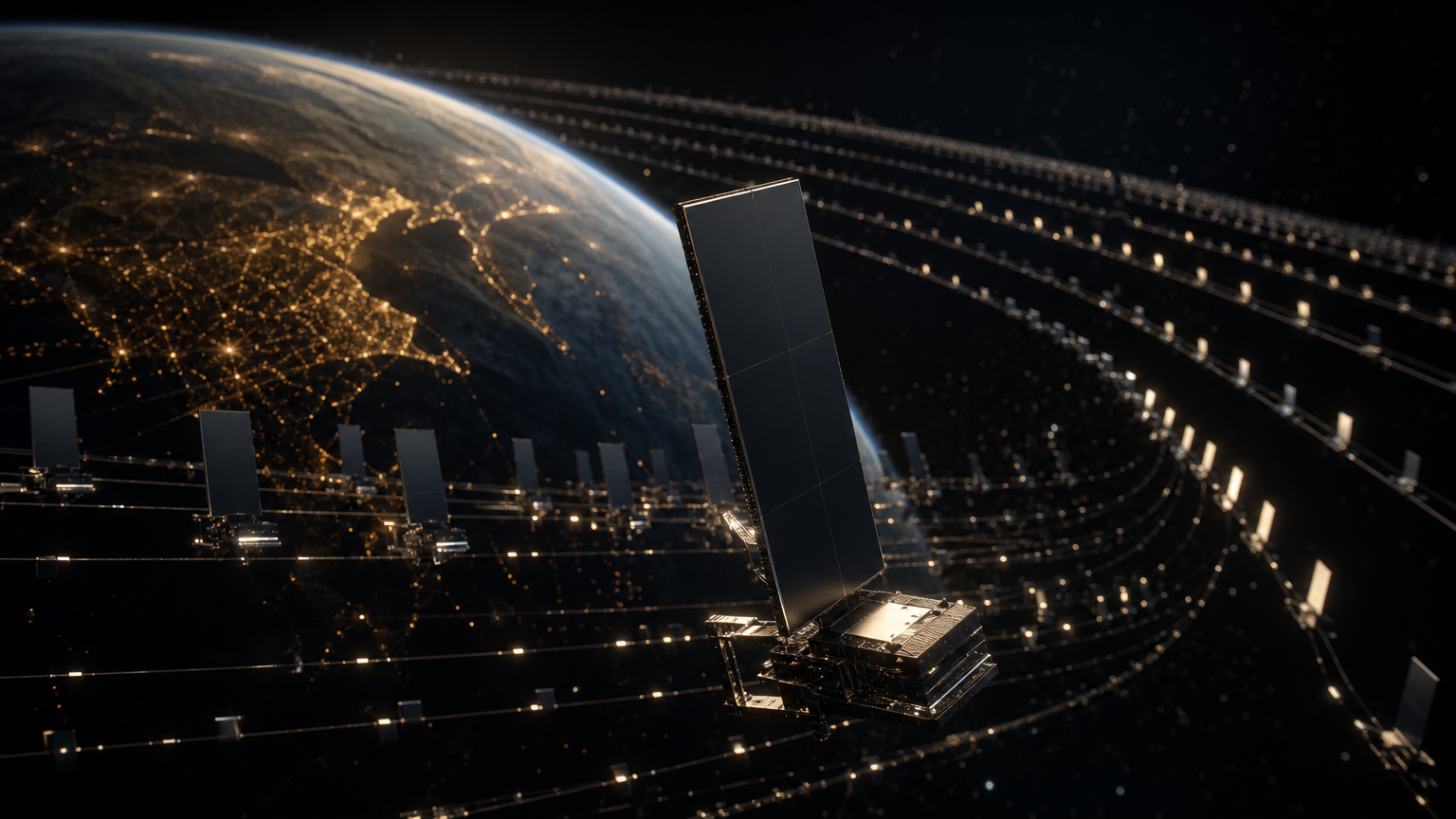
The plan behind the headline
The working headline is the story: SpaceX Insider Reveals Plan to Dominate. The “insider” is not an anonymous leaker but a senior operator at the center of SpaceX’s next orbital expansion: Michael Nicolls, identified in fresh reporting as SpaceX’s senior vice president of Starlink and president of xAI, who used the International Astronautical Congress in Antalya, Turkey, to argue that low Earth orbit can keep scaling only if satellite operators share where their spacecraft are and where they intend to go .
That safety message sounds procedural. It is not. It is the enabling condition for SpaceX’s much larger ambition: grow Starlink from the largest active satellite internet system into a broader orbital platform, then layer Starmind, a planned constellation of AI compute satellites, on top of the same launch, laser-link and traffic-management backbone .
The numbers explain why this is being framed as domination. Starlink already has more than 11,000 satellites in low Earth orbit, and Ars Technica reported that this amounts to about two-thirds of all active spacecraft in that orbital regime . The Register and NeoTeo both reported that SpaceX is pursuing planning ceilings of up to 100,000 Starlink satellites and up to 1 million Starmind AI satellites, a scale that would turn today’s Starlink footprint into only the opening layer of a much larger architecture .
Starmind changes the meaning of Starlink
Starlink began as broadband. Starmind recasts it as a transport and coordination layer for orbital computing. Musk Industries summarized the concept as satellites that run AI workloads in space and return results through Starlink, with SpaceX saying deployments could begin next year and scale toward the million-satellite ceiling over time .
The important distinction is that Starmind is not simply “more internet satellites.” NeoTeo reported that the FCC application covers a proposed non-geostationary system of up to one million satellites, but also stressed that the filing’s acceptance for public comment was not the same as authorization to launch and operate the full system . That caveat matters: the plan is enormous, but it is still partly a regulatory, engineering and manufacturing campaign rather than a deployed constellation.
SpaceX’s described AI1 satellite design shows why the plan is so ambitious. Musk Industries reported published AI1 figures of about 30 meters in deployed height, 75 meters of wingspan, up to 250 kW of peak compute payload, 175 kW average compute power and 75 kW per ton of vehicle efficiency . The architecture is presented as modular and chip-vendor agnostic, with heat rejected into space and data moved through high-bandwidth laser links to Starlink .
That turns low Earth orbit into something closer to a distributed data-center fabric. Nicolls’ reported description of Starmind clusters makes the point: NeoTeo said the proposed architecture involves roughly 10 satellites flying in tight formation with about 10 terabits of bandwidth between them, enough to combine compute capacity for AI workloads . In practical terms, SpaceX is not just proposing one million independent boxes in orbit; it is proposing a vast number of coordinated compute clusters.
Why the safety pitch is also a power play
The orbital safety argument is not separate from the business strategy. If SpaceX wants to multiply its presence from 11,000-plus Starlink satellites to a future ceiling of 100,000 Starlink and 1 million Starmind spacecraft, collision avoidance becomes the foundation of the business model .
The fresh reporting shows why SpaceX is pressing the issue now. Ars Technica reported that Starlink satellites perform about 1,000 collision-avoidance maneuvers per day and that, in recent months, they steered clear of about 650 active satellites from other operators, only about half of which participated in ephemeris sharing with SpaceX . The Register reported SpaceX’s figure of roughly 164,000 conjunctions over six months where the time of closest approach fell within four hours of another operator’s unannounced maneuver .
Those figures support SpaceX’s case for a more transparent low Earth orbit. They also reveal the strategic advantage of being the largest operator. SpaceX can argue that its scale forces it to develop the best safety system, then use that system as a de facto operating standard for everyone else.
Starlink’s safety stack is increasingly central to this pitch. NeoTeo reported that SpaceX’s free safety platform supports ephemeris sharing and conjunction screening, with results returned within about a minute . Ars Technica reported that Starlink’s onboard Stargaze system tracks about 90% of maneuvering satellites that intersect Starlink orbits, according to Nicolls . Musk Industries added that Starlink publishes hourly ephemeris and offers free conjunction screening through Space-Safety.com and Stargaze .
The criticism: who gets to run orbital traffic control?
The counterargument is not that safety data sharing is bad. It is that a single company should not become the default traffic-control layer for an increasingly crowded orbital economy.
The Register captured this concern directly through Neuraspace CEO Chiara Manfletti, who argued that initiatives such as SpaceX’s platform are welcome but that the long-term answer should be a federated, interoperable space-traffic ecosystem rather than dependence on one company’s system . That criticism goes to the heart of the dominance question: if SpaceX owns the largest constellation, the biggest reusable launch system, the broadband customer base, the AI-compute roadmap and the most widely used safety rails, then coordination can become leverage.
Ars Technica also noted that there are no global treaties or regulations requiring satellites to broadcast their locations and maneuvers or mandating coordination among operators . In that vacuum, norms are set by the entities with the most hardware in orbit. Today, that entity is SpaceX.
Competitors are not absent, but they are operating at different scale. Ars reported that Amazon Leo had 396 satellites in orbit at the time of its article, with a first-generation constellation of 3,232 satellites, FCC approval for a 4,504-satellite second-generation network and an additional 5,105-satellite direct-to-device filing still far below Starlink’s fleet size . Amazon’s Rajeev Badyal told Ars that sharing ephemeris for space safety is a “non-issue” for Amazon and that the company coordinates with SpaceX and others .
What “dominate” really means
The strongest reading of SpaceX’s plan is not simply “more satellites.” It is vertical integration applied to orbit.
Starship supplies mass to orbit. Starlink supplies connectivity and laser routing. Stargaze and Space-Safety.com supply the traffic-awareness layer. Starmind supplies the AI-compute expansion. The Gigasat Factory in Bastrop, as described by Musk Industries, is intended to manufacture AI satellites at large scale starting as soon as late 2027 . Put together, the pieces form a single strategic loop: launch, connect, compute, coordinate, repeat.
That is why the story matters even before Starmind is operational. If SpaceX executes, Starlink becomes the base layer for a larger space-based intelligence network. If regulators slow or reshape the plan, the debate will still define how much private control the world is willing to allow over low Earth orbit.
The “satellite singularity” line is playful, but the underlying shift is serious. SpaceX is not merely trying to sell faster internet from space. It is trying to make space itself a compute platform, and it is arguing that the only way to do so safely is for everyone else in orbit to operate by rules SpaceX is already building around its own fleet .
Sources from the last 72 hours
- [1]Starlink's plan to avoid orbital near-misses: Ephemeris sharingOct 7, 2026, 7:29 PM
- [2]SpaceX calls for better coordination in orbit after near-misses with StarlinkOct 8, 2026, 11:37 PM
- [3]Starlink urges orbital data sharing as SpaceX proposes StarmindOct 8, 2026, 2:00 AM
- [4]What is Starmind, SpaceX’s AI satellite constellation?Oct 9, 2026, 2:00 AM
AI-generated article based on recent web research, then preserved as a dated editorial snapshot.
Comments
Be the first to comment.