
Daily Podcast full article
Sydney grid hits AI ceiling as data centres run into power limits
Sydney’s AI data-centre rush has met a hard physical constraint: the city’s electricity network has little spare room for the next wave of large connections, shifting the industry’s critical question from “where is demand?” to “where is power?”
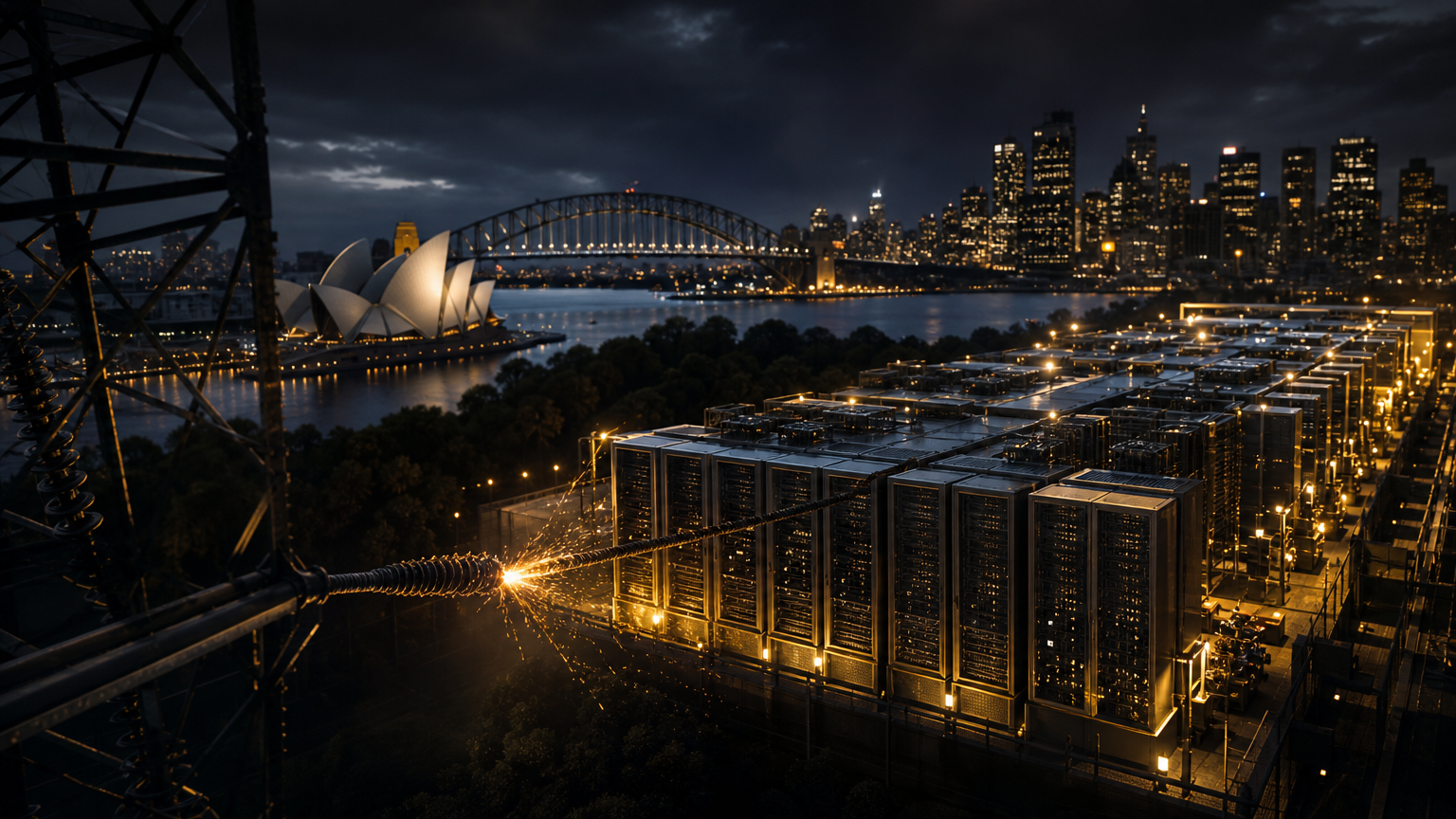
Sydney’s cloud boom meets the grid
Sydney’s AI infrastructure story has moved from the server hall to the substation. The latest reporting on Monday, October 12, 2026, says the city’s electricity transmission network no longer has enough spare capacity to connect the full wave of proposed data-centre projects now seeking power . That is the practical meaning of the “AI ceiling”: not a lack of chips, customers or capital, but a shortage of available grid capacity in the place where developers most want to build.
The numbers explain why the constraint has become so abrupt. Transgrid has received enquiries representing about 20 gigawatts of new large electricity demand, much of it tied to data centres, while western Sydney is already close to its practical transmission limits . For comparison, the issue is not a single campus asking for an unusually large connection; it is a cluster of AI, cloud and hyperscale projects collectively asking the network to behave like a new industrial province.
That is why the story matters beyond local planning. Data centres are often discussed as digital infrastructure, but Sydney is showing that the digital economy still depends on very physical assets: substations, transmission corridors, renewable generation, firming, approvals and years of construction. The bottleneck has turned electricity availability into a first-order planning variable for operators that had expected compute demand, land and fibre to dominate the model.
The new gatekeeper is the connection queue
In this environment, a data-centre project is no longer defined only by its capital budget, tenants or technical design. It is defined by whether it can secure an executable grid connection. Transgrid’s position, according to the latest report, is that new large connections will need developers to fund network upgrades rather than socialising those costs across existing electricity customers . That changes the economics of the sector immediately.
If the next connection requires a share of transmission augmentation, a site that looked attractive on land price and fibre routes can become marginal once grid works are priced in. A project may still have customers, a sponsor and planning momentum, but its timeline can stretch if the power solution is conditional on new network infrastructure. The report says upgrades could unlock up to 2 gigawatts of additional capacity, but major transmission projects can take years to plan, approve and build .
That time lag is central. AI demand has compressed commercial decision cycles: operators want capacity quickly because model training, inference growth and cloud commitments move faster than traditional infrastructure. Transmission systems do not move at software speed. They require route selection, environmental review, land access, engineering procurement, system studies and regulatory approval. Sydney’s data-centre market is therefore hitting a mismatch between AI’s appetite and the grid’s delivery calendar.
This is also why recent industry headlines framed the situation not as a routine utility challenge, but as a reset in the Sydney data-centre pipeline, with projects tumbling or being forced back to the drawing board . Another headline on the same news cycle described data centres as being “in limbo” as Sydney runs out of power, capturing the commercial uncertainty that follows when demand exists but grid capacity does not [3].
Western Sydney feels the pressure first
The stress is most visible in western Sydney because that is where many large sites, logistics corridors and proposed hyperscale campuses have converged. The geography made sense: land parcels were larger than in the inner city, industrial zoning was more plausible, and fibre and transport access were strong. But those same advantages attracted a dense queue of power-hungry projects.
The newest report says western Sydney is already approaching practical transmission limits . That does not mean every existing data centre is suddenly at risk. It means the next tranche of growth has to compete for constrained connection capacity and may have to underwrite upgrades before it can proceed. In other words, the ceiling applies to expansion more than to today’s operating load.
The consequence is strategic. Developers are increasingly examining regional New South Wales, including areas with better access to renewable generation and transmission infrastructure, rather than trying to concentrate every new AI facility around Sydney . That shift could redistribute the map of Australia’s AI infrastructure. Instead of a single Sydney-heavy hub, the next build-out may favour locations where power can be delivered faster, cheaper or with fewer network constraints.
From cheap power to accountable power
The Sydney crunch also changes the politics of who pays. If data centres require substantial upgrades, regulators and utilities gain leverage over connection terms, cost recovery and location decisions. The latest report states that new large connections will need to fund network upgrades rather than passing costs to existing customers . That approach is politically intuitive: households and ordinary businesses are unlikely to welcome higher bills to support private AI campuses.
For operators, however, it introduces another layer of risk. They must now plan not only for power procurement but also for network contribution, timing risk and potential curtailment or staged energisation. A campus may be approved on paper yet unable to energise at its intended scale until the grid catches up. The economics of “build now, fill later” become harder when the most scarce input is not floor space but megawatts.
The financing implications are significant. A data-centre business case depends on committed capacity, tenant revenue and predictable energisation dates. If a grid connection requires developer-funded upgrades that take years, lenders and equity backers will demand clearer milestones. Connection position may become as valuable as land control. Projects with signed agreements, funded network works and realistic energisation schedules will be worth more than speculative sites with impressive renderings.
The AI boom discovers infrastructure gravity
Sydney’s problem is not that demand for AI infrastructure is weak. It is the opposite. More than 60 data centres are already operating or under construction across New South Wales, while another 20 proposed projects represent more than A$50 billion of investment . The pipeline is large enough that the limiting factor has shifted from market appetite to the physical capacity of the electricity system.
That makes the current moment a useful correction to AI hype. Cloud services feel weightless to users, but the cloud is an industrial system. It consumes land, water, steel, transformers, backup generation, cooling equipment and, above all, electricity. Sydney’s grid constraint reveals the hidden boundary condition for AI expansion: compute can scale only where energy infrastructure can scale with it.
The likely result is a more selective market. Projects with strong power strategies will advance; projects that assumed grid capacity would be available on demand will slow. Some developers will pay for upgrades. Some will move. Some will redesign around phased capacity, on-site generation, batteries, renewable power-purchase agreements or more flexible load arrangements. Others may simply lose their place in the queue.
What to watch next
The key question now is not whether Sydney remains an important data-centre market. It will. The question is how much more AI capacity can land there before the next major grid augmentation arrives, and at what cost. The report says upgrades could add as much as 2 gigawatts of capacity, but the timing is measured in years rather than quarters .
That gives utilities and regulators a much stronger hand. They can steer projects toward locations where the grid can absorb them, require developers to pay for reinforcements, and push operators toward renewable generation and firming strategies. For AI companies, the lesson is equally clear: in Sydney, the future of compute now depends on the past and pace of power infrastructure.
The cloud has discovered its terrestrial limit. In Sydney, the next AI breakthrough may need a substation before it gets a server.
Sources from the last 72 hours
- [1]Sydney power grid hits capacity as AI data centre boom runs into infrastructure limitsOct 12, 2026, 2:30 AM
- [2]Sydney data centre power sellout reset begins as projects tumble - The AustralianOct 11, 2026, 8:01 PM
AI-generated article based on recent web research, then preserved as a dated editorial snapshot.
Comments
Be the first to comment.