
Daily Podcast full article
FormFactor and Teradyne commit $300M to the next semiconductor-test bottleneck
FormFactor and Teradyne have announced a broad semiconductor-test collaboration anchored by a $300 million strategic equity investment, a move aimed at making the less visible test layer more ready for advanced packaging, HBM, silicon photonics and AI-era devices.
The deal: capital plus co-development
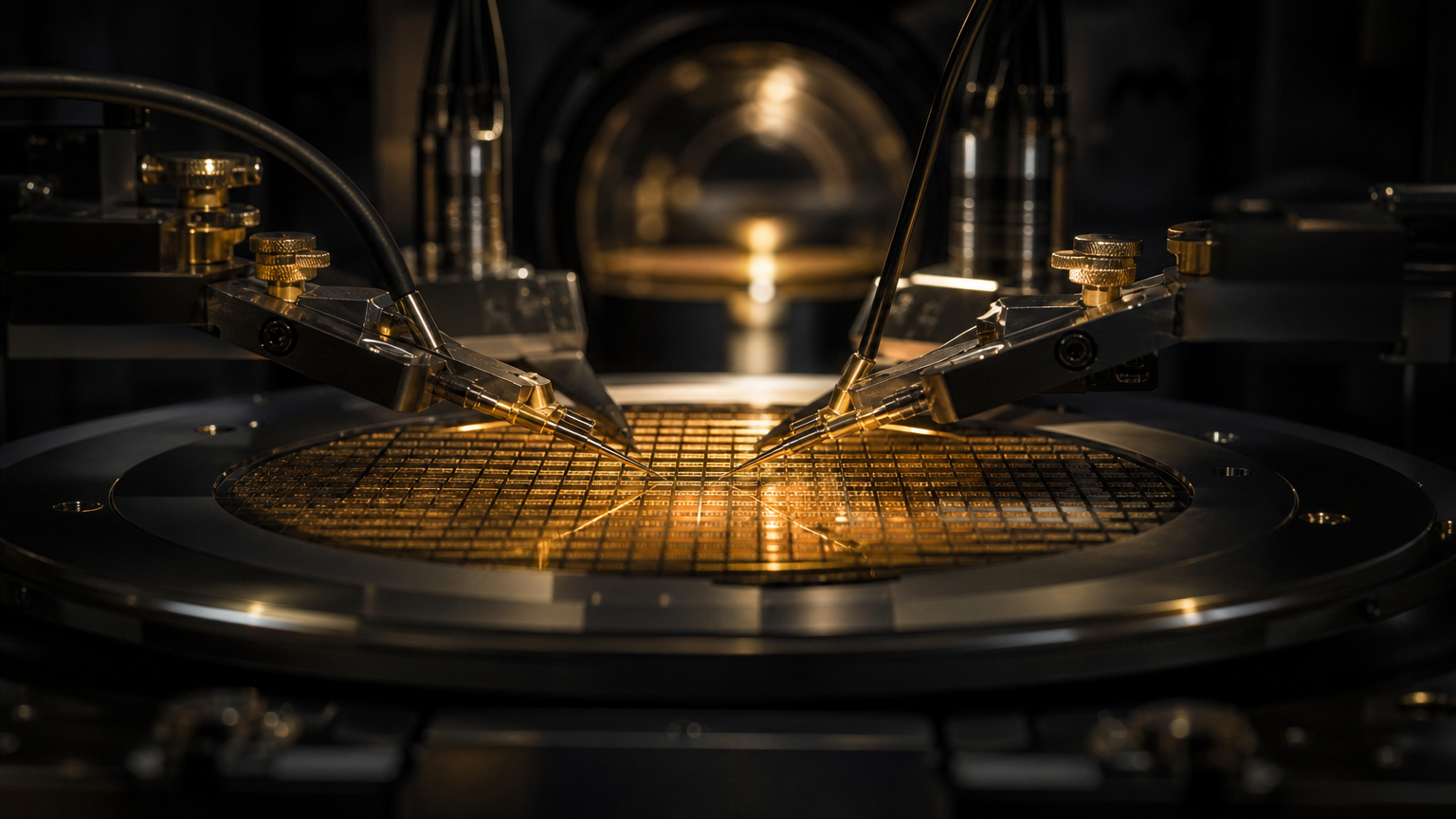
FormFactor and Teradyne have turned a supplier relationship into something more strategic. On October 12, the companies announced a broad technology collaboration intended to accelerate development, validation and high-volume production deployment of next-generation semiconductor devices . The agreement pairs FormFactor’s strengths in probe technologies, interface solutions, test engineering and device characterization with Teradyne’s automated test platforms .
The financial anchor is a $300 million strategic equity investment by Teradyne, structured as a purchase of FormFactor common stock . The companies said the transaction remains subject to customary closing conditions and regulatory approvals, so this is not yet a completed investment . That distinction matters: the announcement signals intent, capital commitment and technical direction, but the final ownership impact will depend on closing and on any terms not yet disclosed.
The companies framed the collaboration around high-performance computing, advanced packaging, high-bandwidth memory and silicon photonics . Those are not incidental labels. They are among the areas where chip architecture is moving fastest, where electrical and optical behavior can be harder to validate, and where yield losses can become expensive quickly once devices move from engineering samples to volume production.
Why test is suddenly strategic
Semiconductor testing is often treated as a downstream checkpoint, but in advanced systems it increasingly shapes the whole economics of a product. A chip may be designed correctly and fabricated successfully, yet still fail to reach its commercial target if the test flow is too slow, too incomplete or too hard to scale. The more complex the package, the more places there are for small defects, weak interfaces or marginal performance to hide.
That is why the FormFactor-Teradyne collaboration is more than a funding headline. FormFactor operates close to the physical interface with the device: probing wafers, enabling measurements and helping customers characterize behavior across the integrated-circuit life cycle . Teradyne brings the broader automated test equipment layer, the systems that execute measurement at speed and in production contexts . Combining those domains can reduce friction between what touches the chip and what evaluates the chip.
For AI infrastructure and high-performance compute, the problem is especially acute. These chips and packages are expensive, power-dense and interconnected. Advanced packaging, HBM stacks and silicon photonics all raise the importance of knowing which components are good before they are assembled into more expensive systems. In that sense, the partnership is aimed at a basic but increasingly difficult question: can the industry identify reliable devices earlier, faster and with fewer handoffs?
What the companies are promising — and what they are not
The announcement says the partners will work to advance test architectures, optimize test infrastructure and improve production readiness for current and emerging applications . It also says the companies expect the collaboration to support joint customer engagement and demand tied to advanced computing and AI infrastructure .
But the announcement does not say that the partnership has already won new customer programs. It does not disclose a purchase price per share, the number of shares Teradyne will receive, the resulting ownership percentage or a fixed closing date. A TECHi analysis published shortly after the announcement highlighted those missing terms and warned that the investment should not be read as guaranteed revenue or an immediate earnings uplift .
That is the right way to interpret the news. The deal is strategically important because it aligns two important pieces of the test stack. It is financially meaningful because $300 million is a large check in the semiconductor test ecosystem. Yet the commercial payoff will depend on whether customers adopt the resulting architectures, whether the integration lowers qualification burden, and whether the collaboration can improve yield learning without locking customers into a closed system.
Teradyne’s CEO Gregory Smith emphasized the need for a more complete and validated path to production, while also referring to an open, interoperable ecosystem . That wording matters. In semiconductor manufacturing, customers are often cautious about supplier lock-in, especially in test flows that must work across multiple device types, fabs, packaging partners and production sites. The collaboration may be most effective if it makes Teradyne and FormFactor work better together without making the customer’s process less flexible.
A large check in context
The size of Teradyne’s proposed investment stands out. TECHi compared the $300 million commitment with a January 2025 FormFactor agreement involving Advantest, another test-equipment supplier, which it calculated at about $15 million based on the disclosed share count and price . On that comparison, Teradyne’s proposed investment is roughly 20 times larger .
The comparison is useful, but it should not be overread. It does not mean Teradyne has bought exclusivity, nor does it mean FormFactor is abandoning other test-platform relationships. In fact, the existence of multiple relationships can be read another way: FormFactor’s probe and interface technologies may be important enough that major automated-test companies want closer technical and financial alignment with it.
For FormFactor, the signal is that its role in the test chain is moving from component supplier toward strategic enabler. For Teradyne, the signal is that automated test platforms may need deeper coupling with upstream probing and interface expertise as devices become harder to validate. For customers, the potential benefit is a smoother route from characterization to qualification to high-volume manufacturing.
Market reaction: positive headline, cautious tape
Initial trading signals were not uniform, which is common for after-hours and overnight snapshots. Investing.com reported that FormFactor shares rose 3.6% in after-hours trading following the announcement of the collaboration and investment . RTTNews later reported that in overnight Nasdaq activity, FormFactor shares were down around 0.56% at $129.55, extending the prior regular-session decline, while Teradyne was down 1.78% at $377.00 after closing Monday lower .
Those snapshots are not contradictory so much as time-sensitive. A stock can rise immediately after a deal headline and then fade as investors parse the missing terms, dilution risk, regulatory timing and broader market conditions. The more important point is that the market appears to be treating the deal as strategically notable but not yet fully quantifiable.
Investors will likely focus next on closing conditions, regulatory review, share issuance details and any customer commentary. They will also watch whether the companies describe specific products, joint reference flows or early customer pilots. Without those details, the collaboration remains a credible strategic move rather than a forecastable revenue event.
The broader meaning
The FormFactor-Teradyne agreement is a reminder that the AI hardware race is not only about GPUs, accelerators or data-center racks. It is also about the infrastructure that decides whether those devices are reliable enough to ship. Every chip has to pass the tutorial before it meets the final boss: deployment at scale.
As advanced packaging and chiplet architectures spread, testing becomes less like a final inspection and more like a design and manufacturing discipline in its own right. The companies are betting that closer alignment between probe, interface, characterization and automated test can shorten the path from lab validation to production readiness . If that bet works, the payoff may show up not as a flashy consumer product, but as fewer failures, faster qualification cycles and better yields for the chipmakers building the next wave of AI and high-performance systems.
The deal is therefore best understood as a strategic investment in the semiconductor industry’s reliability layer. It is not the most glamorous part of the stack, but it is one of the parts that determines whether the rest of the stack can scale.
Sources from the last 72 hours
- [1]FormFactor and Teradyne Announce Strategic Collaboration to Accelerate Next-Generation Semiconductor TestingOct 12, 2026, 10:01 PM
- [2]FormFactor stock rises on $300M Teradyne investment dealOct 12, 2026, 10:18 PM
- [3]Teradyne To Invest $300 Mln In FormFactor; To Jointly Develop Semiconductor DevicesOct 13, 2026, 6:53 AM
- [4]Teradyne’s $300M FormFactor bet dwarfs an earlier Advantest dealOct 13, 2026, 12:05 AM
AI-generated article based on recent web research, then preserved as a dated editorial snapshot.
Comments
Be the first to comment.