
Daily Podcast full article
Kospi plunges 7% on chip fears
South Korea’s benchmark Kospi briefly fell more than 7% on October 13, 2026, as semiconductor heavyweights led a sharp reassessment of the AI trade. The index later pared losses but still closed down about 5.5%, underlining how quickly doubts about memory-chip pricing, Chinese competition and AI infrastructure returns can hit one of Asia’s most chip-sensitive markets.
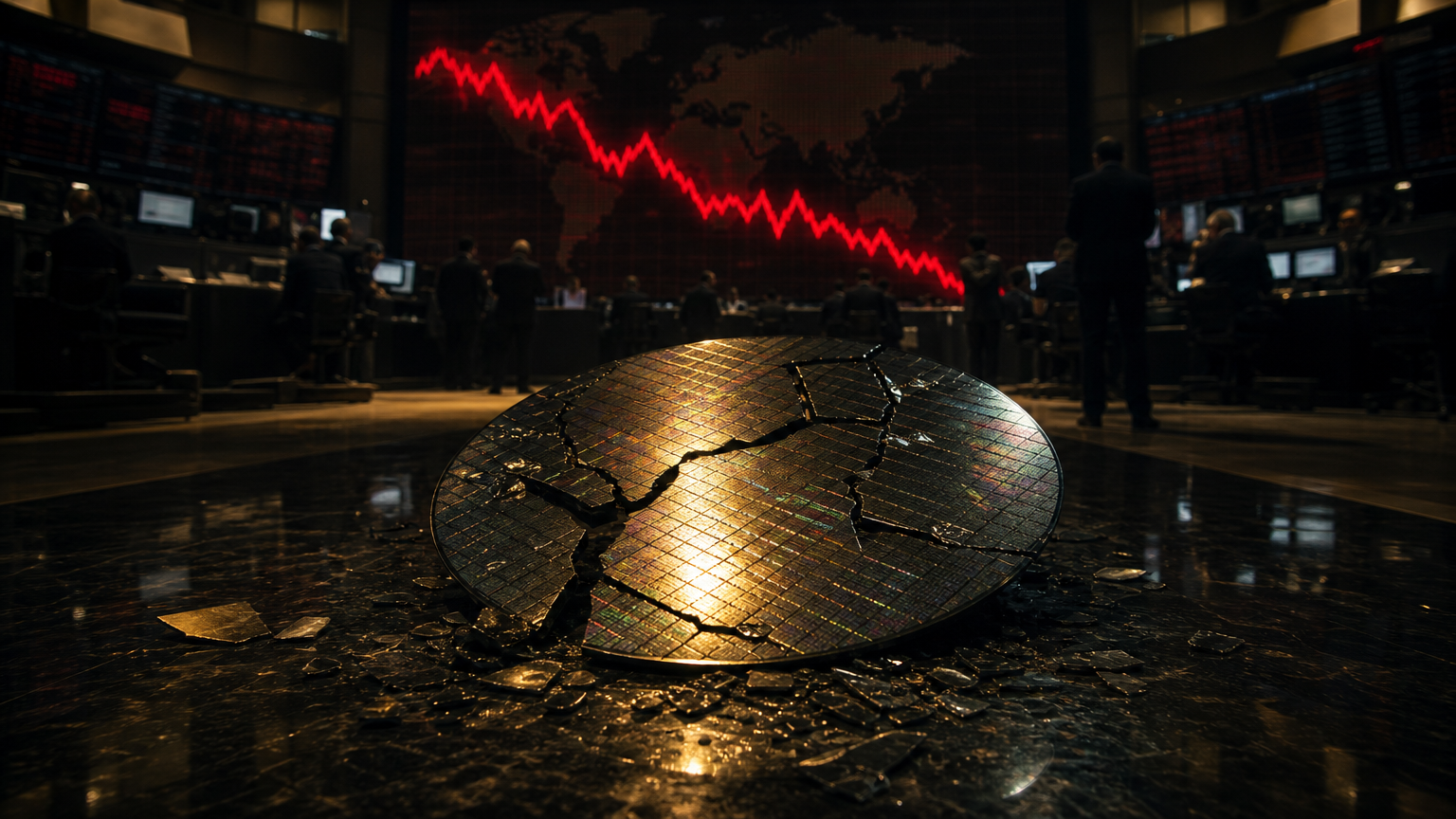
A chip-heavy market hits an AI stress test
South Korea’s Kospi turned into the clearest Asian warning signal for AI-linked equity risk on Tuesday, October 13, 2026. The benchmark dropped more than 7% intraday, briefly falling below the 6,000 mark, before recovering part of the move to finish around 6,035, down roughly 5.5% on the day . The sell-off was concentrated in the semiconductor complex, with Samsung Electronics and SK Hynix among the major casualties as investors questioned how durable the AI-driven memory boom will be .
The scale matters because South Korea is not just another regional equity market. It is one of the most direct public-market expressions of global demand for memory chips, high-bandwidth memory, advanced packaging and the broader AI server supply chain. When the Kospi falls this hard on semiconductor selling, the message is not limited to Seoul; it is a repricing of the hardware foundations underneath the AI capital cycle .
The day’s first shock was mechanical. The Korea Exchange triggered a sell-side sidecar at 9:47 a.m. local time after Kospi 200 futures fell 5.08%, temporarily halting program sell orders for five minutes . SBS reported that the move came 47 minutes after the market opened, as the index rapidly extended losses after starting the session more than 3% lower . The sidecar did not reverse the mood, but it highlighted the intensity of the selling pressure.
Samsung and SK Hynix take the hit
The pressure centered on Korea’s semiconductor champions. AP reported Samsung Electronics down 7.4% and SK Hynix down 10.1% during the session, while SBS said SK Hynix fell to the 1.44 million won range and Samsung Electronics slipped into the 230,000 won range . Reuters reporting carried by Business Recorder showed similar early losses, with Samsung down 7.19% and SK Hynix down 8.72% at one point .
The trigger was not a single earnings miss from either Korean company. Instead, investors reacted to reports that China’s ChangXin Memory Technologies, or CXMT, was making rapid progress in memory technology, raising concerns that Chinese producers could narrow the gap with global rivals in parts of the DRAM market . That matters for Korea because Samsung and SK Hynix dominate the memory narrative that has powered much of the country’s equity rally during the AI boom.
The fear is not that AI demand has suddenly disappeared. The fear is that the extraordinary profits attached to AI-linked memory could become harder to defend if new supply, cheaper competition or slower customer returns compress margins. Charu Chanana of Saxo framed the issue as a market becoming “much less forgiving” of the AI trade, with investors asking not just how fast demand can grow but how long exceptional profits and margins can last as competition rises .
From AI euphoria to valuation discipline
For months, the bull case in Korea was simple: AI needs data centers, data centers need accelerators, accelerators need memory, and Korea sits at the center of that chain. The Kospi had crossed 9,000 in June, supercharged by the global AI boom, before Tuesday’s fall took it back toward levels last seen in late July . SBS reported that the index had regained the 7,000 level on October 2, only to lose about 1,000 points across five consecutive down sessions .
That reversal shows a market shifting from revenue excitement to return-on-capital anxiety. Reuters described the global mood as a “fragile AI trade,” with concerns that China is closing the technology gap and that investors are reassessing how quickly massive spending on AI infrastructure can generate returns . Another Reuters analysis called the session one of the strongest signs yet that the mood around the “trade of the decade” is shifting, especially as higher rates make large capital-expenditure cycles more expensive to finance .
This is why Korea’s plunge is bigger than a local equity story. AI optimism has been strongest where investors could identify tangible beneficiaries: chipmakers, data-center builders, cable suppliers, power providers and hardware firms. But that concentration cuts both ways. When doubts emerge about demand, pricing or funding, the same market concentration can accelerate losses .
China’s CXMT becomes the market’s pressure point
CXMT’s reported progress became the focal point because memory markets are cyclical and brutally sensitive to supply. The Edge Malaysia, citing Reuters, reported that Asian chipmakers tracked overnight weakness on Wall Street, where Micron fell nearly 4%, and that sentiment was hit by reports of CXMT progress on a new server-memory chip . Kieron Poon of Aberdeen Investments said the news suggested China’s memory industry was catching up faster than expected, triggering a broad sell-off across memory-related stocks in Japan, Korea, Taiwan and the United States .
Still, the reaction may have moved faster than the fundamentals. Aadil Ebrahim of Klay Group argued that CXMT’s advances were not in high-bandwidth memory chips, where South Korean and U.S. firms retain an edge, and that the key question is whether CXMT can manufacture at scale with yields comparable to established memory makers . That distinction is important: the market sold the idea of a narrowing technology moat, but the commercial threat depends on scale, yield, quality and customer qualification.
In other words, Tuesday’s rout was about the probability of future margin pressure, not proof that Korea’s AI chip earnings cycle has already broken. That is often how hardware sell-offs begin: first the market prices risk, then it waits for earnings to confirm or reject the new story.
Contagion across Asia
The Kospi’s drop did not happen in isolation. AP reported Japan’s Nikkei 225 lower, with Tokyo Electron falling 7.2% and SoftBank Group, an OpenAI investor, losing 8.5% . The Edge Malaysia said emerging Asian equities hit a two-month low, with an MSCI index tracking emerging Asian shares down nearly 3.5% and a broader Asia-Pacific ex-Japan gauge down nearly 3% . MarketScreener’s Reuters report said Taiwan’s TSMC, Japan’s Kioxia and SoftBank also fell as investors reduced exposure to AI-linked names .
Korea remained the epicenter because Samsung Electronics and SK Hynix carry large index weight and because memory is the market’s clearest AI lever. The Edge Malaysia reported that Samsung and SK Hynix together accounted for roughly 16% of the MSCI emerging Asia index, helping explain why a Korean chip rout could drag regional benchmarks lower .
Foreign selling added pressure. SBS reported foreign investors net sold 4.5 trillion won on October 13 after more than 2 trillion won of net sales the previous day . Business Recorder reported foreigners were net sellers of shares worth 2,065.3 billion won earlier in the session and that the won weakened against the dollar .
What investors should watch next
The immediate question is whether Tuesday’s move was capitulation or the start of a broader reset. On the bullish side, AI infrastructure demand remains real, and some analysts argue that CXMT’s progress does not directly erase Korea’s advantage in high-end memory . On the bearish side, the market is no longer willing to pay any price for exposure to AI hardware if margins, financing costs and future returns look less certain .
The next tests are straightforward: Samsung and SK Hynix earnings commentary, Micron’s reaction to China-related competition, hyperscaler capital-expenditure guidance, and signs of whether foreign investors return to Korean equities. The Kospi’s fall showed that the AI boom has entered a more punishing phase, where investors still believe in demand but are questioning who captures the profit.
For Korea, that is a difficult level. Even silicon can discover Dark Souls difficulty.
Sources from the last 72 hours
- [1]KOSPI Plunges 5.5% on "Black Tuesday"... Briefly Collapsing Below 6,000 During Intraday TradingOct 13, 2026, 10:15 AM
- [2]South Korea shares tumble over 6% as chip selloff triggers trading curbOct 13, 2026, 8:41 AM
- [3]Morning Bid: The fragile AI tradeOct 13, 2026, 6:34 AM
- [4]‘Brutal session’ for chip stocks shows AI trade is turningOct 13, 2026, 9:06 AM
- [5]Seoul chip rout sends emerging Asian stocks to two-month lowOct 13, 2026, 10:09 AM
- [6]Asian stocks hit 2-month low on AI jitters, bonds find favourOct 13, 2026, 7:25 AM
- [7]Global semiconductor stocks sell-off over AI boom worries pulls Asian shares lowerOct 13, 2026, 4:56 AM
AI-generated article based on recent web research, then preserved as a dated editorial snapshot.
Comments
Be the first to comment.