
Daily Podcast full article
Google secures $4B fuel-cell project
Google has locked in a 20-year power purchase agreement tied to a 702-megawatt fuel-cell project near Cheyenne, Wyoming, with American Electric Power planning about $4 billion of investment and Bloom Energy systems at the center of the buildout.
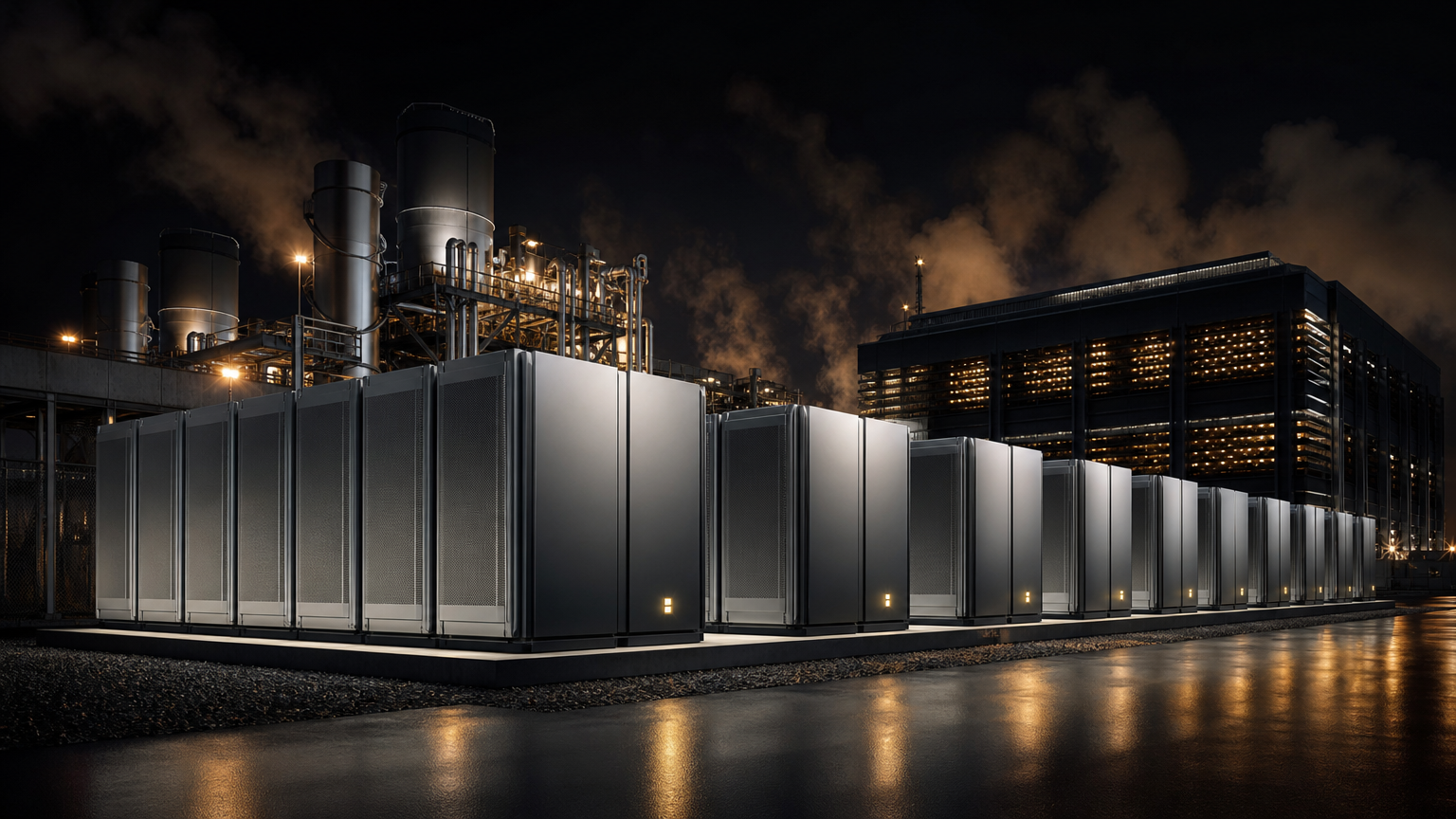
The deal: dedicated power for a hungry AI campus
Google’s latest power move is not another standard renewable-energy certificate purchase. It is a dedicated, utility-backed generation project: American Electric Power plans to invest approximately $4 billion in a 702-megawatt fuel-cell generation facility near Cheyenne, Wyoming, under a 20-year power purchase agreement with Google . Under the agreement, Google will buy power from Cheyenne Fuel Cell, LLC, a project company that AEP says it owns and controls at about 92%, with funds advised by Basalt Infrastructure Partners holding nearly 8% .
The project is scheduled to begin construction in 2026 and reach full commercial operation by the end of 2028 . That timeline matters because the power requirement is not theoretical. Data Center Dynamics reports that Google is developing a 2.7-gigawatt data center near Cheyenne, on a 716-acre parcel south of the city, with construction of the campus expected to be completed by 2031 . In other words, the power project is not an accessory to the data center story; it is part of the data center’s core infrastructure.
The facility will use fuel-cell technology developed by Bloom Energy, which AEP describes as deployable at scale and capable of providing reliable, on-demand power for large-load customers . Data Center Dynamics adds that the Bloom systems are being supplied under a previously announced agreement of up to 1 gigawatt . For Google, the attraction is clear: a contracted source of electricity with a defined counterparty, schedule and scale. For AEP, the appeal is also clear: a 20-year anchor customer for a project that sits beyond the utility’s traditional service territory strategy while still using utility-style contracting .
Why this is bigger than one Wyoming project
The 702-megawatt number is the headline, but the more important signal is strategic. Hyperscalers used to talk about buying clean energy to match consumption. Now they are increasingly securing physical power supply because artificial intelligence and cloud expansion are running into grid constraints. Reuters, via Boursorama, framed the same pressure directly: technology companies are seeking new electricity sources as rising data-center and AI demand meets limited grid capacity and slow infrastructure deployment .
That is what makes this project a marker for the next phase of the AI buildout. Google is not merely adding another data hall and assuming the grid will catch up. It is contracting around the bottleneck. The agreement effectively turns Google into the anchor tenant for a large generation asset, a role that industrial companies have played before but that cloud platforms are now adopting at far larger digital-infrastructure scale.
AEP’s own language points in the same direction. The company said the project reflects its strategy to serve growing demand from large-scale customers, and its chief executive Bill Fehrman described the effort as a way to deliver reliable energy solutions “quickly and at scale” . AEP also said it plans to invest $78 billion from 2026 through 2030 to support customers and growing energy needs across its system . The Google project is not inside a vacuum; it lands in a utility sector being reshaped by large-load customers with the balance sheets to underwrite new generation.
The Cheyenne power stack is getting crowded
The AEP agreement also arrives immediately after another Cheyenne energy package involving Google. AEP said its fuel-cell plan follows agreements reached between Google and Black Hills Corp. effective September 30 . Reuters reported that Google had signed a similar arrangement with Black Hills to power a planned Cheyenne data center, with Black Hills planning $1.8 billion in new generating capacity between 2027 and 2029 .
That sequence is important. It suggests Google is building a layered power strategy in Wyoming rather than relying on a single supplier. Data Center Dynamics reports that the Cheyenne campus is expected to involve a 2.7-gigawatt development . Against that backdrop, 702 megawatts of fuel cells is massive, but it is also only one part of a broader resource stack.
For utilities, this is a new kind of customer relationship. The data center does not simply ask for interconnection and service. It can support purpose-built generation, long-duration contracts and infrastructure financing. AEP’s Cheyenne Fuel Cell structure, with AEP controlling the vehicle and Basalt-advised funds holding a minority position, shows how utility balance sheets and infrastructure capital can meet hyperscaler demand .
Bloom Energy gets a flagship use case
Bloom Energy is the technology vendor whose systems sit at the center of the plan. Dow Jones, carried by MarketScreener, reported that the facility would use Bloom-developed fuel-cell technology designed for rapid deployment and reliable, on-demand power . Data Center Dynamics described Bloom as a leading fuel-cell supplier for data centers and noted that its solid-oxide fuel cells generate electricity through an electrochemical reaction rather than combustion .
That distinction is central to Bloom’s pitch. Fuel cells can provide firm, dispatchable electricity closer to the load, which is attractive when transmission queues, substation buildouts and turbine lead times become constraints. For AI campuses, “time to power” can matter almost as much as the power price. If a new model-training cluster waits years for grid upgrades, the opportunity cost can dwarf the premium paid for dedicated generation.
Still, the deal also raises the question that will follow every “sustainable” fuel-cell announcement: what is the fuel, and what are the real emissions? AEP says the technology generates electricity without combustion of natural gas and that the project includes plans to integrate carbon-capture technology to deliver reliable, near-zero-emissions power . RTTNews reported the same point, noting that AEP says the project will integrate carbon capture and use Bloom technology that generates electricity without combustion of natural gas .
That wording is careful. “Without combustion” is not the same as “without natural gas,” and “plans to integrate carbon capture” is not the same as a fully operating, verified capture system. The project may prove cleaner than conventional gas generation, but its sustainability claim will depend on execution, fuel sourcing, methane leakage, capture performance and how Google accounts for the electricity.
The scrutiny ahead
The public debate will likely focus on three issues. The first is emissions. If the fuel cells run on natural gas, critics will ask whether the project is genuinely a clean-energy solution or a lower-emissions fossil-gas project with carbon-capture ambitions. The second is cost allocation. AEP says Google will acquire power under the PPA from Cheyenne Fuel Cell . That structure helps separate the project from ordinary retail customers, but regulators and local communities will still watch whether transmission, gas supply, water use, land use or backup needs create wider costs.
The third is precedent. If a 702-megawatt fuel-cell plant becomes a replicable model, other hyperscalers may seek similar arrangements. That could unlock faster data-center growth, but it could also intensify competition for gas infrastructure, interconnection capacity and equipment. Fuel-cell vendors would gain large anchor customers; utilities would gain new investment channels; communities would inherit the industrial footprint.
For Google, the deal is best understood as a power-security play. The company is securing energy not by waiting for the conventional grid planning cycle, but by helping create a dedicated generation asset with a utility partner. For AEP, it is a bet that the next wave of load growth will be financed by customers big enough to sign long-term offtake contracts. For Bloom, it is a high-profile chance to prove that fuel cells can serve AI-scale demand.
The headline number is $4 billion. The deeper message is that AI infrastructure is now rewriting the electricity business. Google’s power budget has entered final-boss territory, and the grid is being redesigned around that reality.
Sources from the last 72 hours
- [1]AEP Advances Innovative Energy Solution for Google with 702MW of Bloom Fuel CellsOct 14, 2026, 2:00 AM
- [2]American Electric Power va investir 4 milliards de dollars dans un projet de piles à combustible destiné à alimenter Google en électricitéOct 14, 2026, 2:40 PM
- [3]Google signs 20-year PPA with AEP for 702MW Wyoming fuel cell projectOct 14, 2026, 2:00 AM
- [4]American Electric Power to Invest $4 Billion in Fuel Cell Project to Meet Energy Demand From GoogleOct 14, 2026, 2:41 PM
- [5]American Electric Power To Build $4 Bln Google Fuel Cell ProjectOct 14, 2026, 4:34 PM
AI-generated article based on recent web research, then preserved as a dated editorial snapshot.
Comments
Be the first to comment.