
Daily Podcast full article
Japan invests $21B in GlobalFoundries fabs, locking in a U.S.-Japan chip corridor
Japan’s plan to put up to $21 billion behind two GlobalFoundries-operated fabs in Malta, New York, turns a supply-chain slogan into an industrial structure: Japanese capital, U.S. public ownership exposure, and an American foundry operating foundational-chip capacity for customers including Renesas and Apple.
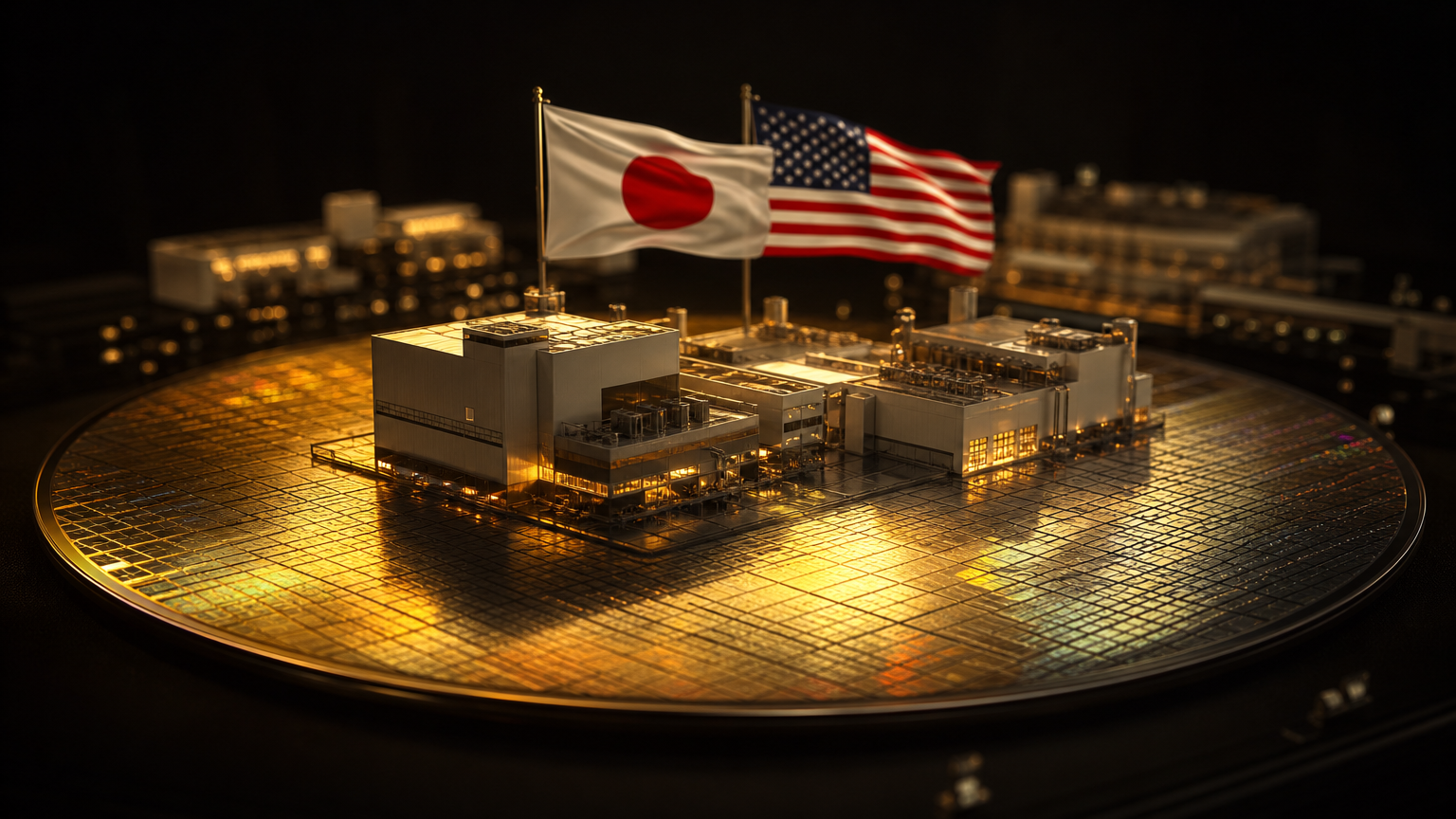
A chip deal built like an alliance
Japan’s up-to-$21 billion investment in two GlobalFoundries fabs is not just another subsidy headline. GlobalFoundries said on October 14, 2026 that it had been selected as the technology provider and operator for two new semiconductor manufacturing facilities at its Malta, New York, site under a U.S.-Japan initiative backed by up to $21 billion in funding . The structure matters as much as the dollar amount: Japan is set to provide the investment capital, while GlobalFoundries contributes process technology, manufacturing know-how and operational execution .
The first tranche is expected to be about $10 billion, aimed at accelerating construction of a new 300mm semiconductor fab scheduled to come online in 2029 . A second investment of about $10 billion would fund another fab at the same Malta campus, creating a two-plant expansion anchored in an existing semiconductor cluster rather than a greenfield experiment . In capacity terms, GlobalFoundries says the first fab should add roughly 900,000 300mm wafers of annual U.S. manufacturing output when fully operational, with a second fab expected to add a similar amount .
That makes the announcement a major bet on “essential” or foundational chips: the specialized, durable and often mature-node semiconductors used across vehicles, industrial systems, communications infrastructure, defense, connected devices and data-center-related hardware. The new fabs are not framed as a chase for the smallest leading-edge transistor geometry; they are framed as resilience capacity for markets where reliability, geographic trust and long product cycles often matter as much as raw density.
Japan supplies capital; GlobalFoundries supplies the factory brain
The deal’s defining feature is that Japan provides the capital while GlobalFoundries operates the fabs. Reuters reported that the two New York factories will be jointly owned by the U.S. government and Japanese interests, with GlobalFoundries earning fees for building and operating the factories and for licensing chip-manufacturing technology to them . That model separates capital ownership from manufacturing execution: Japan helps fund the assets, the U.S. gains strategic manufacturing presence, and GlobalFoundries monetizes its role as operator and technology provider.
This is an unusually explicit industrial partnership. According to Reuters, the move sits inside a broader $550 billion Japanese investment commitment to the United States, linked to a trade arrangement under which U.S. tariffs on Japanese cars and other imports were reduced from at least 25% to 15% . Under that wider arrangement, available free cash flows from the investments are initially split evenly between the United States and Japan until a defined allocation is reached, after which 90% goes to the United States .
That governance design shows why the deal is more than a corporate capital expenditure. It gives Japan a direct economic stake in U.S.-based chip capacity, while giving Washington more leverage over domestic semiconductor infrastructure. It also provides GlobalFoundries with a path to scale without carrying the full balance-sheet burden of two capital-intensive fabs.
Washington takes a larger equity position
The U.S. government is not only involved through the fab ownership structure. GlobalFoundries said the U.S. Department of Commerce will receive approximately 4% equity in the company under a separate agreement . Reuters reported that the new 4% stake would bring the U.S. government’s total ownership of GlobalFoundries to about 7%, according to CEO Tim Breen .
That equity component is politically important. It suggests a shift from classic grant-based industrial policy toward public participation in strategic companies. Instead of merely paying to attract capacity, Washington is taking an ownership exposure in a foundry that it views as essential to domestic supply-chain resilience. For GlobalFoundries, the arrangement may also align the company more tightly with federal procurement, defense, communications and infrastructure priorities.
GlobalFoundries also said it agreed with the Commerce Department to amend its existing CHIPS and Science Act award, reallocating $955 million to accelerate investments in silicon photonics, silicon-germanium and advanced packaging at its Malta, New York, and Burlington, Vermont, facilities . That detail is crucial because the new fabs are not isolated shells: they sit alongside a broader push into enabling technologies used in communications infrastructure, data centers and high-performance mixed-signal systems .
Why Malta, New York, keeps winning
The Malta site gives the project a major execution advantage. GlobalFoundries says it expects to break ground on the first fab later in 2026, and that the site is already permitted and shovel-ready, using existing Malta infrastructure to speed construction . For a fab project, that is not a footnote. Permitting, utilities, workforce pipelines, tool installation and ecosystem density can determine whether a headline investment turns into actual wafer output on schedule.
New York’s Capital Region has spent years trying to build itself into a semiconductor hub, and this project reinforces that strategy. GlobalFoundries says the two-fab project is expected to create about 27,000 construction and ecosystem jobs and more than 1,000 high-skilled manufacturing jobs in the region . Governor Kathy Hochul, quoted in the company’s announcement, framed the expansion as a vote of confidence in New York’s workforce and semiconductor ecosystem .
The company’s own role in Malta also matters. GlobalFoundries already operates a major Fab 8 presence there, and the new project builds on that footprint rather than requiring a new operating culture from scratch. In semiconductor manufacturing, where yield learning, process control and supplier coordination can make or break economics, that continuity is a strategic asset.
Customers: Renesas, Apple and the logic of trusted supply
The customer list helps explain Japan’s interest. Reuters reported that initial customers for the New York fabs include Japan’s Renesas Electronics and Apple, with Breen saying GlobalFoundries would manage customer relationships . Renesas’ involvement is especially telling: as a Japanese chipmaker with heavy exposure to automotive and industrial electronics, it benefits from stable access to trusted U.S.-based manufacturing capacity backed by a U.S.-Japan political framework.
GlobalFoundries’ announcement also included statements from Renesas, Tokyo Electron, Apple, Cirrus Logic and General Motors, tying the project to a broader ecosystem of chip buyers, toolmakers and end users . Tokyo Electron’s presence signals a likely equipment-supply channel back into Japan’s semiconductor machinery base. Reuters also reported Breen’s expectation that some Japanese capital would flow back to Japanese toolmakers such as Tokyo Electron and other firms that are central to the manufacturing supply chain .
Apple’s role is equally strategic. The company has been emphasizing U.S. manufacturing commitments, and its participation suggests that foundational chips made at GlobalFoundries can fit into high-volume consumer-device supply chains as well as industrial and automotive systems . In other words, these fabs are not only about national-security demand; they are also about the commercial customers needed to keep capacity utilized.
The strategic meaning: resilience over node prestige
The semiconductor debate often focuses on leading-edge AI accelerators and extreme ultraviolet lithography. This deal points to a different bottleneck: geographically trusted supply for the chips that make advanced systems usable in the real world. Cars, base stations, factory equipment, sensors, power-management devices and mixed-signal components do not always need the most advanced node. They do need dependable supply, long qualification cycles and manufacturing continuity.
That is where GlobalFoundries’ positioning matters. The company is not trying to be TSMC at the bleeding edge. It is a specialty foundry built around differentiated platforms, long-lifecycle processes and customers that value secure, localized and resilient production. The Japan-backed New York fabs strengthen that niche at a scale large enough to influence procurement decisions across automotive, industrial, communications and defense supply chains.
The financial structure also distributes risk. Japan gets a stake in U.S. manufacturing resilience without having to operate the fabs itself. The United States gets more domestic capacity and equity exposure. GlobalFoundries gets fee income, technology-licensing economics and a larger operating platform without funding the full construction cost alone . Customers get a clearer line of sight into future capacity.
What to watch next
The first practical test is execution: groundbreaking later in 2026, construction progress, tool orders, workforce development and whether the first 300mm fab stays on track for 2029 . The second is customer allocation. Breen told Reuters that GlobalFoundries would like to prioritize U.S. and Japanese customers, while leaving room for other companies after demand is finalized .
The third is how the second fab moves from conditional language to committed construction. GlobalFoundries has described the second roughly $10 billion investment as funding that “would” support another fab, so investors and customers will watch for firm milestones, demand commitments and capacity agreements . The fourth is whether the U.S. government’s equity model becomes a template for other strategic chip deals.
For now, the signal is clear: Japan is not merely buying supply security from abroad. It is co-financing U.S. semiconductor capacity operated by one of America’s key specialty foundries. In the geopolitics of chips, that is a deeper kind of alliance than a purchase order.
Sources from the last 72 hours
- [1]GlobalFoundries selected to operate two new semiconductor fabs in New York under landmark U.S.-Japan initiativeOct 14, 2026, 6:00 AM
- [2]Japan to invest up to $21 billion in two US chip factories to be run by GlobalFoundriesOct 14, 2026, 2:30 PM
- [3]GlobalFoundries tapped to run 2 new chip plants backed by $21 billion from JapanOct 14, 2026, 6:00 AM
- [4]UAE-backed GlobalFoundries to run two chip plants under $21bn US-Japan dealOct 14, 2026, 12:20 PM
- [5]GlobalFoundries to Build 2 Chip Fabs in NY With Up to $21 Billion in Funding From U.S.-Japan InitiativeOct 14, 2026, 3:38 PM
AI-generated article based on recent web research, then preserved as a dated editorial snapshot.
Comments
Be the first to comment.