
Daily Podcast full article
OpenAI recording device triggers arrest in San Francisco
A Saudi engineer employed by OpenAI has been arrested after U.S. authorities said a covert audio device was found in an executive conference room at the company’s San Francisco offices, turning a workplace security sweep into a federal case about insider risk at frontier AI labs [1].
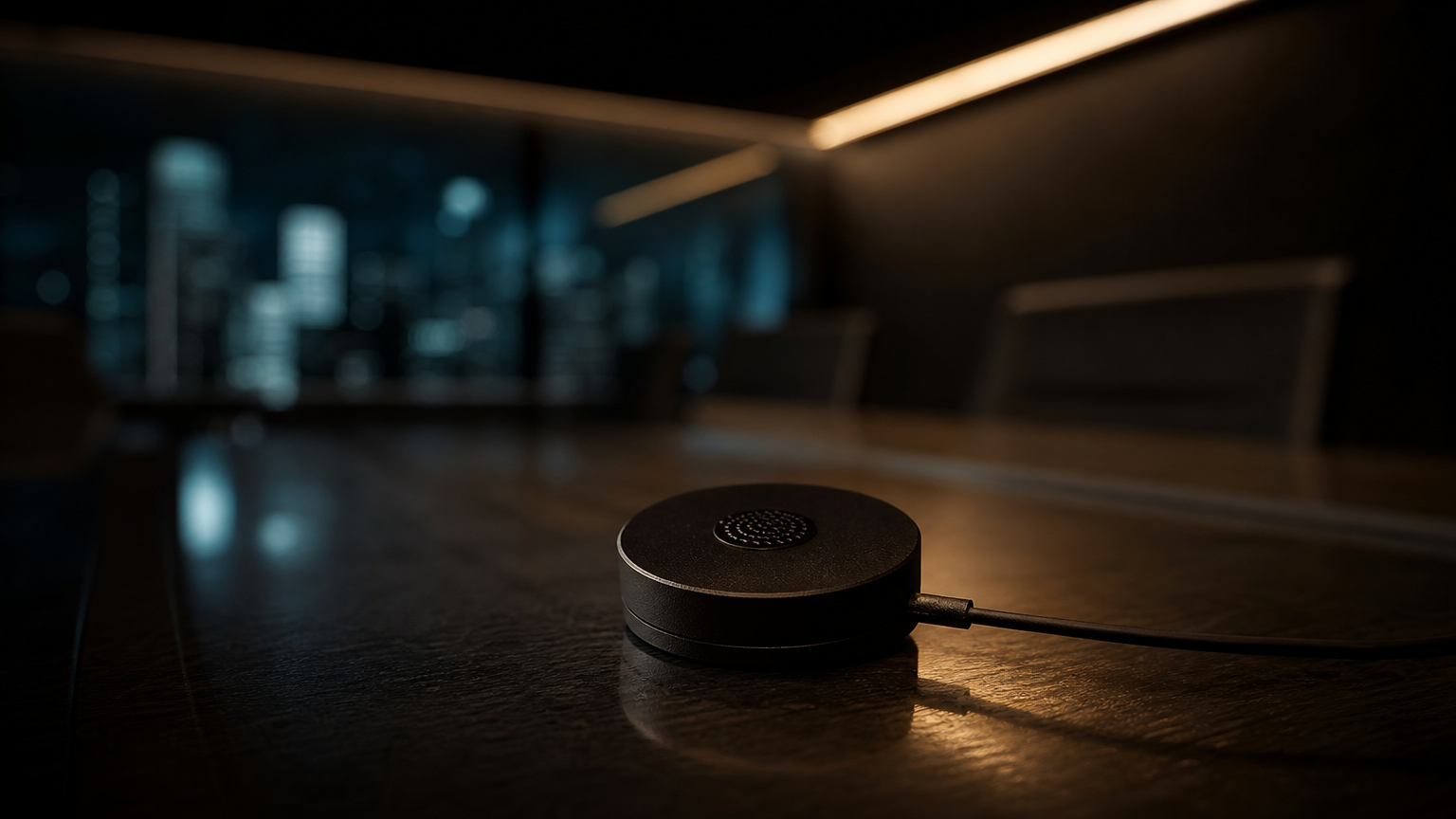
A conference room becomes a federal case
The story now before federal court is strikingly physical for an AI company: not a model leak, not a cloud intrusion, not a stolen token, but an audio recorder allegedly hidden behind a television in a room where executives discussed sensitive work. The Justice Department said Abdulrahman Alfozan, 35, a Saudi national employed as an OpenAI engineer since July 2025, was arrested on October 9, 2026, and made his first federal court appearance on October 13 .
Prosecutors charged him with using, or trying to use, an electronic, mechanical or other device to intercept oral communications . The Northern District of California said Alfozan remained in federal custody after the initial appearance and was scheduled for a detention hearing on October 19 before U.S. Magistrate Judge Alex G. Tse . The charge carries, if proven, a maximum penalty of five years in prison, a $250,000 fine and three years of supervised release .
The allegation is still an allegation. The complaint is not a conviction, and prosecutors will have to prove their case in court. But the facts disclosed by the Justice Department, OpenAI and reporting from major outlets already show why the incident has landed as more than an office misconduct matter. In the government’s telling, the target was a room where nonpublic technical, commercial and strategic information was often discussed, including research, product plans, government engagements and commercial relationships .
What investigators say they found
According to the Justice Department, OpenAI personnel discovered the first recording device on or about September 30, inserted into a USB port on the back of a television in an executive conference room in one of the company’s San Francisco buildings . The device was allegedly concealed in toilet paper, installed around September 28, and its contents were encrypted .
That detail matters because it suggests the device was not simply left out in the open or accidentally present in the room. TechCrunch reported that OpenAI described the device as containing advanced encryption, audio monitoring capabilities and a mechanism for transferring data designed to evade monitoring . The company also told TechCrunch that it had no indication that Alfozan had improperly accessed or exfiltrated model weights, source code or customer data .
The complaint described a chain of physical and digital evidence. Closed-circuit television footage allegedly showed Alfozan near the executive conference room on several dates before the device was found, despite having no authority to access the room or attend meetings there . Prosecutors also said that, on October 5, he entered the room and appeared to look behind the television where the device had been placed .
The same day, according to prosecutors, Alfozan allegedly left a bag unattended in another room in an OpenAI building; security personnel opened it and found his wallet, identification and a second recording device similar to the first . The Associated Press likewise reported that the criminal complaint described a second similar device found in an unattended bag that also contained Alfozan’s wallet and identification .
The chatbot trail
The case has an unusually modern evidentiary wrinkle: prosecutors say a chatbot account associated with Alfozan’s spouse, and sharing multiple identifiers and attributes with Alfozan’s own account, made prompts between September 24 and September 30 about building, customizing, installing, testing, hiding and remotely accessing an audio device . The Justice Department said the prompts covered topics such as building a continuous recorder, improving audio and live listening, customizing Wi-Fi connectivity and encrypting an SD card .
Prosecutors also alleged that the same account submitted prompts specifically related to the first recording device, including its custom header and unique MAC address, between September 27 and September 28 . Wired framed that detail as one of the defining features of the case: an OpenAI engineer is alleged to have used chatbot-assisted queries in the days before a device was discovered in an executive meeting room .
That does not mean the chatbot “committed” the act, nor does it mean prompts alone prove guilt. It does mean that in AI companies, internal investigative trails may now include conventional surveillance footage, access logs, device forensics and prompt histories. In this case, the alleged digital preparation appears to sit beside the physical evidence rather than replacing it.
OpenAI’s response and the role of its own models
OpenAI said it discovered a sophisticated recording device hidden inside one of its offices, used its own models to understand the device and where it had come from, identified a specific employee, and referred the matter to the FBI . TechCrunch reported that the employee was fired and arrested on October 9, about a week after OpenAI found the device .
That statement is likely to attract as much attention as the alleged bug itself. A company that builds AI systems used those systems, according to its own account, to help analyze a suspected surveillance device and connect it to an insider. The irony is obvious: at a frontier AI lab, even the investigation into a hardware bug became partly an AI-assisted process.
But the more important point is operational. High-end AI labs increasingly treat their research as strategic infrastructure. The Justice Department’s statement repeatedly presented the case through the lens of national security and competition in advanced AI . FBI Director Kash Patel said protecting American “super intelligence” innovation was essential to economic strength and national security, while U.S. Attorney Craig H. Missakian said Silicon Valley innovation was a national security matter for prosecutors .
Why the room matters
The apparent target was not a server rack. It was a meeting room. That is the lesson security teams will be debating after this arrest.
Frontier-model companies spend heavily on cloud security, identity management, model-weight controls and insider access restrictions. But a sensitive conversation can still escape through a microphone, a poorly inspected peripheral, an unattended bag, a compromised video display or a device disguised as something too boring to notice. The complaint alleges that the recorder was placed behind a television, in a USB port, in a room used for executive discussions .
That makes the conference room a surprisingly fragile endpoint. Product roadmaps, safety debates, government partnerships, hiring decisions, compute constraints, deployment schedules and commercial negotiations can all pass through spoken conversation before they exist in documents. If those conversations are captured, the damage may be harder to measure than a file download.
The case also shows why insider risk is different from external hacking. An outsider has to break in. An insider often begins with legitimate access to the building, the culture and the rhythms of work. Prosecutors allege Alfozan used an internal productivity tool to ask about OpenAI building addresses, meeting rooms, room capacities, calendars, leadership locations and external partner meetings . If proven, that pattern would illustrate how ordinary workplace systems can become reconnaissance tools.
What remains unanswered
The biggest unanswered question is motive. The public filings and statements describe alleged conduct, evidence and possible exposure, but they do not establish who, if anyone, was meant to receive recordings or whether any audio was successfully captured or transmitted. The DOJ emphasized that the device contents were encrypted . OpenAI, for its part, said it had no indication that model weights, source code or customer data had been improperly accessed or exfiltrated .
It is also unclear how technically unusual the device was. OpenAI’s description emphasizes sophistication, encryption and evasion . Court proceedings may eventually clarify whether the hardware was bespoke, modified consumer equipment or something in between.
For now, the arrest is a warning. The frontier AI race is often described in terms of chips, data centers, model architecture and regulation. This case adds another line item: physical counter-surveillance. Even Skynet, one might joke, forgot to patch the conference room. The serious version is simpler. If the most valuable conversations in AI happen around a table, then the table has become part of the attack surface.
Sources from the last 72 hours
- [1]Saudi National Arrested for Installing Surreptitious Audio Recording Device at OpenAIOct 13, 2026, 2:00 AM
- [2]Saudi National Arrested For Installing Surreptitious Audio Recording Device At OpenAI In San FranciscoOct 13, 2026, 2:00 AM
- [3]FBI arrests OpenAI employee accused of planting hidden recording device in conference roomOct 13, 2026, 10:59 PM
- [4]FBI arrests OpenAI employee accused of placing recording device in company conference roomOct 13, 2026, 11:10 PM
- [5]An OpenAI Employee Allegedly Used a Chatbot to Help Plant a Recording Device at the OfficeOct 14, 2026, 1:17 AM
AI-generated article based on recent web research, then preserved as a dated editorial snapshot.
Comments
Be the first to comment.