
Daily Podcast full article
SpaceX seeks $40B and launches CRS-35
SpaceX’s week compressed two versions of the same story into one news cycle: a company trying to normalize orbital logistics while preparing investors for borrowing on a scale that matches Starship, Starlink, AI infrastructure and Elon Musk’s interplanetary ambitions.
A capital raise as big as the ambition
SpaceX’s latest financing push is not a routine aerospace debt story; it is a stress test of how much private markets are willing to advance against a company whose most valuable future businesses are still being built. Fresh market coverage says SpaceX is seeking about 40 billion dollars in additional debt, including 30 billion dollars through bonds and 10 billion dollars from banks, with Nvidia chips and AI compute capacity identified as the immediate use of proceeds . Another current analysis frames the same borrowing as part of a much larger capital cycle: SpaceX is trying to scale compute quickly while also funding Starship, Starlink satellite deployment, spectrum purchases and direct-to-mobile connectivity .
That mix matters. SpaceX is no longer only a launch company with a broadband constellation; it is increasingly being valued as a vertically integrated infrastructure platform spanning rockets, spacecraft, satellites, ground networks, orbital logistics and now heavy compute. The attraction for investors is obvious: if Starlink’s cash generation keeps rising and Starship eventually cuts launch costs, SpaceX could own critical layers of the space economy. The risk is just as obvious: each layer demands capital before it generates mature cash flow.
The scale of the proposed debt is large even beside SpaceX’s own recent fundraising. The company had 39.4 billion dollars of debt and finance leases at the end of June, according to the market report, so the proposed 40 billion dollars would roughly double that burden . The same report says credit-default-swap pricing on SpaceX debt has jumped sharply, with annual protection on 1 million dollars of debt rising from 11,000 dollars in early June to 19,400 dollars, a 76 percent increase . That is not a market saying “no,” but it is a market asking to be paid more for uncertainty.
Starship, Starlink and the long bill for Mars
The financial question is whether Starlink can help bridge the long period between today’s operating cadence and tomorrow’s Mars architecture. Current analysis notes that SpaceX generated 12.5 billion dollars of revenue in the first half of 2026 while capital expenditures reached 28.5 billion dollars, with much of that spending tied to AI infrastructure . It also cites estimates that moving from about 2 gigawatts of compute capacity to 10 gigawatts could imply roughly 480 billion dollars in capital expenditure for data-center builds alone .
That is why the 40 billion dollar package should be read less as a one-off transaction and more as a preview. SpaceX’s operational identity depends on repetition: launch, recover, relaunch; build satellites, deploy satellites, sell connectivity; iterate Starship until full reusability becomes routine. Its financial identity may now follow the same pattern. Borrowing could become a recurring feature rather than an emergency measure, especially if SpaceX tries to advance AI infrastructure, Starlink capacity and Starship development at the same time.
For Musk’s Mars program, the lesson is blunt: interplanetary infrastructure is not financed like a single flagship mission. It requires factories, test stands, launch pads, tanker flights, life-support systems, communications networks, power systems and the patience to absorb repeated technical setbacks. The 40 billion dollar headline is therefore less a final price tag than a down payment on an architecture whose ultimate financing needs could run far higher . Mars is expensive even before the downloadable content launches.
CRS-35 shows the routine side of SpaceX
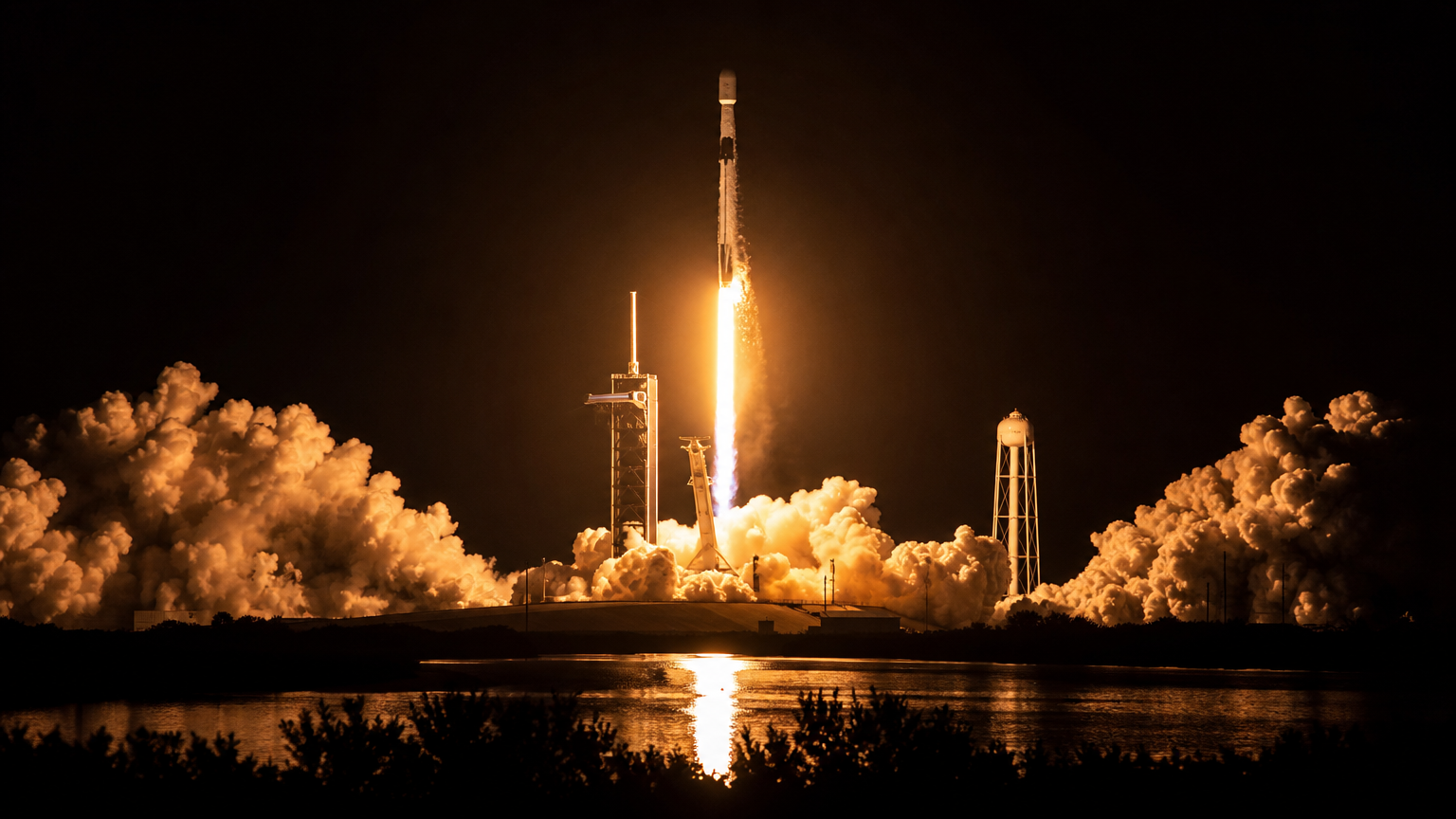
While debt markets debated the cost of SpaceX’s next phase, the company executed a familiar piece of its present business. At 6:33 a.m. EDT on Tuesday, October 13, 2026, a Falcon 9 lifted a Dragon spacecraft from Space Launch Complex 40 at Cape Canaveral Space Force Station, carrying more than 6,300 pounds of science investigations and cargo to the International Space Station . NASA described the flight as SpaceX’s 35th commercial resupply services mission for the agency .
The mission’s timeline was straightforward. About nine minutes after launch, Dragon separated from Falcon 9’s second stage, opened its nosecone and began a sequence of thruster firings for the trip to the station . NASA scheduled Dragon to arrive at about 11 a.m. EDT on Thursday, October 15, with live rendezvous and docking coverage beginning at 9:15 a.m. . A NASA release added that Dragon would dock autonomously to the space-facing port of the station’s Harmony module and remain at the orbiting laboratory until mid-November before returning time-critical research and cargo to Earth off the coast of California .
CRS-35 is valuable precisely because it is not exotic. The station depends on cargo flights that deliver experiments, hardware, food, supplies and replacement equipment. SpaceX’s role is now embedded in that logistics chain, making low Earth orbit feel less like a heroic exception and more like a serviced destination. That routinization is one of the company’s strongest arguments to investors: it has repeatedly turned difficult aerospace operations into scheduled transportation.
The science riding inside Dragon
NASA’s manifest for CRS-35 also underlines why these cargo flights matter beyond the launch itself. The agency said Dragon is carrying the final pair of International Space Station Roll-Out Solar Arrays, which will complete the station’s power-system augmentation and support research, operations and safe deorbit planning . Spaceflight Now reported that the arrays are carried in Dragon’s unpressurized trunk and are the fourth and final pair of ROSA wings bound for the station .
The science cargo includes health and biotechnology research with clear links to longer missions. NASA’s science preview said the mission includes investigations involving 3D human brain models, disease-resistant crops, rapid analysis of astronaut health biomarkers and drug-resistant organisms on station surfaces . These studies are not only about life in orbit; they are about the practical biological problems that become harder as crews travel farther from Earth.
NASA’s post-launch release also highlighted work on artificial retinas, 3D heart tissue models, unconventional glass formation and brain organoids linked to neurodegenerative disease research . In other words, CRS-35 is both a supply run and a laboratory expansion. The cargo bay contains the kind of incremental science that makes future exploration less speculative, one experiment at a time.
A launch seen and heard across Florida
CRS-35 also produced an unusually photogenic public moment. The pre-sunrise Falcon 9 plume mixed with the rising Sun to create the familiar “space jellyfish” effect, a glowing cloud seen in parts of Florida, Georgia and South Carolina, according to FOX Weather . Local reporting described the effect as sunlight reflecting off the rocket’s expanding exhaust plume at dawn, producing a bright, bulb-like cloud across the sky .
The booster’s return added sound to the spectacle. Spaceflight Now reported that the first-stage booster, B1096, completed its eighth trip to space and back with a landing at Landing Zone 40 less than 7.5 minutes after liftoff, followed by a thunderous sonic boom across the spaceport and beyond . The result was an almost cinematic contrast: a routine NASA cargo flight that looked like science fiction from the ground.
One company, two clocks
Taken together, the two developments show SpaceX operating on two clocks. The first is the operational clock of CRS-35: exact launch windows, docking schedules, cargo manifests, booster landings and ISS logistics. The second is the financial clock of Starship, Starlink, AI infrastructure and Mars: years of capital spending, uncertain payback periods and investor tolerance for extraordinary leverage.
That tension is now the core SpaceX story. The company can make a Dragon cargo run look ordinary, yet still require financing that would be extraordinary in almost any other industrial sector. If SpaceX can keep turning frontier systems into routine services, the borrowing may look like infrastructure investment. If timelines stretch or markets cool, the same debt could look like a very expensive loading screen.
Sources from the last 72 hours
- [1]SpaceX Dragon Lifts Off for Thursday Cargo Delivery - NASAOct 13, 2026, 12:54 PM
- [2]NASA Science, Cargo Launch on 35th SpaceX Resupply Mission to Station - NASAOct 13, 2026, 2:00 AM
- [3]SpaceX launches NASA science and cargo to the International Space StationOct 13, 2026, 2:00 AM
- [4]SpaceX Wants $40 Billion in New Debt, and It'll Need Hundreds of Billions More to Achieve Musk's VisionOct 13, 2026, 11:00 PM
- [5]Bond Investors Are Wary of SpaceX's Borrowing Binge to Buy Nvidia ChipsOct 13, 2026, 4:37 PM
- [6]NASA’s SpaceX CRS-35 Mission to Launch Health ResearchOct 12, 2026, 2:00 AM
- [7]See it: SpaceX Falcon 9 launch dazzles millions along the East Coast as rare 'space jellyfish' illuminates skyOct 13, 2026, 7:41 PM
- [8]Photos: SpaceX CRS-35 launch creates 'space jellyfish' over Bay AreaOct 13, 2026, 4:54 PM
AI-generated article based on recent web research, then preserved as a dated editorial snapshot.
Comments
Be the first to comment.