
Daily Podcast full article
Amazing Inside 4.0 Elon Musk's Assembly Production Line
Tesla’s Cybercab story is no longer just about a radical-looking robotaxi. It is now a manufacturing experiment: modular “unboxed” assembly, giant castings, paint-free panels and a claimed path toward a vehicle every 10 seconds, all while the first fleet data from Austin begins to test whether the factory vision can become an operating network.
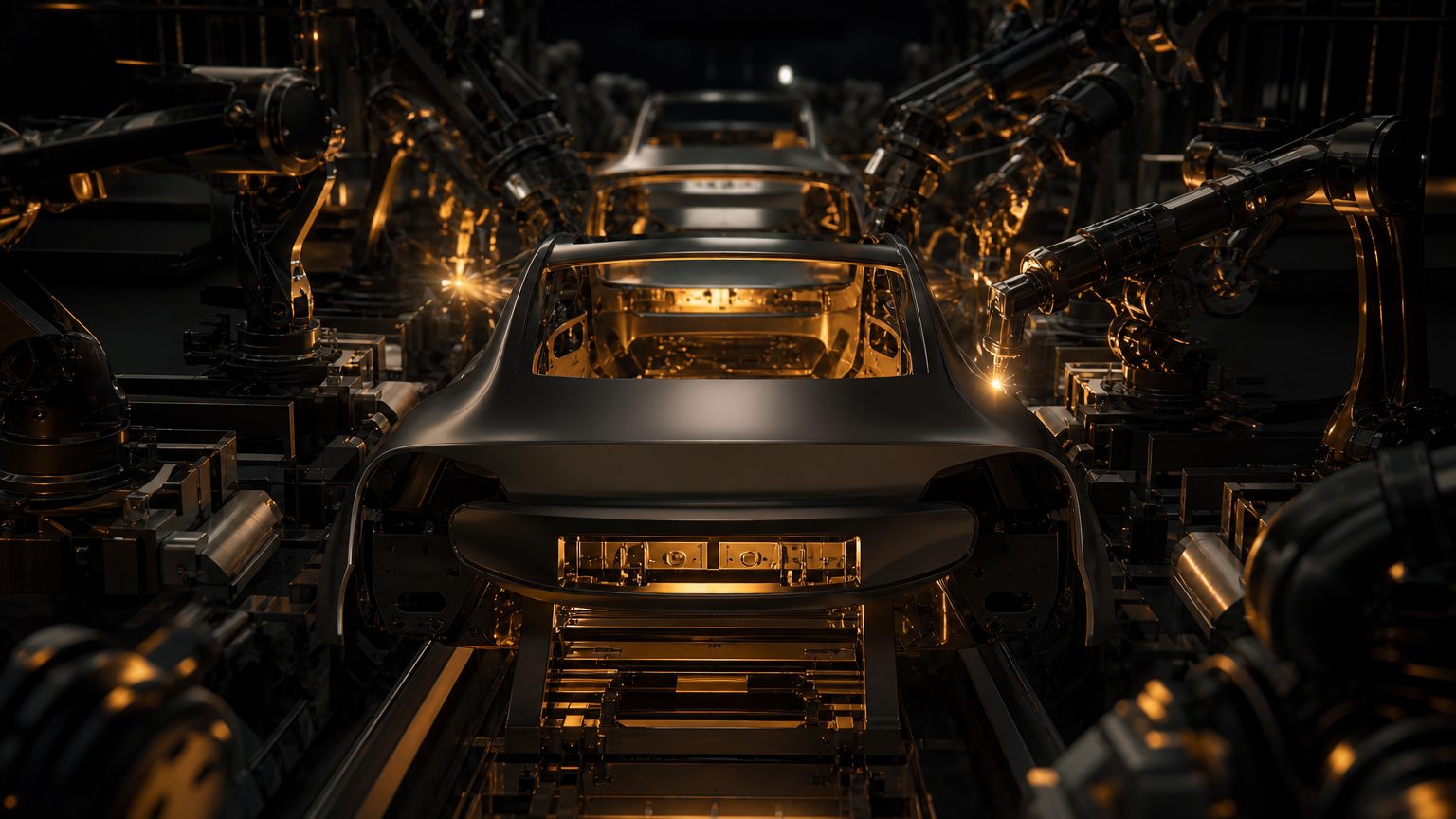
The factory is the product
The most important part of the Cybercab may not be the gold two-seat vehicle itself, but the production system Tesla is building around it. The current manufacturing pitch is stark: replace the long, linear car plant with a modular “unboxed” layout in which the front, rear, sides, roof and structural battery floor are prepared in parallel, then brought together near the end of the process . That sounds technical, but the business logic is simple. If more work happens at the same time, the line can be shorter, robots can access parts before the car is closed, and the final joining operation becomes the bottleneck Tesla wants to compress.
That is why the 10-second number has become the headline. Tesla’s target, as summarized in the latest HelloBro subject briefing, is to push Cybercab assembly toward roughly one vehicle every 10 seconds, compared with about 34 seconds for a Model Y built through a more conventional sequence of stamping, welding, painting and final assembly . The claim should be read as an industrial target, not as independently audited factory output. Still, it explains why Tesla is treating Cybercab as a manufacturing platform as much as a mobility product.
From Model Y sequence to Cybercab parallelism
The Model Y remains a useful comparison because it shows how even a highly optimized EV factory can still be bound by sequence. In a traditional flow, the body structure advances through stations in order; each phase depends on the last, and the factory footprint grows with the number of operations that must sit along the line. Tesla’s Cybercab approach breaks that logic by assigning major modules to parallel paths before final integration .
The structural battery pack is central to that shift. Because it doubles as the floor, Tesla can install seating and interior elements before the upper body closes around them, reducing awkward late-stage assembly work . The result is not just a faster line in theory; it is a different order of operations. The car is not “filled” after a body shell is completed. Instead, several pieces of the car mature separately and meet as a near-finished system.
Giant castings and fewer parts
Tesla’s unboxed idea depends on simplifying the vehicle itself. The Cybercab has two seats, no steering wheel and no pedals, which removes entire categories of parts, interfaces and assembly steps . HelloBro’s latest briefing says the Cybercab is designed with more than 50% fewer parts than a Model 3, a claim that fits Tesla’s broader strategy of deleting complexity before automating what remains .
Large single-piece castings are part of the same philosophy. Rather than weld many stamped sections into front and rear structures, Tesla uses large cast elements, while the Cybercab program is described as pushing toward even larger-scale casting equipment . That can reduce part count and joining operations, but it raises manufacturing risk: bigger castings require tighter control of temperature, pressure, clamping and defect inspection. At high speed, a flawed casting is not a small inconvenience; it can interrupt the rhythm of the entire modular system.
Paint-free panels may be the quiet breakthrough
The least glamorous change may also be one of the most consequential. Tesla is pairing the Cybercab’s structure with reaction-injection-molded polyurethane exterior panels that integrate color into the material rather than relying on a conventional paint process . If that works at scale, the advantage is not only cosmetic. Paint shops are expensive, space-intensive and energy-hungry, and they add time, environmental controls and emissions-management requirements.
A paint-free exterior would therefore support the broader “unboxed” promise: less factory space, fewer process steps and fewer delays between body formation and final assembly. HelloBro’s briefing says Tesla links the molded-panel approach to lower greenhouse-gas emissions tied to panel manufacturing and supply chains . The caveat is durability. Color-through panels must still satisfy customers, fleet operators and repair networks after years of scratches, sun exposure and urban taxi duty.
The 10-second line meets the real fleet
The current state of Cybercab makes the manufacturing claim more serious because Tesla is no longer only showing a concept. As of the latest reports, Tesla says more than 300 Cybercabs now serve Austin, describing the count as an eightfold increase in 30 days, while Dallas has been named as the next Cybercab city without a launch date . That does not prove a 10-second factory cadence. It does show that Cybercab output has moved from display vehicles into a fleet large enough to expose manufacturing consistency, service issues and operational constraints.
The numbers still need discipline. Registered vehicles, vehicles available in an app, vehicles actively carrying passengers and vehicles running without anyone aboard are not the same thing. Tesla’s public “300+ serving Austin” claim is a fleet statement, not a transparent production audit . For manufacturing watchers, the key question is how quickly the line can replenish, maintain and expand the fleet without quality escapes or rework swallowing the time saved by modular assembly.
Software now feeds back into manufacturing
The latest operating update adds another layer: Tesla says shorter Austin wait times come from both more Cybercabs and “orchestration algorithms,” meaning software that positions vehicles and assigns rides across the service area . That matters for the factory story because a robotaxi is not sold and forgotten like a private car. Fleet utilization, charging windows, repair cycles and geographic demand all feed back into what Tesla needs to build, how many variants it can tolerate and how quickly parts must be replaced.
If Austin wait times improve because more cars are available and dispatch software is better, Tesla gains a clearer signal about the required manufacturing ramp . If wait times remain uneven at the edge of service areas, the bottleneck may be fleet density rather than final assembly speed. In other words, a 10-second production target is only valuable if the resulting vehicles can be deployed, charged, cleaned, repaired and trusted at a similar systems-level pace.
Paris shows the car, not the European launch
Tesla’s decision to show a production Cybercab at the Paris Motor Show gives the program global visibility, but it should not be confused with a European commercial launch. The displayed vehicle is described as a unit from Tesla’s operational U.S. Robotaxi fleet, and visitors can inspect it, but they cannot ride in it . The same report notes that Tesla is offering separate FSD supervised drives in Model 3 vehicles, not Cybercab rides .
That distinction is important. A Cybercab without a steering wheel or pedals is a manufacturing simplification, but it is also a regulatory challenge. The Paris display helps Tesla frame the car as real hardware from a working U.S. fleet, yet the European story remains a showcase, not a service rollout .
The promise and the risk
Tesla’s assembly-line 4.0 idea is compelling because it attacks cost at the source. Delete parts, build modules in parallel, avoid the paint shop, cast large structures, and make the vehicle around the factory instead of forcing the factory to accommodate a conventional vehicle. If Tesla can repeat that at scale, the Cybercab may become the clearest test yet of whether EV manufacturing can move closer to consumer-electronics tempo.
The risk is equally clear. A 10-second target magnifies every weakness. Casting defects, panel fit, battery-pack handling, software validation, cleaning, charging and crash-repair logistics all become part of the same production system. Tesla is trying to outrun the traditional assembly line, but the race is not only against time on the factory floor. It is against the full complexity of making thousands of autonomous vehicles reliable enough to work all day, every day.
Sources from the last 72 hours
- [1]Amazing Inside 4.0 Elon Musk's Assembly Production LineOct 14, 2026, 1:40 PM
- [2]Tesla Says 300+ Cybercabs Now Serve Austin, Names Dallas as Next CityOct 12, 2026, 2:00 AM
- [3]Tesla Credits Orchestration Algorithms — and More Cybercabs — for Shorter Austin WaitsOct 14, 2026, 2:00 AM
- [4]Cybercab Makes Its European Debut at the Paris Motor ShowOct 12, 2026, 2:00 AM
AI-generated article based on recent web research, then preserved as a dated editorial snapshot.
Comments
Be the first to comment.