
Daily Podcast full article
Nvidia revenue jumps 106% as Vera Rubin strengthens its AI data-center engine
Nvidia’s latest AI infrastructure story is not just another chip-cycle beat: fresh reporting shows revenue more than doubled, data-center sales now dominate the business, and Vera Rubin is being framed as the next lever for hyperscaler spending, even as supply, memory costs and customer concentration remain the key checks on the boom.
The headline: Nvidia’s growth curve is still vertical
Nvidia’s revenue has jumped 106% year over year, turning what would once have looked like an impossible comparison into the new baseline for the AI infrastructure market . The reported quarter is now being read less as a one-off earnings surprise than as evidence that demand for accelerators, networking, rack-scale systems and software is still absorbing every unit Nvidia can put into the channel. Recent coverage places fiscal Q2 2027 revenue at about $96.2 billion, with data-center revenue near $89 billion, up 117% from a year earlier . That means the company’s AI infrastructure business is not merely the largest segment; it is effectively the company’s economic center of gravity.
The Pluang summary of the story adds an important market angle: Nvidia reportedly touched a new all-time high around $243 before settling lower, while the same report described 106% revenue growth and 120% EPS growth as the catalyst . The stock action matters because investors are no longer asking whether AI spending is real. They are asking how long Nvidia can keep converting that spending into reported revenue before constraints in power, memory, supply commitments or customer budgets create a cooldown.
Why Vera Rubin is the important part of the story
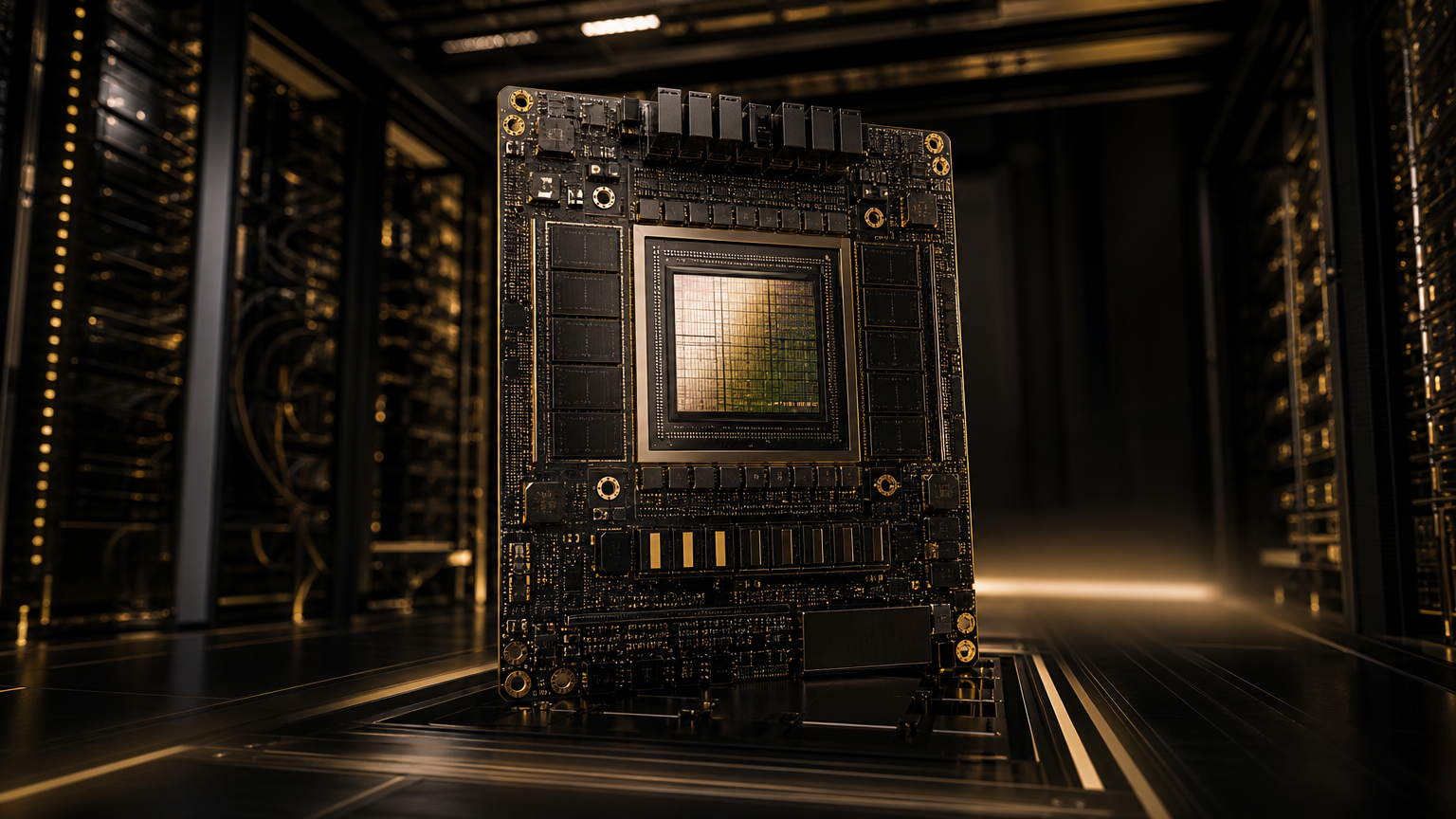
The 106% revenue jump is backward-looking, but Vera Rubin is why the market is treating the growth as potentially durable. Fresh summaries say Nvidia expects the Vera Rubin platform to contribute roughly 20% of data-center revenue in fiscal Q3, an unusually large expected contribution for a platform still in the early phase of ramping . Another recent report says the platform is moving toward full production and presents Vera Rubin not as a single GPU but as an integrated system combining GPUs, CPUs, networking, storage and other infrastructure components .
That distinction is crucial. Nvidia is not selling only chips into a server anymore; it is selling the blueprint for AI factories. If Vera Rubin locks customers deeper into Nvidia’s rack-scale architecture, then the revenue opportunity expands across compute, interconnect, systems, cooling-aware designs and software. A 24/7 Wall St. analysis cited Jensen Huang’s framing that Vera Rubin raises Nvidia’s revenue opportunity to about $40 billion per gigawatt, compared with $25 billion for Blackwell . Even allowing for the promotional nature of that metric, it explains how Nvidia wants investors to think: in units of power-constrained AI capacity, not just in units of silicon.
Data centers are now the company
The central number behind the story is the weight of data centers in Nvidia’s mix. Pluang’s summary says the data-center segment now accounts for 92.5% of total sales, driven by hyperscaler capital expenditure and the expected Vera Rubin contribution . Insider Monkey’s October 14 note reached the same broad conclusion, saying Nvidia “gets the first share” of AI spending because its chips sit inside most AI data centers and that data centers bring in about 92.5% of revenue .
That level of concentration is powerful and risky at the same time. It gives Nvidia operating leverage because every generation of AI models tends to require more compute, more memory bandwidth and more networking. But it also ties the stock to a narrow set of buyers: hyperscalers, AI cloud providers, large enterprises and system OEMs. If they keep spending, Nvidia’s leverage improves. If they pause, stretch deployments or demand better pricing, the same concentration could cut the other way.
The current investor debate: cash machine or peak cycle?
Nvidia’s supporters point to the company’s cash generation and capital returns. A 24/7 Wall St. article published October 14 said Nvidia returned a record $26 billion to shareholders in Q2 FY27, including $20 billion of buybacks and $6 billion of dividends, and that roughly $99 billion remained under repurchase authorization at quarter-end . That matters because a company growing revenue at triple digits while returning that much cash is not being valued only as a future promise. It is already producing the kind of free cash flow that lets management reward shareholders and still invest aggressively in supply.
But the same bullish framing contains the bear case. The report also highlighted export restrictions that keep China data-center compute out of guidance, $279 billion in supply commitments, guarantees limited at $108.5 billion, days sales outstanding rising to 60 days from 45 days, and gross margin expected to bottom around 71% to 72% in Q4 because of memory costs . In other words, Nvidia’s demand is enormous, but the machinery needed to serve that demand is also enormous. The AI boom is not asset-light when measured across fabs, HBM, substrates, racks, networking, power and data-center construction.
What the $108 billion guide says
Recent coverage says Nvidia guided fiscal Q3 revenue to about $108 billion, plus or minus 2%, while assuming no data-center compute revenue from China . Roic News also cited the same $108 billion Q3 guide and noted that the company’s latest reported quarter included $96.221 billion in revenue, up 106% year over year and 18% sequentially . This is the part of the story rivals will watch most closely: even after a 106% jump, management is guiding to another sequential step-up.
That step-up is where Vera Rubin becomes more than a product name. If the platform really does represent around a fifth of data-center revenue in the next quarter, Nvidia is attempting a handoff from Blackwell-era demand to Vera Rubin-era demand without a visible gap. In semiconductor cycles, transitions often create pauses as customers wait for the next generation or as supply chains rebalance. Nvidia’s current message is the opposite: the upgrade tree has no cooldown timer.
The competitive read-through
AMD and Intel are still part of the conversation, but the scale gap remains the immediate issue. A recent 24/7 Wall St. comparison argued that AMD’s Helios racks may provide real second-source pressure, while noting that Nvidia’s data-center revenue hit $89 billion at a 75% gross margin, far above AMD’s current AI data-center scale . The relevant point is not that Nvidia has no competition. It is that competitors must fight a platform, not a part.
Vera Rubin reinforces that platform dynamic. Buyers evaluating alternatives are not comparing only accelerator benchmarks. They are comparing procurement certainty, software maturity, rack design, networking, energy efficiency, cooling requirements and the ability to deploy at hyperscale. That is why Nvidia’s leverage extends beyond the GPU socket. If customers standardize around Nvidia’s systems architecture, switching costs can become operational as much as financial.
The infrastructure bottleneck behind the boom
The current story also makes clear that AI revenue is increasingly constrained by the physical world. Vera Rubin’s ramp depends on HBM availability, advanced packaging, power delivery, liquid cooling, rack integration and data-center readiness. DiarioBitcoin’s October 14 report emphasized that Vera Rubin’s claimed reduction in inference cost per token should not be confused with a simple claim of 10 times better agent performance, because results depend on workloads and operating conditions . That is a useful caution: system economics, not headline peak performance, will decide whether customers keep buying at this pace.
The same report said Nvidia presents Vera Rubin as a coordinated hardware-and-software architecture for large-scale AI factories . That supports the larger interpretation of the 106% revenue jump: the market is paying Nvidia not just for faster chips, but for the ability to turn capital expenditure into usable AI capacity. In the current AI buildout, that may be the scarcest product of all.
Bottom line
Nvidia’s 106% revenue growth is the headline, but the deeper story is the durability of the machine behind it. Data centers are now the overwhelming share of sales, Vera Rubin is expected to become a meaningful contributor almost immediately, and management’s guidance implies that demand is still ahead of supply . Investors should celebrate the scale, but not ignore the risks: memory costs, supply commitments, China restrictions, customer concentration and the sheer capital intensity of AI factories .
For now, Nvidia remains the central toll collector of the AI infrastructure race. Vera Rubin gives that toll road a new lane. The question for the next few quarters is whether hyperscalers keep driving fast enough to fill it.
Sources from the last 72 hours
- [1]Nvidia hits new high with 106% revenue growth; Vera Rubin chip boosts data center sales.Oct 14, 2026, 2:00 AM
- [2]Nvidia’s Aggressive Buyback Expansion is a Flashing Green LightOct 14, 2026, 2:45 PM
- [3]NVIDIA lleva Vera Rubin a producción plena y busca sostener su avance en IAOct 14, 2026, 2:00 AM
- [4]Nvidia Expands AI Push Into Chip Manufacturing With New CUDA-X ToolsOct 14, 2026, 2:00 AM
- [5]Trump and Nancy Pelosi’s Top AI Stock Pick: NVIDIA (NVDA)Oct 14, 2026, 3:33 PM
AI-generated article based on recent web research, then preserved as a dated editorial snapshot.
Comments
Be the first to comment.